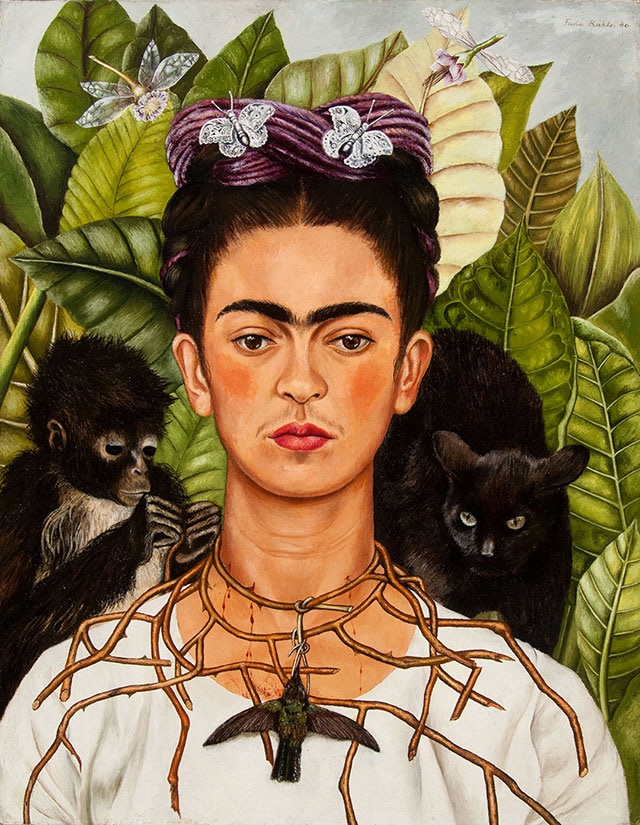
Frida Kahlo
 Mexico
Also known as: Magdalena Carmen Frida Kahlo y Calderón
Data de nascimento
July 6, 1907
Signo
Cancer
Local de nascimento
Coyoacán, Mexico City, Mexico
Idade
Faleceu aos 47
Altura
5 ft 3 in (160 cm)
Sobre
Frida Kahlo, born Magdalena Carmen Frida Kahlo y Calderón on July 6, 1907, in Coyoacán, Mexico City, was a Mexican painter whose work has become synonymous with bold self-expression and cultural pride. Known for her many self-portraits, she used a naïve folk art style to explore identity, postcolonialism, gender, class, and race. Her paintings mix realism with fantasy, often drawing from her own life, including her chronic pain. She is celebrated as an icon for Chicanos, feminists, and the LGBTQ+ community, her uncompromising depictions of the female experience making her a global symbol of resilience and cultural identity. Her image has been featured on Mexican banknotes, and her home, La Casa Azul, is now the Frida Kahlo Museum, one of the most visited museums in Mexico City. The 2002 biopic Frida, starring Salma Hayek, won two Academy Awards and introduced her to a new generation. In 2018, she was ranked #1 on Rolling Stone's list of "10 Best Visual Artists of All Time," and in 2020, she was named one of TIME's "100 Women of the Year" as a proxy for 1937. The intense global cult of personality around her is sometimes called "Fridamania." Fans often dress as her for Halloween or "Frida Fest" events, and her image is a staple of Day of the Dead celebrations. The official social media accounts post a mix of art history, political statements aligned with her Communist past, and inspirational quotes. As of 2026, her estate is estimated to be worth $60–$80 million, managed by the Frida Kahlo Museum and the Diego Rivera and Frida Kahlo Trust.
Início da vida e origens
Kahlo cresceu na casa da família conhecida como La Casa Azul, em Coyoacán. Aos seis anos, a poliomielite deixou sua perna direita mais fina que a esquerda, e ela andou com uma claudicação pelo resto da vida. Seu pai, um fotógrafo, a incentivou a jogar futebol e nadar para fortalecer a perna. Ela era uma estudante brilhante e rebelde, uma das apenas 35 meninas na Escola Nacional Preparatória da Cidade do México. Foi lá que ela viu Diego Rivera pintando um mural no campus pela primeira vez. Um momento crucial ocorreu em 17 de setembro de 1925, quando o ônibus em que ela estava colidiu com um bonde. O acidente a empalou pela pélvis, fraturou sua coluna, clavícula, costelas, pélvis e perna direita. Durante sua longa e dolorosa recuperação, imóvel em um gesso, ela começou a pintar. Sua mãe mandou fazer um cavalete especial para que ela pudesse pintar na cama, e um espelho colocado acima dela para que pudesse pintar autorretratos. Aquele acidente de ônibus redirecionou sua vida completamente, transformando uma estudante de medicina em artista. Ela frequentemente dava seu ano de nascimento como 1910, início da Revolução Mexicana, para alinhar sua vida com o México moderno.
Crescimento na carreira
O avanço de Kahlo veio em 1938, quando o surrealista André Breton organizou sua primeira exposição individual na Galeria Julien Levy, em Nova York. A mostra vendeu cerca de metade das 25 pinturas, um sucesso comercial. Em 1939, ela viajou para Paris para uma exposição na Galeria Renou & Colle, onde o Louvre comprou The Frame, tornando-a a primeira artista mexicana do século XX a ser adquirida pelo museu. Ao longo dos anos 1940, ela lecionou na Escola Nacional de Pintura, Escultura e Gravura "La Esmeralda" e tornou-se membro fundadora do Seminário de Cultura Mexicana. Em 1953, sua primeira exposição individual no México foi realizada na Galeria Arte Contemporâneo. Ela compareceu à abertura em uma ambulância e foi carregada para sua cama, que foi colocada na galeria. Ela continuou pintando até sua morte em 1954. Postumamente, seu trabalho ganhou enorme tração. Em 2021, sua pintura Diego y yo foi vendida por US$ 34,9 milhões, um recorde para um artista latino-americano em leilão. Em 1954, ela recebeu o Prêmio Nacional de Pintura do governo mexicano. Uma grande exposição, "Frida Kahlo: A Vida de um Ícone", está em turnê global, apresentando experiências digitais imersivas. Em 2024, o Museu Frida Kahlo anunciou uma nova exposição permanente focada em seu ativismo político.
Linha do tempo da carreira
Imagem pública e estilo
O estilo característico de Kahlo inclui sua monocelha, coroas de flores, vestidos coloridos de Tehuana e um olhar direto e inabalável em seus autorretratos. Ela é retratada como um ícone feminista trágico, mas resiliente, um símbolo da dor transformada em arte e uma figura de orgulho cultural para mexicanos e chicanos. Ela apareceu na capa da Vogue em 1937, fotografada por Toni Frissell, apresentando-a ao público da moda americana. A TIME estampou uma ilustração dela em sua capa em 2002, e a Vanity Fair teve uma reportagem de capa para o filme Frida no mesmo ano. A conta oficial do Instagram @museofridakahlo tem mais de 1,1 milhão de seguidores, e a página do Facebook tem mais de 500 mil seguidores. A conta do Twitter/X @FridaKahlo tem mais de 300 mil seguidores. Os fãs são frequentemente chamados de "seguidores de Frida" ou "fãs de Frida", e há uma forte subcultura de casamentos com "tema Frida". O espólio continua a lançar novas linhas de produtos licenciados, incluindo uma colaboração recente com uma grife de alta costura.
Fama e fandom (iFAMOUS Rankings)
Frida Kahlo remains the 1st most famous person from Mexico, a position she holds with quiet authority. Her standing extends far beyond her borders, ranking as the 3rd most famous person in Latin America and securing the 4th spot globally for her country of origin at the 4th most famous person in Mexico. Within the global pantheon of creativity, she is recognized as the 3rd most famous person in Art & Design, while her overall cultural footprint places her at the 185th most famous person in the world. These placements, consistent across recent cycles within the iFANN Global Fame Rankings, reflect an enduring devotion that transcends generations. The scale of this attention tracks how her image permeates media coverage, search behaviors, and consumption signals worldwide, cementing her status not merely as a historical figure but as a living presence in contemporary culture.
There is no formal name for her fanbase, though the term "Fridas" has emerged in cultural discourse to describe women who emulate her style or identify with her legacy rather than a structured organization. Unlike modern celebrities whose followers drive campaigns or fund billboards, Kahlo's devotees express their admiration through the preservation of her mythos. This mythology rests on verified biographical events amplified into folklore, such as her survival of a near-fatal bus accident which transformed physical suffering into the pain and passion evident in her self-portraits. Her tumultuous marriage to Diego Rivera and her distinct visual persona, elaborate Tehuana clothing and floral hairstyles adopted to assert Mexican identity, have become symbols of resistance. Recent institutional reactions underscore this devotion; a major exhibition broke pre-sale ticket records at the Tate, while activists filed lawsuits to prevent her paintings from leaving Mexico, arguing they are too culturally vital to be exported. These events highlight a fierce protection of her legacy by a global audience that treats her life story as high drama and her art as a national treasure.
Fatos interessantes e lendas
Born Magdalena Carmen Frida Kahlo y Calderón on July 6, 1907, in Coyoacán, she became a painter whose work defined bold self-expression and cultural pride. Known for her many self-portraits, she utilized a naïve folk art style to explore identity, postcolonialism, gender, class, and race. Her paintings mixed realism with fantasy, often drawing from her own life and chronic pain. She was celebrated as an icon for Chicanos, feminists, and the LGBTQ+ community, with her uncompromising depictions of the female experience making her a global symbol of resilience. Her image appeared on Mexican banknotes, and her home, La Casa Azul, served as a museum. Her signature style included her unibrow, flower crowns, colorful Tehuana dresses, and a direct gaze. She appeared on the cover of Vogue in 1937, photographed by Toni Frissell, introducing her to an American fashion audience. TIME featured an illustration of her on its cover in 2002, and Vanity Fair had a spread. She was bisexual and had affairs with both men and women, including the singer Chavela Vargas. She was an avid political activist and joined the Mexican Communist Party in 1928. She loved wearing traditional Tehuana dresses to highlight her Indigenous heritage and hide her scarred leg. She often incorporated her unibrow and facial hair into her self-portraits as a deliberate statement against conventional beauty standards. Her height was 5 feet 3 inches (160 cm). She was honored with a Google Doodle on July 6, 2010, for her 103rd birthday. Notable quotes include: "I paint self-portraits because I am so often alone, because I am the person I know best" (from her diary, circa 1940s); "They thought I was a Surrealist, but I wasn't. I never painted dreams. I painted my own reality" (interview, 1953); "Feet, what do I need you for when I have wings to fly?" (from her diary, 1953, after her leg amputation); and "I hope the exit is joyful, and I hope never to return" (final diary entry, 1954). A story fans still retell involves her near-fatal bus accident in 1925, which sparked her artistic career during recovery. Another legend centers on her relationship with Diego Rivera, marked by volatility and infidelities, including rumors of an affair with Leon Trotsky. Her deliberate rejection of beauty norms, growing a mustache and unibrow, became a core part of her lore.
Frases notáveis
“I paint self-portraits because I am so often alone, because I am the person I know best.”
“They thought I was a Surrealist, but I wasn't. I never painted dreams. I painted my own reality.”
“Feet, what do I need you for when I have wings to fly?”
“I hope the exit is joyful — and I hope never to return.”
Família e vida pessoal
O pai de Kahlo, Guillermo Kahlo, era um imigrante alemão e fotógrafo. Sua mãe, Matilde Calderón y González, era de ascendência indígena e espanhola. Ela tinha três irmãs: Matilde, Adriana e Cristina. Kahlo nunca teve filhos; uma gravidez em 1930 foi interrompida por razões médicas, e abortos espontâneos subsequentes a deixaram profundamente deprimida. Ela e Rivera viveram em La Casa Azul, que mais tarde se tornou o Museu Frida Kahlo. A casa era cheia de animais, incluindo macacos, papagaios e um cão Xoloitzcuintli. Ela também possuía um veado de estimação chamado Granizo.
Conexões notáveis
Diego Rivera, seu marido e colega muralista, foi uma influência por toda a vida. André Breton, o escritor surrealista, apoiou seu trabalho e organizou sua primeira grande exposição. O fotógrafo Nickolas Muray, seu amante, capturou imagens icônicas dela. Salma Hayek a interpretou no filme biográfico de 2002 e ajudou a levar sua história para um público global.
Relacionamentos e história amorosa
O primeiro relacionamento sério de Kahlo foi com Alejandro Gómez Arias, um líder estudantil carismático da Escola Preparatória Nacional. Eles namoraram de 1922 a 1927, e ele estava com ela durante o acidente de ônibus de 1925. O relacionamento terminou devido à desaprovação da família dele e à sua infidelidade. Em 1929, ela se casou com Diego Rivera, um notório mulherengo. O casamento foi apaixonado, mas tumultuado, marcado por casos de ambos os lados. Kahlo teve casos com homens e mulheres, incluindo o fotógrafo Nickolas Muray (intermitentemente de 1931 a 1941), o escultor Isamu Noguchi (1936–1937), o negociante de arte alemão Heinz Berggruen (1938) e o artista catalão José Bartolí (1946–1950). Um suposto caso com o revolucionário russo exilado Leon Trotsky em 1937 causou uma ruptura entre Kahlo e Rivera. Eles se divorciaram em 1939, mas se casaram novamente um ano depois, em 8 de dezembro de 1940, mantendo uma companhia platônica até a morte dela. Em 2026, Frida Kahlo é falecida.
- NamoraramAlejandro Gómez Arias1922 - 1927Seu primeiro namorado sério; eles estavam juntos durante o acidente de ônibus.
- Casado(a)Diego Rivera1929 - 1939Primeiro casamento, tumultuado com infidelidades.
- NamoraramNickolas Muray1931 - 1941Caso intermitente; Muray tirou fotografias icônicas de Kahlo.
- NamoraramIsamu Noguchi1936 - 1937Caso enquanto Rivera estava com a irmã dela, Cristina.
- RumoresLeon Trotsky1937 - 1939Caso amplamente acreditado enquanto Trotsky morava na Casa Azul.
- NamoraramHeinz Berggruen1938 - 1938Relacionamento breve com o negociante de arte alemão.
- Casado(a)Diego Rivera1940 - 1954Segundo casamento, companheirismo platônico até sua morte.
- NamoraramJosé Bartolí1946 - 1950Relacionamento à distância com o artista catalão.
Morte e repercussões
Morte
July 13, 1954 (aos 47 anos)
Local da morte
Coyoacán, Mexico City, Mexico
Causa da morte
Pulmonary embolism
The announcement of Frida Kahlo's passing came from her family at La Casa Azul in Coyoacán, confirming the end of a life marked by intense physical struggle and artistic brilliance. On July 13, 1954, she died at the age of 47 within the very home where she had spent so much of her creative life, bedridden and isolated by the severe complications of gangrene that had necessitated the amputation of her right leg earlier that year. Her final diary entry reading "I hope the exit is joyful, and I hope never to return" was widely interpreted by historians as relief from chronic suffering rather than an act of suicide, effectively refuting rumors that had circulated about her intent. Public reaction at the time remained subdued, confined largely to close peers and the Mexican art community since she had not yet achieved global fame.
Her husband, Diego Rivera, was devastated by the loss and fell into a deep depression, dying just over a year later in 1957. The funeral was a private affair attended by Rivera, their daughter Matilde Kahlo, and friends like photographer Lola Álvarez Bravo before she was cremated at the Panteón Civil de Dolores. Her ashes were eventually interred at La Casa Azul, which Rivera converted into a museum dedicated to her memory. In the decades that followed, her legacy surged through feminist art history and the publication of her diaries, leading to major exhibitions, the 2002 film Frida, and enduring recognition as a global icon of resilience.
Patrimônio (valor do espólio)
$80 Million
Estimativa da equipe editorial do iFANN
As Frida Kahlo is deceased, her net worth refers to the value of her estate, which is estimated at $80 Million per iFANN's editorial analysis as of 2026. The estate generates income through licensing her image, which is one of the most licensed in the world, appearing on everything from T-shirts to sneakers to Barbie dolls. Merchandise sales, royalties from book and art print sales, and admissions to the Frida Kahlo Museum in Mexico City also contribute. The estate is managed by the Frida Kahlo Museum and the Diego Rivera and Frida Kahlo Trust, which aggressively protects her intellectual property. The trust has sued companies for unauthorized use of her likeness, maintaining the estate's value. Some fan sites project an estate value as high as $200 million, but this is considered a forward-looking projection based on potential future licensing deals.
Prêmios conquistados (1)
Kahlo recebeu o Premio Nacional de Pintura do governo mexicano em 1954, pouco antes de sua morte. Seu trabalho foi homenageado postumamente por meio de exposições em museus e reconhecimento cultural, incluindo ser retratada em notas mexicanas e em Google Doodles.
1954 · Prêmio Nacional de Pintura
Lifetime achievement
Conhecido por
Self-Portrait with Thorn Necklace and Hummingbird
1940 · pintor
The Two Fridas
1939 · pintor
The Broken Column
1944 · pintor
Diego y yo
1949 · pintor
The Frame
1938 · pintor
Palavras-chave
Dados rápidos
- Profissão
- painter, artist
- Nascimento
- July 6, 1907
- Local de nascimento
- Coyoacán, Mexico City, Mexico
- Morte
- July 13, 1954
- Local da morte
- Coyoacán, Mexico City, Mexico
- Gênero
- Feminino
- Cônjuge
- Diego Rivera
- Signo
- Cancer
Dados pessoais
- Nome completo
- Magdalena Carmen Frida Kahlo y Calderón
- Altura
- 5 ft 3 in (160 cm)
- Cônjuge
- Diego Rivera
- Formação
- National Preparatory School, Mexico City
Perguntas frequentes
Pelo que Frida Kahlo é mais famosa?
Como Frida Kahlo morreu?
Frida Kahlo teve filhos?
Por que Frida Kahlo pintava tantos autorretratos?
Frida Kahlo era surrealista?
Pessoas semelhantes
Junte-se à comunidade
fãs comentando