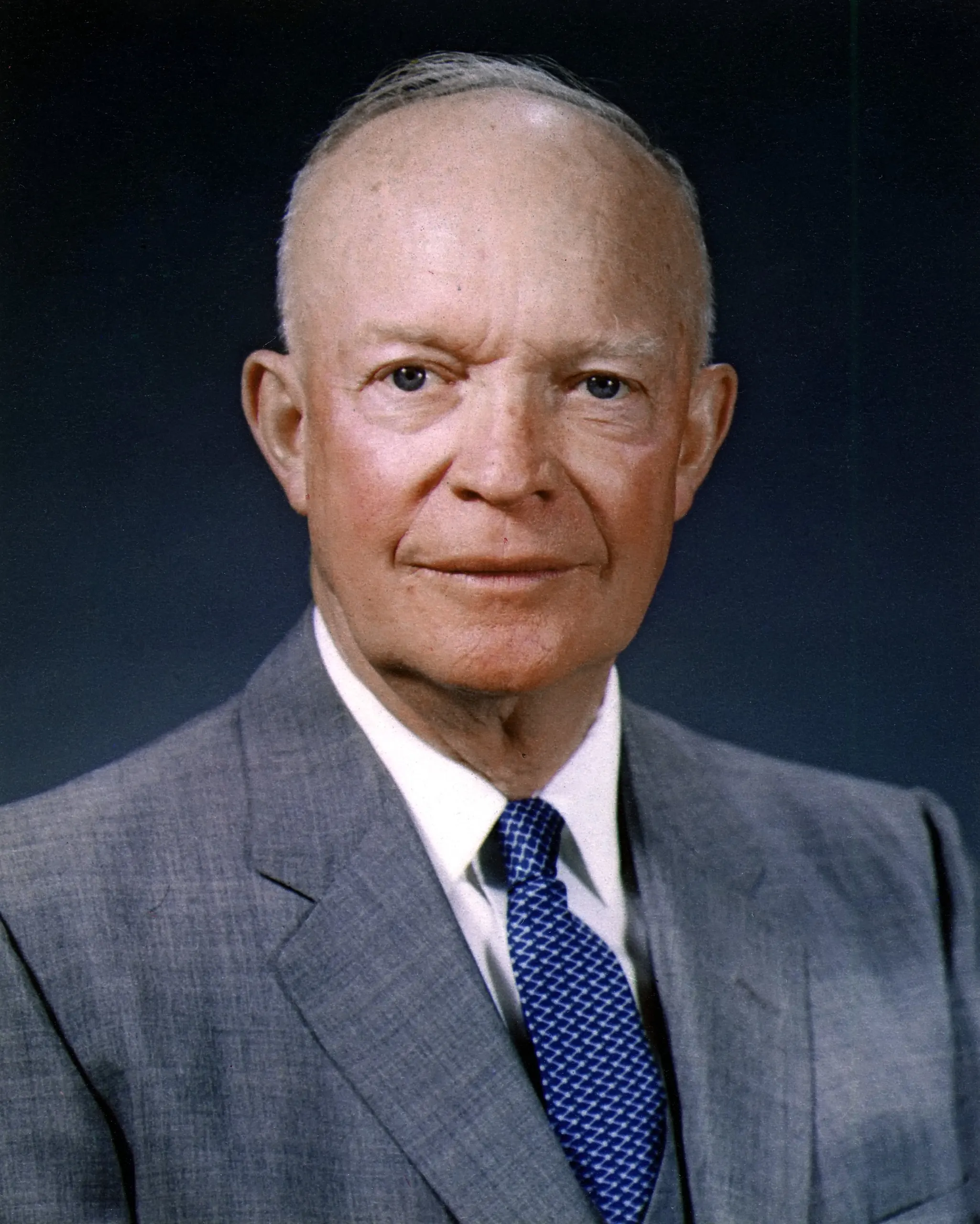
Dwight D. Eisenhower
 United States
politician•writer•military officer
Also known as: Ike
Data de nascimento
October 14, 1890
Signo
Libra
Local de nascimento
Denison, Texas, USA
Idade
Faleceu aos 78
Altura
5 ft 10 in (1.78 m)
Sobre
Dwight D. Eisenhower foi um soldado e estadista americano. Ele é mais famoso por comandar a invasão aliada da Europa Ocidental durante a Segunda Guerra Mundial, papel no qual orquestrou os bem-sucedidos desembarques do Dia D. Como 34º Presidente dos Estados Unidos, de 1953 a 1961, alcançou marcos significativos, incluindo o fim da Guerra da Coreia, o início do Sistema de Rodovias Interestaduais e o estabelecimento da NASA. Sua presidência é lembrada por sua liderança firme durante a Guerra Fria e seu impactante alerta contra o complexo militar-industrial em seu discurso de despedida. O legado duradouro de Eisenhower é o de uma figura central que conduziu a nação por um período de tensão global e avanço tecnológico.
Início da vida e origens
David Dwight Eisenhower nasceu em 14 de outubro de 1890, em Denison, Texas, EUA. Logo depois, sua família se mudou, e ele foi criado em Abilene, Kansas, onde cresceu em circunstâncias modestas. Sua família, embora pobre, era trabalhadora; seu pai administrava uma leiteria. Para contribuir com a renda familiar, o jovem Dwight realizou vários trabalhos temporários, incluindo operar uma caldeira e trabalhar na leiteria local.
Eisenhower frequentou a Abilene High School, destacando-se como atleta excepcional tanto no futebol americano quanto no beisebol, antes de se formar em 1909. Sem condições financeiras para a faculdade, ele buscou uma nomeação para a Academia Militar dos Estados Unidos em West Point. Ele ingressou com sucesso em West Point em 1911 e se formou com um diploma de Bacharel em Ciências em 1915. Ele fez parte de uma turma distinta que mais tarde produziria impressionantes 59 generais.
Sua carreira militar inicial foi inicialmente inglória. Durante a Primeira Guerra Mundial, ele foi encarregado de treinar tripulações de tanques em Camp Colt, Pensilvânia. Após a guerra, ocupou vários cargos de estado-maior, servindo sob figuras notáveis como o General Fox Conner no Panamá e, posteriormente, sob Douglas MacArthur nas Filipinas. Eisenhower avançou constantemente nas patentes, recebendo uma promoção significativa a general de brigada em 1941, poucos meses antes do ataque crucial a Pearl Harbor marcar a entrada dos EUA na Segunda Guerra Mundial.
Crescimento na carreira
O momento decisivo de Eisenhower veio em 1942, quando foi nomeado Comandante Supremo da Força Expedicionária Aliada. Ele orquestrou a Operação Tocha no Norte da África, as invasões da Sicília e da Itália e, acima de tudo, os desembarques do Dia D em 6 de junho de 1944, a maior invasão anfíbia da história. Promovido a General do Exército, ele aceitou a rendição da Alemanha em maio de 1945. Após a guerra, serviu como Chefe do Estado-Maior do Exército e depois tornou-se presidente da Universidade Columbia em 1948. Em 1951, assumiu o papel de primeiro Comandante Supremo da OTAN. Eleito presidente em uma vitória esmagadora em 1952, encerrou a Guerra da Coreia em poucos meses. Domesticamente, sancionou a Lei de Ajuda Federal para Rodovias de 1956, criando o sistema interestadual, e estabeleceu a NASA em 1958. Enviou tropas federais a Little Rock, Arkansas, em 1957, para impor a dessegregação escolar. Seus dois mandatos foram marcados por paz e prosperidade.
Linha do tempo da carreira
Imagem pública e estilo
Eisenhower projetava uma confiança calma e paternal; seu apelido Ike capturava seu estilo acessível e direto. Falava com um sotaque do meio-oeste e frequentemente usava metáforas militares. A mídia o retratava como uma mão firme guiando a América através da Guerra Fria. Seu discurso de despedida alertando sobre o complexo militar-industrial é frequentemente citado. Apoiadores, às vezes chamados de apoiadores de Ike, comemoram seu aniversário e o Dia D anualmente em sua biblioteca e memorial presidenciais. As contas oficiais nas redes sociais mantêm um tom respeitoso e educacional.
Fama e fandom (iFAMOUS Rankings)
Dwight D. Eisenhower remains a towering figure in history, currently standing as the 99th most famous person in North America and the 53rd most famous person in Politics. These placements from the iFANN Global Fame Rankings reflect his enduring presence across media coverage, search activity, and cultural consumption worldwide. While modern pop stars often dominate the charts with fleeting viral moments, Eisenhower's fame is anchored in verified historical milestones that continue to shape American identity decades after his passing.
Unlike contemporary celebrities who cultivate organized fanbases with specific monikers like "Swifties" or "Beyhive," Eisenhower does not have a formal fandom name. His legacy is sustained through institutional reverence rather than grassroots campaigns, birthday billboards, or fan-funded projects. Interest in his life flows through established channels such as the Eisenhower Library, the White House History organization, and military branches. The USS Dwight D. Eisenhower (CVN-69) serves as a namesake vessel for the U.S. Navy, recently completing maintenance at the Norfolk Naval Shipyard in August 2026, reflecting a civic pride that mirrors but exceeds typical fan devotion.
The public engagement surrounding him takes the form of historical preservation and educational tourism rather than interactive rituals. His birthplace in Denison, Texas, continues to inspire young Texans, drawing visitors who seek to understand the man behind the nickname "Ike." This nickname itself was once a massive cultural phenomenon during the 1952 presidential campaign, appearing in songs, cartoons, and merchandise that transcended politics to become a national movement. Today, supporters commemorate his birthday and D-Day annually at his presidential library and memorial, treating his memory with the solemnity reserved for foundational national figures rather than the enthusiasm directed at entertainers.
Fatos interessantes e lendas
Eisenhower was an avid golfer who had a putting green installed on the White House lawn, and he painted over 250 works, mostly landscapes and portraits. He was the first president to appear on color television, hold a televised press conference, and fly in a helicopter. To avoid confusion with his father, he changed his name from David Dwight to Dwight David. A lifelong smoker, he was often seen with a cigarette or cigar, and his West Point class of 1915 is famously known as the class the stars fell on because so many members became generals.
Beyond these facts, several legendary moments define his mythos. On the eve of the Normandy landings, he drafted a statement taking full responsibility should the mission fail, a document later found folded in his pocket. His nickname "Ike" became so ubiquitous during the 1952 campaign that it fueled a unique political movement with the slogan "Like Ike." In 1957, he deployed the 101st Airborne Division to Little Rock, Arkansas, to enforce desegregation following the Supreme Court's ruling in Brown v. Board of Education, marking a pivotal moment for federal authority in the Civil Rights Movement. Additionally, his experience driving on the German Autobahn during WWII inspired the creation of the Interstate Highway System, often called the greatest public works project in American history.
Frases notáveis
“In the councils of government, we must guard against the acquisition of unwarranted influence, whether sought or unsought, by the military-industrial complex.”
“The eyes of the world are upon you. The hopes and prayers of liberty-loving people everywhere march with you.”
“Neither a wise nor a brave man lies down on the tracks of history to wait for the train of the future to run over him.”
“Plans are nothing; planning is everything.”
Família e vida pessoal
Eisenhower casou-se com Mamie Geneva Doud em 1º de julho de 1916, em Denver, Colorado. Tiveram dois filhos: Doud Dwight, que morreu de escarlatina aos três anos, e John Sheldon Doud, que se tornou oficial do Exército dos EUA e diplomata. Mamie serviu como primeira-dama com elegância, conhecida por sua franja e pérolas. O casal viveu na fazenda Eisenhower em Gettysburg, Pensilvânia, após a presidência. Os pais de Eisenhower eram David Jacob Eisenhower, trabalhador de uma leiteria, e Ida Elizabeth Stover, uma devota menonita. Ele teve seis irmãos, todos os quais viveram vidas comuns.
Conexões notáveis
Eisenhower trabalhou em estreita colaboração com o Primeiro-Ministro britânico Winston Churchill e o General Bernard Montgomery durante a Segunda Guerra Mundial. Serviu sob o General Douglas MacArthur nas Filipinas. Seu vice-presidente foi Richard Nixon. Nomeou Earl Warren como Chefe de Justiça da Suprema Corte.
Relacionamentos e história amorosa
Eisenhower casou-se com Mamie Geneva Doud em 1º de julho de 1916, depois de se conhecerem através de amigos em comum em 1915, enquanto ele estava estacionado no Texas. O casamento suportou inúmeras realocações militares e as pressões da presidência, gerando dois filhos. Mamie serviu como primeira-dama de 1953 a 1961. Durante a Segunda Guerra Mundial, circularam rumores de um caso com sua motorista e secretária, Kay Summersby. Summersby mais tarde escreveu uma memória alegando um relacionamento íntimo, mas a família de Eisenhower e muitos historiadores questionaram sua precisão. O relacionamento, se existiu, terminou após a guerra. Eisenhower morreu em 1969, sobrevivido por Mamie, que faleceu em 1979.
- Casado(a)Mamie Eisenhower1916 - 1969Conheceram-se em 1915 enquanto Eisenhower estava estacionado no Texas; casaram-se em Denver. Tiveram dois filhos.
- RumoresKay Summersby1942 - 1945Motorista e secretária irlandesa durante a Segunda Guerra Mundial; caso rumoroso amplamente contestado.
Morte e repercussões
Morte
March 28, 1969 (aos 78 anos)
Local da morte
Washington, D.C., USA
Causa da morte
Massive heart attack from coronary artery disease
Dwight David Eisenhower died on March 28, 1969, at Walter Reed Army Medical Center in Washington, D.C., at the age of 78. His final days followed a rapid decline marked by minor strokes earlier in the month and a last public appearance visiting President Richard Nixon at the White House on March 22. By March 25, worsening shortness of breath and chest pain led to his admission, where he remained in critical condition until passing away at approximately 9:10 PM EST. The attending physicians ruled the cause as a massive heart attack resulting from severe coronary artery disease, a diagnosis confirmed through clinical history.
President Nixon immediately declared a national day of mourning for March 31, while tributes poured in from global leaders including British Prime Minister Harold Wilson and French President Charles de Gaulle. Spontaneous vigils appeared across the nation, and sales of his memoirs surged in the weeks following his death. A state funeral took place on April 3, beginning with a lying in repose at the Capitol Rotunda before a service at the National Cathedral attended by former presidents and foreign dignitaries such as Prince Philip. Vice President Spiro Agnew delivered the eulogy, and the U.S.
Marine Band provided musical performances during the ceremony. Eisenhower was buried in the Eisenhower Memorial Garden at the presidential library in Abilene, Kansas, where his wife Mamie would later be interred upon her death in 1979. Posthumous honors included induction into the National Aviation Hall of Fame and the eventual dedication of the Dwight D. Eisenhower Memorial in Washington, D.C., in 2020. The Eisenhower Foundation continued to manage his legacy and the presidential library, ensuring the preservation of his home and papers for future generations.
Patrimônio (valor do espólio)
$85 Million
Estimativa da equipe editorial do iFANN
Dwight D. Eisenhower died in 1969, but his estate continues to generate revenue. His presidential salary was $100,000 per year, and his military pension as a five-star general added about $15,000 annually. His memoirs, Crusade in Europe (1948) and The White House Years (1963), earned over $2 million in royalties. Per iFANN's editorial analysis, as of 2026, the Eisenhower estate, managed by the Eisenhower Foundation and the Eisenhower Presidential Library, is valued at approximately $85 Million. Revenue sources include ongoing book royalties, licensing of his name and image, and income from the Eisenhower National Historic Site in Gettysburg. The Eisenhower Memorial in Washington, D.C., opened in 2020, also draws tourism.
Prêmios conquistados (21)
Eisenhower recebeu inúmeras honrarias militares e civis. Ele foi agraciado com a Medalha de Serviço Distinto com três folhas de carvalho, a Medalha de Serviço Distinto da Marinha e a Legião do Mérito. Internacionalmente, recebeu a Ordem do Banho e a Ordem do Mérito do Reino Unido, a Legião de Honra e a Croix de Guerre da França, e muitas outras. Prêmios civis incluem a Medalha de Ouro do Congresso (1960) e a Medalha Presidencial da Liberdade (1969, póstuma).
1960 · Civil
Public service
1969 · Civil
Public service
Conhecido por
Supreme Commander of Allied Expeditionary Force
1944 · Geral
34th President of the United States
1953 · Presidente
Interstate Highway System
1956 · Presidente
NASA Creation
1958 · Presidente
Civil Rights Act of 1957
1957 · Presidente
Palavras-chave
Dados rápidos
- Profissão
- politician, writer, military officer
- Nascimento
- +1890-10-14
- Local de nascimento
- Denison, Texas, USA
- Morte
- +1969-03-28
- Local da morte
- Washington, D.C., USA
- Gênero
- Masculino
- Cônjuge
- Mamie Eisenhower
- Signo
- Libra
Dados pessoais
- Nome completo
- David Dwight Eisenhower
- Altura
- 5 ft 10 in (1.78 m)
- Cônjuge
- Mamie Eisenhower
- Filhos
- Doud Dwight Eisenhower (1917–1921), John Sheldon Doud Eisenhower (1922–2013)
- Formação
- United States Military Academy at West Point (BS, 1915)
Perguntas frequentes
Quantos anos tinha Dwight D. Eisenhower quando morreu?
Qual é o patrimônio de Dwight D. Eisenhower em 2026?
Dwight D. Eisenhower ainda está ativo em 2026?
Pelo que Dwight D. Eisenhower é mais conhecido?
Como Dwight D. Eisenhower se tornou presidente?
Redes sociais

Junte-se à comunidade
fãs comentando