
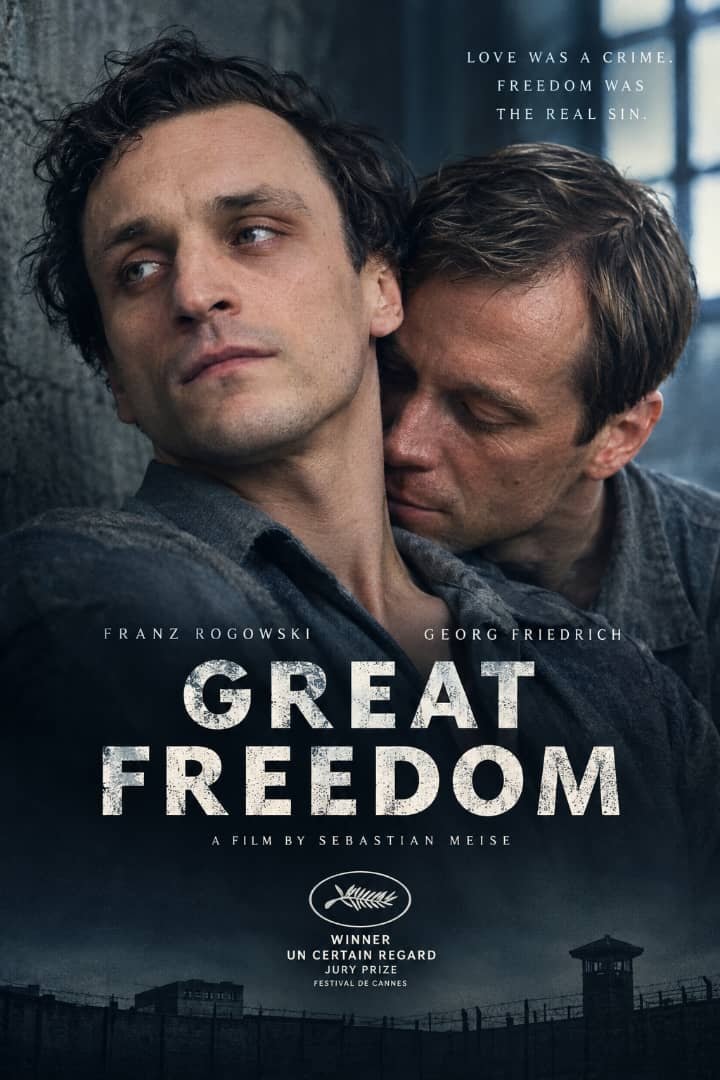
@kimonSurviving a concentration camp should be the end of the sentence. For Hans Hoffmann it wasn't, and that's the knot Great Freedom keeps pulling at. Franz Rogowski plays him, a gay man locked up again and again in post-war Germany, his sexuality still a criminal offense under Paragraph 175. Sebastian Meise directed it in 2021, and the way the film handles time is what stays with me, decades slipping by with these walls as the constant. Then there's Viktor, Georg Friedrich's convicted murderer, who starts out with nothing but contempt for him. Watch that contempt wear down over the years into trust, into tenderness, into something that looks a lot like love. Two men who had no business finding each other, finding each other anyway 🍿 What the film won't let you forget is the history underneath it: gay men still hunted by the law once Nazi Germany had fallen, desire treated as a punishable act, Hans holding onto some stubborn will to live and love while the system tries to grind it out of him. And the big one, freedom itself, because what does that word even mean when the state has already ruled that who you are is illegal. Rogowski and Friedrich play all of it with a restraint that hits harder than any big speech would. A haunting drama about oppression and human dignity, and genuinely essential queer cinema. It walked away with the Un Certain Regard Jury Prize at the 2021 Cannes Film Festival. The tagline earns its keep too: LOVE WAS A CRIME. FREEDOM WAS THE REAL SIN
Ver publicação original











Ainda não há comentários. Seja o primeiro!