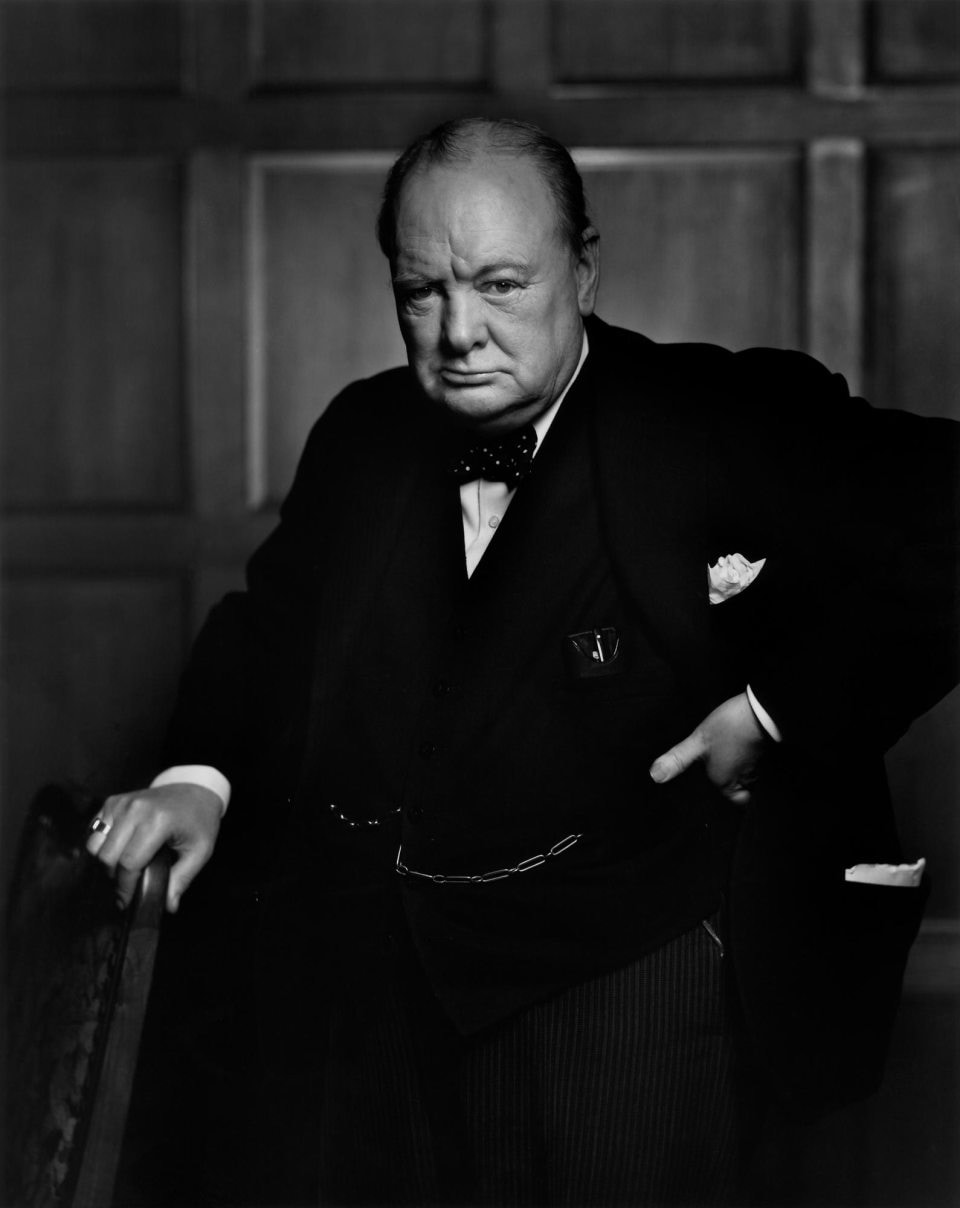
Winston Churchill
 United Kingdom
British statesman•military officer•writer
Also known as: Winston Leonard Spencer Churchill, Sir Winston Churchill
Data de nascimento
November 30, 1874
Signo
Sagittarius
Local de nascimento
Blenheim Palace, Oxfordshire, England
Idade
Faleceu aos 90
Altura
5 ft 6 in (168 cm)
Sobre
Winston Churchill foi um estadista, oficial militar e escritor britânico que serviu como Primeiro-Ministro do Reino Unido duas vezes: de 1940 a 1945 durante a Segunda Guerra Mundial, e novamente de 1951 a 1955. Nascido em 30 de novembro de 1874, no Palácio de Blenheim em Oxfordshire, ele veio de uma rica família aristocrática com raízes mistas inglesas e americanas. Sua carreira política se estendeu por mais de seis décadas, durante as quais ele foi Membro do Parlamento por 62 anos, representando cinco distritos eleitorais diferentes. Ideologicamente, ele defendeu o liberalismo econômico e o imperialismo, e embora tenha liderado o Partido Conservador de 1940 a 1955, ele também passou duas décadas como Liberal.
Churchill juntou-se ao Exército Britânico em 1895, vendo ação na Índia, na Guerra Mahdista e na Segunda Guerra dos Bôeres. Ele ganhou fama como correspondente de guerra e escreveu livros sobre suas campanhas, incluindo The Story of the Malakand Field Force e The River War. Eleito como Membro do Parlamento Conservador em 1900, ele mudou para os Liberais em 1904. No governo de H. H. Asquith, ele serviu como Presidente do Conselho de Comércio e Secretário do Interior, defendendo a reforma prisional e a segurança social dos trabalhadores. Como Primeiro Lorde do Almirantado antes e durante a Primeira Guerra Mundial, ele supervisionou a desastrosa campanha dos Dardanelos, levando à sua rebaixamento. Ele renunciou em 1915 e serviu na Frente Ocidental com os Royal Scots Fusiliers. Retornando ao governo sob David Lloyd George, ele ocupou vários cargos importantes, incluindo Ministro de Munições e Secretário de Estado para a Guerra. Como Chanceler do Tesouro nos anos 1930, ele devolveu a Grã-Bretanha ao padrão ouro, uma medida que deprimiu a economia.
Durante seus "anos de deserto" nos anos 1930, Churchill alertou contra a ascensão da Alemanha nazista e pediu o rearmamento. Quando a Segunda Guerra Mundial eclodiu, ele foi renomeado Primeiro Lorde do Almirantado. Em maio de 1940, ele se tornou Primeiro-Ministro, formando um governo nacional que levou a Grã-Bretanha à vitória em 1945. Seus discursos, como "Nós lutaremos nas praias", galvanizaram a nação. Após perder a eleição de 1945, ele serviu como Líder da Oposição e cunhou o termo "Cortina de Ferro" para descrever a influência soviética. Ele também escreveu The Second World War, uma memória em seis volumes que lhe rendeu o Prêmio Nobel de Literatura em 1953. Retornando ao poder em 1951, seu segundo mandato se concentrou em assuntos externos e um programa bem-sucedido de construção de casas. Ele renunciou em 1955 devido ao declínio da saúde e morreu em 24 de janeiro de 1965, recebendo um funeral de estado.
Churchill continua sendo uma figura proeminente na história britânica, celebrado por sua liderança em tempos de guerra na defesa da democracia liberal. No entanto, seu imperialismo firme e comentários sobre raça atraíram críticas. Historiadores o classificam consistentemente entre os maiores primeiros-ministros britânicos. Além da política, ele foi um escritor prolífico, produzindo cerca de 40 livros, e um pintor amador. Sua vida e carreira foram retratadas em inúmeros filmes e programas de televisão, incluindo Darkest Hour e The Crown.
Início da vida e origens
A infância de Churchill no Palácio de Blenheim foi de privilégio aristocrático, mas de distância emocional. Seu pai, Lord Randolph Churchill, era membro do Parlamento Conservador, e sua mãe americana, Jennie Jerome, era uma socialite. Criado em grande parte por uma babá, ele foi enviado para a St. George's School em Ascot em 1882, onde era infeliz. Mais tarde, transferiu-se para Brighton e ingressou na Harrow School em 1888, colocando-se na parte inferior de sua turma nos exames de admissão. Ele se destacou em inglês e história e ganhou o campeonato de esgrima das Public Schools.
Seu pai concluiu que ele "não era inteligente o suficiente para ir para o Bar" e o direcionou para uma carreira militar. Churchill frequentou a Royal Military College em Sandhurst, graduando-se em 1894. Ele se juntou aos British Fourth Hussars em 1895, poucos meses após a morte de seu pai. Ele serviu na Índia, no Sudão e na África do Sul, distinguindo-se em batalha. Como correspondente de guerra, ele ganhou fama através de seus escritos, incluindo The Story of the Malakand Field Force (1898) e The River War (1899). Durante a Segunda Guerra dos Bôeres, ele foi capturado como prisioneiro de guerra, mas escapou na noite de 12 a 13 de dezembro de 1899, pulando uma cerca quando os guardas viraram as costas. Essa ousada fuga o tornou um herói nacional e o ajudou a vencer sua primeira eleição para o Parlamento em 1900.
Crescimento na carreira
O avanço político de Churchill veio com sua eleição como Membro do Parlamento Conservador por Oldham em 1900. Ele mudou para o Partido Liberal em 1904, um movimento que chocou o establishment político. Sua nomeação como Primeiro Lorde do Almirantado em 1911 permitiu-lhe modernizar a Marinha Britânica e preparar-se para a Primeira Guerra Mundial. No entanto, a desastrosa campanha dos Dardanelos em 1915 forçou sua renúncia. Ele então serviu na Frente Ocidental com os Royal Scots Fusiliers, uma experiência humilhante.
Seu maior momento chegou em 10 de maio de 1940, quando ele se tornou Primeiro-Ministro e Ministro da Defesa, formando um governo nacional que liderou a Grã-Bretanha durante a Segunda Guerra Mundial. Seus discursos, incluindo "Nós lutaremos nas praias" e "Esta foi a sua hora mais gloriosa", tornaram-se lendários. Após a guerra, ele perdeu a eleição de 1945, mas continuou como Líder da Oposição. Ele cunhou o termo "Cortina de Ferro" em um discurso em 1946 em Fulton, Missouri, moldando a retórica da Guerra Fria. Ele retornou como Primeiro-Ministro de 1951 a 1955, concentrando-se na política externa e na construção de casas doméstica. Ele também escreveu The Second World War (seis volumes, 1948-1953), que lhe rendeu o Prêmio Nobel de Literatura em 1953. Ele renunciou em 1955 devido ao declínio da saúde.
Linha do tempo da carreira
Imagem pública e estilo
A persona pública de Churchill é definida por sua gravata borboleta, charuto e o sinal de V de vitória com os dedos. Ele popularizou o macacão, um traje de peça única que usou durante a Segunda Guerra Mundial. Seus discursos estão entre os mais citados na língua inglesa, e sua postura desafiadora contra a Alemanha nazista o tornou um símbolo da determinação britânica. Representações na mídia, de Darkest Hour a The Crown, enfatizam sua sagacidade rude e determinação. A erudição moderna tem criticado cada vez mais suas visões imperialistas e comentários sobre raça, gerando debates sobre seu legado. Ele tem um séquito dedicado entre historiadores e entusiastas militares, com a International Churchill Society mantendo uma membresia global. Suas citações são frequentemente invocadas por políticos de todo o espectro.
Fama e fandom (iFAMOUS Rankings)
Winston Churchill commands a legacy that transcends the fleeting nature of modern celebrity, sustained not by active fan campaigns or viral trends, but by the enduring weight of his historical impact and the reverence of scholars. His audience is less a fandom in the contemporary sense and more a global community of history enthusiasts and political students who keep his words alive through study and citation. The International Churchill Society serves as the primary hub for this devotion, functioning as a scholarly preservation society rather than a pop-culture movement, with no formal name attached to a general fanbase beyond this specific organization. There are no recorded rituals, subway ad campaigns, or crowd-shutting events akin to Beatlemania; instead, his presence is felt through the circulation of his speeches and the preservation of his artifacts. Despite the passage of time since his death in 1965, his status remains formidable within the iFANN Global Fame Rankings, which track global attention across media coverage, search, and consumption signals worldwide. This authority places him as the 157th most famous person in the world, holding steady from the previous cycle. Within his homeland, he stands as the 13th most famous person in United Kingdom, also maintaining his position. He ranks as the 24th most famous person from United Kingdom and the 19th most famous person in Europe. In the specific sphere of leadership, he is recognized as the 27th most famous person in Politics. These placements confirm that while he lacks a living fanbase, his influence remains a dominant force in how the world remembers its most significant figures.
Fatos interessantes e lendas
Churchill adopted the pen name "Winston S. Churchill" to distinguish himself from an American novelist of the same name, with whom he maintained a friendly correspondence. An accomplished amateur painter, he created over 500 works throughout his life, many of which now reside at his home, Chartwell. He personally constructed a dam, swimming pool, and red brick wall at Chartwell using his own hands. His interest in breeding butterflies at Chartwell stemmed from his earlier experiences in India. He also authored an unpublished manuscript titled Are We Alone in the Universe? which explored themes of evolution and fusion power. Notably, he became the first person to be made an honorary citizen of the United States, a title conferred by President John F. Kennedy in 1963. Beyond these personal details, his legend is anchored in verified historical moments, such as his address to a joint session of the U.S. Congress following the attack on Pearl Harbor. This speech, delivered as a leader of the British Empire to the American legislature, remains a widely retold story of diplomatic unity. His oratory skills have become part of cultural folklore, with quotes like "Success is not final, failure is not fatal: it is the courage to continue" frequently cited today. While modern legends often focus on entertainment scandals, Churchill's lore consists of his steadfast leadership during World War II and his multifaceted career as a writer and artist, reinforced by recent exhibitions and the sale of his paintings.
Frases notáveis
“We shall fight on the beaches, we shall fight on the landing grounds, we shall fight in the fields and in the streets, we shall fight in the hills; we shall never surrender.”
“I have nothing to offer but blood, toil, tears and sweat.”
“Never in the field of human conflict was so much owed by so many to so few.”
“An iron curtain has descended across the Continent.”
“Success is not final, failure is not fatal: it is the courage to continue that counts.”
Família e vida pessoal
Churchill casou-se com Clementine Hozier em setembro de 1908. Tiveram cinco filhos: Diana (1909), Randolph (1911), Sarah (1914), Marigold (1918-1921, morreu de sepse) e Mary (1922). A família viveu em Chartwell, em Kent, a partir de 1922, uma casa que Churchill comprou e renovou extensivamente. Clementine era uma mulher de altos princípios e muito nervosa; o casamento deles foi longo e geralmente feliz, embora marcado por discussões, ela uma vez atirou um prato de espinafre em Winston (errou). O pai de Churchill, Lord Randolph Churchill, foi um membro do Parlamento Conservador que morreu em 1895. Sua mãe, Jennie Jerome, foi uma socialite americana e filha do financista de Nova York Leonard Jerome. Churchill teve um irmão mais novo, John Strange Spencer-Churchill.
Conexões notáveis
Os relacionamentos-chave de Churchill incluíram sua esposa Clementine, os aliados de guerra Franklin D. Roosevelt e Joseph Stalin, e os colegas políticos David Lloyd George, H.H. Asquith e Anthony Eden. Ele sucedeu Neville Chamberlain como Primeiro-Ministro e foi sucedido por Anthony Eden. Seu pai, Lord Randolph Churchill, foi uma inspiração política, e sua mãe, Jennie Jerome, foi uma socialite americana.
Relacionamentos e história amorosa
O primeiro interesse romântico sério de Churchill foi Pamela Plowden, com quem ele namorou por volta de 1899-1900. Eles se conheceram na Índia, mas ela mais tarde se casou com Victor Lytton, 2º Conde de Lytton. Rumores também indicam que ele esteve envolvido com Violet Asquith, filha do Primeiro-Ministro H.H. Asquith, entre 1906 e 1908, antes de seu noivado com Clementine. Churchill casou-se com Clementine Hozier em 12 de setembro de 1908, após conhecê-la em um jantar em 1904. O casamento durou até sua morte em 1965, gerando cinco filhos. Foi um relacionamento amoroso, mas às vezes tempestuoso, Clementine uma vez atirou um prato de espinafre nele. Na época de sua morte, ele era viúvo de Clementine, que o sobreviveu por 12 anos.
- NamoraramPamela Plowden1899 - 1900Primeiro interesse romântico sério; conheceu na Índia.
- RumoresViolet Asquith1906 - 1908Interesse romântico especulado antes do noivado com Clementine.
- Casado(a)Clementine Churchill1908 - 1965Conheceram-se num jantar em 1904; casaram-se a 12 de setembro de 1908; cinco filhos.
Morte e repercussões
Morte
January 24, 1965 (aos 90 anos)
Local da morte
London
Causa da morte
Cerebral thrombosis
Sir Winston Churchill passed away on the morning of January 24, 1965, at his London residence. His final days had been marked by a rapid decline following a severe bout of pneumonia and a major stroke suffered earlier that month while recovering from a fall at his country estate, Chartwell. He was found unconscious by his family and physician shortly before 11:00 AM, with his son Randolph confirming the end of his life after the condition deteriorated quickly. The official cause was determined to be a cerebral thrombosis, a blood clot in the brain, based on clinical diagnosis.
The nation responded with an unprecedented outpouring of grief, leading the government to declare a state funeral, a rare honor usually reserved for monarchs. Tributes poured in from global leaders, including US President Lyndon B. Johnson, who called him the greatest man of our age, while crowds gathered spontaneously outside Buckingham Palace and St. Paul's Cathedral. Over 300,000 members of the public filed past his coffin during three days of lying-in-state at Westminster Hall before a service conducted by the Archbishop of Canterbury. Following the cathedral service, the coffin traveled down the Thames by river barge to the Chapel of the Guards at Wellington Barracks before being transported to Bladon in Oxfordshire.
The private burial took place at the Parish Church of St. Martin, where he rests beside his parents. A flypast by the Royal Air Force echoed his famous tribute to the Few from the Battle of Britain. Posthumously, his legacy continued through the preservation of his papers at the Churchill Archives Centre and the dedication of the Churchill War Rooms, ensuring his historical contributions remained accessible to future generations.
Patrimônio (valor do espólio)
$10 Million
Estimativa da equipe editorial do iFANN
Per iFANN's editorial analysis, Winston Churchill's estate is valued at approximately $10 Million as of 2026. At the time of his passing in 1965, his estate was worth about £300,000-£400,000, a figure equivalent to roughly £7-10 million in today's value. The estate continues to generate revenue through book royalties from his extensive collection of over 40 titles, including The Second World War and A History of the English-Speaking Peoples. Licensing deals for his name, image, and speeches provide additional income streams, alongside merchandise sold through the International Churchill Society. The Churchill family manages the estate, while the International Churchill Society oversees legacy programming. It is important to note that Chartwell, his former home, is owned by the National Trust and is not included in the estate calculations.
Prêmios conquistados (225)
Churchill ganhou o Prêmio Nobel de Literatura em 1953 pelos seus escritos históricos e biográficos, particularmente 『A Segunda Guerra Mundial』. Ele também recebeu inúmeras honras de Estado, incluindo a Ordem da Jarreteira (1953), a Ordem do Mérito (1946) e o Companheiro de Honra (1922). Ele foi feito cidadão honorário dos Estados Unidos em 1963.
1953 · Literatura
The Second World War and other writings
Conquista heráldica de Churchill como cavalheiro
Conquista heráldica de Churchill como Cavaleiro Companheiro da Jarreteira
Conquista heráldica de Churchill como Cavaleiro da Ordem Dinamarquesa do Elefante
O escudo de armas isoladamente
Conhecido por
Prime Minister of the United Kingdom
1940 · Wartime Leader
The Second World War
1948 · Autor
Iron Curtain speech
1946 · Palestrante
Palavras-chave
Fontes
Dados rápidos
- Profissão
- politician, journalist, painter
- Nascimento
- +1874-11-30
- Local de nascimento
- Blenheim Palace
- Morte
- +1965-01-24
- Local da morte
- Hyde Park Gate
- Gênero
- Masculino
- Cônjuge
- Clementine Churchill
- Signo
- Sagittarius
Dados pessoais
- Nome completo
- Winston Leonard Spencer Churchill
- Altura
- 5 ft 6 in (168 cm)
- Cônjuge
- Clementine Churchill
- Filhos
- Diana, Randolph, Sarah, Marigold, Mary
- Formação
- St. George's School, Ascot; Brighton School; Harrow School; Royal Military College, Sandhurst
Perguntas frequentes
Quantos anos tinha Winston Churchill quando morreu?
Qual era o patrimônio de Winston Churchill em 2026?
Winston Churchill ainda é considerado um grande líder hoje?
Winston Churchill ganhou um Prêmio Nobel?
Quantos filhos Winston Churchill teve?
Pessoas semelhantes
Junte-se à comunidade
fãs comentando