
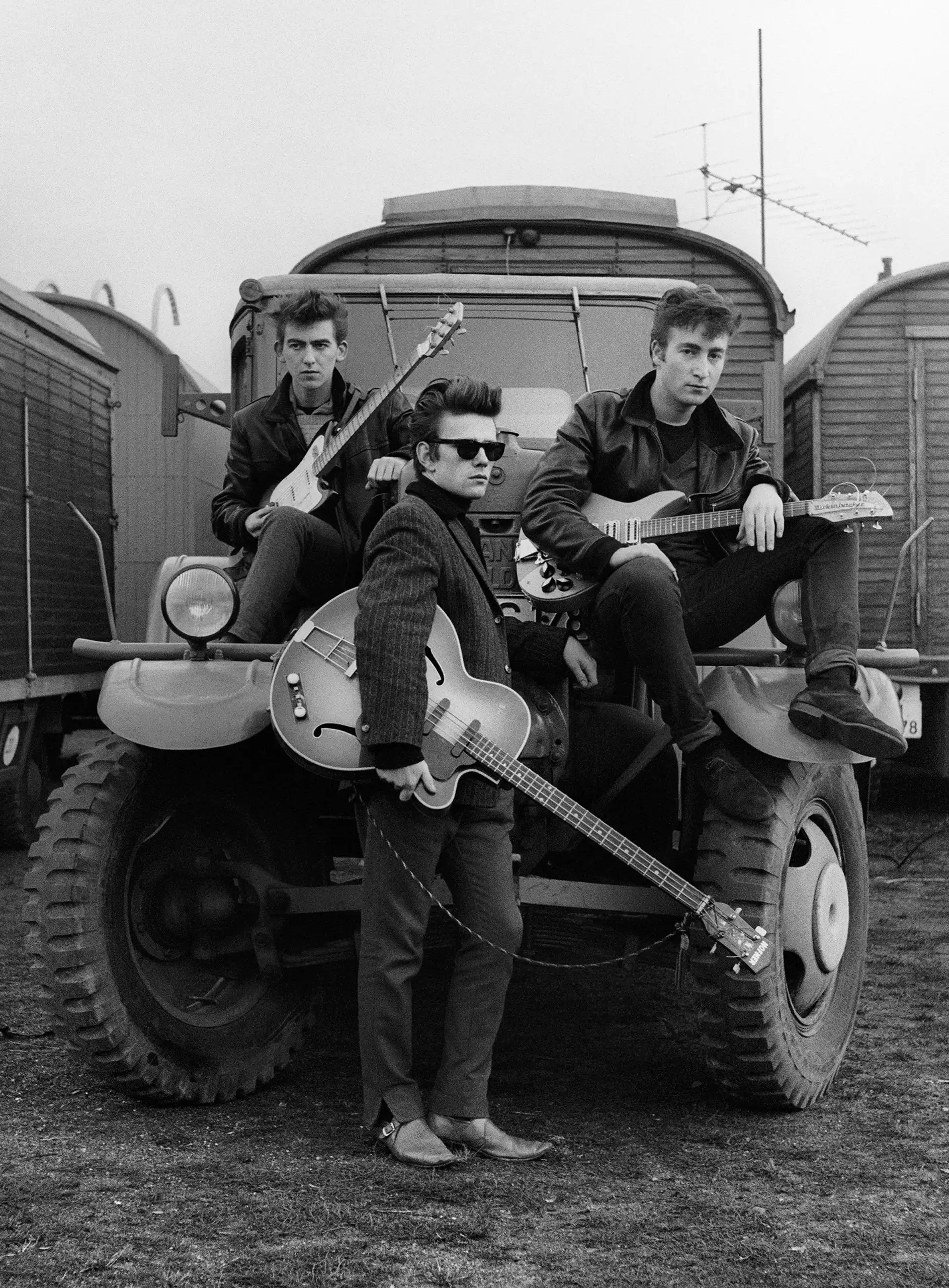
Stuart Sutcliffe
 United Kingdom
Member of The Beatles
Data de nascimento
June 23, 1940
Signo
Cancer
Local de nascimento
Edinburgh, Scotland
Idade
Faleceu aos 21
Sobre
Stuart Sutcliffe foi um pintor e músico britânico, mais conhecido como o baixista original dos The Beatles. Seus esforços artísticos, particularmente na pintura de vanguarda, são reconhecidos por sua qualidade e estilo distinto. A carreira inicial de Sutcliffe com os The Beatles foi breve, antecedendo sua imensa fama global. Ele é lembrado hoje como um membro fundador da banda icônica e um artista promissor cuja vida foi tragicamente interrompida. Fãs e críticos reconhecem sua contribuição única tanto para a música quanto para a arte, com seu trabalho continuando a ser exibido e estudado.
Início da vida e origens
Stuart Fergusson Victor Sutcliffe nasceu em 23 de junho de 1940, em Edimburgo, Escócia, filho de Charles Stuart Sutcliffe, um marinheiro mercante, e Millie Sutcliffe. Embora nascido na Escócia, foi criado em Liverpool, Inglaterra, para onde sua família se mudou logo após seu nascimento. As frequentes e prolongadas ausências de seu pai no mar impuseram considerável tensão financeira e emocional à família, o que, por sua vez, promoveu um forte vínculo entre Stuart, sua mãe e suas irmãs, além de levá-lo a um círculo próximo de amigos e um interesse crescente pela expressão artística. Desde cedo, Sutcliffe mostrou considerável promessa artística, o que o levou a frequentar a Prescot Grammar School, seguida pela prestigiosa Liverpool College of Art. Lá, ele rapidamente se destacou como um desenhista e pintor excepcionalmente talentoso, ganhando reconhecimento e prêmios de arte escolar por seu talento. Seu trabalho durante esse período mostrou fortes influências do Expressionismo Abstrato e do modernismo europeu, e ele começou a exibir pinturas em exposições estudantis locais, construindo constantemente uma reputação séria como um artista plástico emergente.
Foi na Liverpool College of Art que Sutcliffe forjou uma amizade próxima com o colega estudante John Lennon, tornando-se parte integrante de um círculo boêmio de estudantes de arte e músicos. Essa conexão se mostrou fundamental em sua vida. Em 1960, Sutcliffe experimentou um avanço significativo em sua carreira artística quando vendeu uma de suas pinturas por uma quantia considerável, estimada em cerca de £65-75. Esse sucesso financeiro tornou-se um ponto de virada, pois Lennon e seus amigos em comum o incentivaram fortemente a usar o dinheiro para comprar um baixo. Apesar de ter pouca experiência musical prévia, Sutcliffe seguiu o conselho deles, adquirindo um baixo Höfner President. Ele então se juntou ao grupo musical de Lennon, então conhecido como Johnny and the Moondogs, que logo evoluiria para os The Beatles . Sua decisão de entrar para a banda marcou um novo e inesperado capítulo em sua vida, deslocando momentaneamente seu foco principal da pintura para a música, e preparando o cenário para seu envolvimento nos anos formativos do grupo em Liverpool e Hamburgo.
Crescimento na carreira
Embora sua carreira musical tenha sido breve e tenha antecedido o sucesso comercial dos The Beatles, o impacto de Sutcliffe é notável em duas áreas. Como baixista original, ele fez parte do período formativo dos The Beatles em Hamburgo e Liverpool, quando eles aprimoraram seu som tocando sets maratona. Sua decisão de deixar a banda levou Paul McCartney a assumir permanentemente o baixo, uma mudança que ajudou a solidificar o som clássico dos The Beatles.
Na arte, suas pinturas foram exibidas postumamente em livros e exposições em galerias, apresentadas como o trabalho de um artista moderno sério e em evolução, e não meramente um associado dos Beatles. Ele é frequentemente referido como o quinto Beatle nas histórias dos Beatles, mas historiadores de arte enfatizam cada vez mais sua contribuição independente para a arte britânica do pós-guerra.
Linha do tempo da carreira
Imagem pública e estilo
Stuart Sutcliffe é lembrado como o enigmático "quinto Beatle" — uma figura intensa e artisticamente melancólica, cuja breve passagem pela banda foi ofuscada por seu genuíno talento como pintor. Com suas maçãs do rosto marcantes, cabelo escuro penteado para trás e, mais tarde, o corte moptop que ele pioneirizou, Sutcliffe cultivou uma estética boêmia e sombria que contrastava com a imagem roqueira inicial do grupo. Seu estilo, influenciado por Astrid Kirchherr, incluía jaquetas de couro preto e um toque beatnik. A mídia e os fãs frequentemente o retratam como uma alma trágica e sensível — o artista que escolheu a tela em vez da fama. Entre os entusiastas dos Beatles, ele é reverenciado como um arquiteto-chave da identidade visual da banda. Historiadores de arte, no entanto, focam em suas obras expressionistas abstratas, que foram exibidas em galerias e descritas como "cruas, emocionais e à frente de seu tempo." Não há um nome oficial de fandom, mas uma comunidade dedicada de "estudiosos de Sutcliffe" e fãs dos Beatles mantém seu legado vivo. Sua presença nas redes sociais é póstuma, mantida por espólios e contas de fãs que destacam sua arte e mitologia.
Fama e fandom
Stuart Sutcliffe remains a figure of haunting absence rather than active adoration. His legacy is defined by the tragic arc of a life extinguished at twenty-one, just as his band was on the cusp of global domination. Unlike the frenzied worship directed at his surviving bandmates, Sutcliffe never cultivated a formal fanbase with its own rituals or self-identifying name. His admirers are subsumed within the vast, decentralized community of Beatles fans, drawn to him not by hit singles or stadium tours, but by the mythos of the "fifth Beatle" who chose art over fame. The story of his departure from the group to pursue painting in Hamburg and his subsequent death from a cerebral hemorrhage serves as the primary narrative anchor for this retrospective reverence. Fans today engage with his memory through organic tributes, such as annual social media remembrances and visits to exhibitions featuring his lost paintings, treating these moments as pilgrimages to a site of unfulfilled potential. There were no meet-and-greets during his lifetime, no organized campaigns, and no specific fandom faction; his influence is purely cultural and historical. While he shaped the visual identity of the early Beatles and suggested their iconic name, his personal impact is felt most deeply in the quiet spaces between the known history of the group's rise. He exists now as a foundational ghost, a necessary element of the band's origin story that was removed before the world could fully know him. Stuart Sutcliffe is currently evaluated by iFANN but holds no placement in the Global Top 1,000 rankings. The iFANN Global Fame Engine has determined that he does not currently occupy a position in any published scope list.
Fatos interessantes e lendas
Stuart Sutcliffe was the first member of the group to adopt the moptop haircut, a style pioneered by photographer Astrid Kirchherr that the others later emulated. He frequently performed with his back to the audience, a habit born of both shyness and the fact that he had learned the bass lines relatively late in his tenure. Most contemporaries viewed him as an artist who happened to play bass, rather than a musician dabbling in paint. A persistent legend suggests he may have suffered a head injury in a fight months before his death, a detail some accounts claim contributed to the fatal brain hemorrhage that took his life. The most enduring story surrounding him is the emotional bond he shared with John Lennon, whom he described as his alter ego. This connection began at the Liverpool College of Art in 1957 and fueled the bohemian aesthetic that defined the band's early image. Another pivotal moment in his lore is his decision to leave the group in 1961 to stay with Kirchherr in Germany, a choice that fundamentally altered the band's trajectory by forcing Paul McCartney to switch permanently to bass. His death in Hamburg in April 1962 is often framed as the moment the "real" Beatles lost their soulmate, leaving the remaining trio to navigate stardom without their original creative anchor.
Família e vida pessoal
Stuart Sutcliffe nasceu de Charles Stuart Sutcliffe, um marinheiro mercante, e Millie Sutcliffe. Ele tinha irmãos, embora os detalhes sejam escassos. As longas ausências de seu pai no mar criaram um ambiente doméstico desafiador. Ele estava noivo de Astrid Kirchherr na época de sua morte, mas não teve filhos.
Conexões notáveis
Relacionamentos e história amorosa
O único relacionamento sério documentado de Stuart Sutcliffe foi com Astrid Kirchherr, uma fotógrafa alemã que ele conheceu em 1960 durante a primeira temporada dos Beatles em Hamburgo. Eles rapidamente se tornaram um casal; ela se tornou sua musa e estilista, e ficaram noivos. Sutcliffe permaneceu com Kirchherr em Hamburgo depois de deixar a banda, focando em sua arte, até sua morte súbita em 1962. Em 2026, ele está falecido; na época de sua morte, ele estava noivo de Kirchherr.
- Noivo(a)Astrid Kirchherr1960 - 1962Conheceu durante a primeira temporada dos Beatles em Hamburgo; ela se tornou sua noiva e influência criativa; o relacionamento terminou com sua morte.
Morte e repercussões
Morte
April 10, 1962 (aos 21 anos)
Local da morte
Hamburg, West Germany
Causa da morte
Cerebral hemorrhage from ruptured aneurysm
Stuart Sutcliffe lay in a quiet room at the Klinikum Eppendorf in Hamburg, West Germany, where he had been rushed after collapsing from severe headaches that had plagued him for weeks. On April 10, 1962, he passed away in his sleep at the age of 21 without regaining consciousness. An autopsy conducted shortly after his death established the official cause as a cerebral hemorrhage resulting from the rupture of a congenital intracranial aneurysm, ruling out speculation regarding drug use or prior trauma that had circulated in later accounts. The German authorities handled the medical certification administratively.
The news devastated his inner circle, particularly John Lennon, who viewed Sutcliffe as his alter ego and reportedly refused to play the piano for a long time afterward. Paul McCartney also expressed deep grief over the loss of the band's original creative spark, though global reaction remained limited due to the group's status before their international breakthrough. A private funeral took place on April 13, 1962, at Ohlsdorf Cemetery in Hamburg, attended by close friends like Astrid Kirchherr and Klaus Voormann alongside members of the local art scene. His grave remains a site of quiet pilgrimage marked by a simple headstone.
Posthumously, his legacy has been preserved through the management of his artwork by the Official Stuart Sutcliffe Estate, which has overseen exhibitions of previously unseen pieces and publications such as Stuart Sutcliffe: Four Myths About the 5th Beatle . While he never received induction into a musician Hall of Fame, art historians increasingly emphasize his independent contribution to post-war British art rather than viewing him solely as a Beatles associate.
Patrimônio (valor do espólio)
$0
Estimativa da equipe editorial do iFANN
Because Sutcliffe died very young and before The Beatles' commercial breakthrough, detailed financial records are sparse. At the time of his death, he lived as a student artist and musician with modest means, earning from club performances and occasional art sales. There is no credible, sourced estimate for his exact estate value at death, but context suggests it was relatively small. Posthumous revenues connected to his name come primarily from licensing and reproduction of his artwork in books and exhibitions, as well as rights in photographs and related merchandise where his image appears as an early Beatle. However, detailed audited figures for how much the estate has earned since his passing are not publicly available in reputable sources. No reliable public estimate exists for the current value of the Stuart Sutcliffe estate as of 2026. Per iFANN's editorial analysis, the total net worth is $0.
Prêmios e condecorações
Conhecido por
The Beatles
1960 · Bass guitarist
Palavras-chave
Fontes
Dados rápidos
- Birthdate
- June 23, 1940
- Death date
- April 10, 1962
- Age at death
- 21
- Local de nascimento
- Edinburgh, Scotland
- Occupation
- Painter, musician
- Instrument
- Bass guitar
- Grupo
- The Beatles
- Fiancée
- Astrid Kirchherr
Dados pessoais
- Nome completo
- Stuart Fergusson Victor Sutcliffe
- Formação
- Liverpool College of Art, Hamburg College of Art
Perguntas frequentes
Qual é o patrimônio de Stuart Sutcliffe em 2026?
Por que Stuart Sutcliffe deixou os Beatles?
Como Stuart Sutcliffe morreu?
Stuart Sutcliffe era um bom baixista?
Com quem Stuart Sutcliffe estava noivo?
Pessoas semelhantes
Junte-se à comunidade
fãs comentando