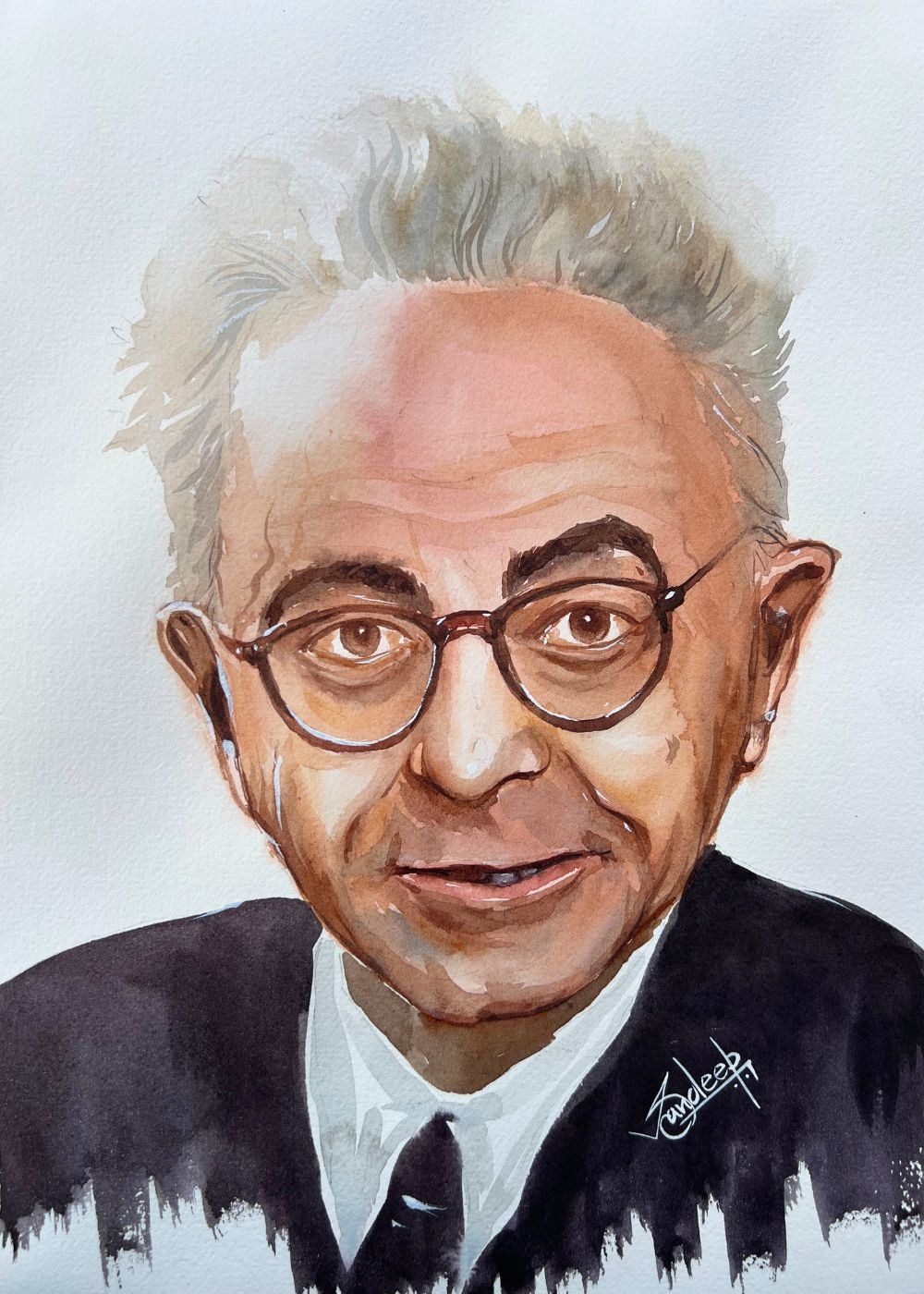
Richard Courant
 Poland
mathematician•university teacher•physicist
Data de nascimento
January 8, 1888
Signo
Capricorn
Local de nascimento
Lubliniec, Prussia (now Poland)
Idade
Faleceu aos 84
Sobre
Richard Courant foi um matemático teuto-americano que transformou a matemática aplicada e construiu um dos maiores institutos de pesquisa do mundo. Nascido em 8 de janeiro de 1888, em Lubliniec (então Prússia, hoje Polônia), ele fugiu dos nazistas e se estabeleceu nos Estados Unidos, onde fundou o que hoje é o Courant Institute of Mathematical Sciences da New York University. Ele faleceu em 27 de janeiro de 1972.
A pesquisa de Courant abrangeu análise real, física matemática, cálculo de variações e equações diferenciais parciais. Ele coescreveu o livro-texto marco Methods of Mathematical Physics com David Hilbert e What is Mathematics? com Herbert Robbins, um livro que abriu ideias avançadas para leitores em geral. Seus livros didáticos educaram gerações de cientistas e matemáticos.
Hoje, o Courant Institute se destaca como um centro global líder em matemática aplicada e ciência da computação, um legado direto de sua visão. A influência de Courant é sentida não apenas através de seu próprio trabalho, mas através da instituição que ele construiu e dos muitos alunos que ele orientou.
Início da vida e origens
Richard Courant cresceu em uma família judia que se mudou frequentemente. Seu pai, Siegmund, teve uma carreira comercial instável, e a família viveu em Glatz e Breslau antes de se estabelecer em Berlim em 1905. Quando menino, Courant teve dificuldades na escola, ele era até fraco em aritmética, mas eventualmente frequentou o König-Wilhelm Gymnasium em Breslau, onde seu talento para a matemática emergiu.
Ele estudou na Universidade de Breslau, na Universidade de Zurique e, finalmente, na Universidade de Göttingen, o epicentro da matemática alemã. Lá ele se tornou assistente do lendário David Hilbert e obteve seu doutorado em 1910. Seu trabalho inicial já demonstrava um forte interesse nas aplicações práticas da matemática, uma postura que o diferenciava de muitos matemáticos puros de sua época.
Courant serviu brevemente na Primeira Guerra Mundial, mas foi ferido e dispensado. Após a guerra, ele retornou a Göttingen e começou a construir sua carreira. Durante a hiperinflação do início dos anos 1920, ele mostrou notável desenvoltura, garantindo apoio do industrial Carl Still para manter o instituto de matemática funcionando.
Crescimento na carreira
De 1920 a 1933, Courant dirigiu o instituto de matemática da Universidade de Göttingen, transformando-o em um centro de classe mundial. Durante este período, ele coescreveu Methods of Mathematical Physics com David Hilbert (publicado pela primeira vez em 1924), um texto que permanece um pilar da área. Ele também começou a desenvolver o que mais tarde se tornou o método de elementos finitos, publicando uma versão pela primeira vez em 1922.
Como refugiado judeu alemão, Courant emigrou para os Estados Unidos na década de 1930. Em 1946, ele fundou o Institute for Mathematics and Mechanics na New York University, que mais tarde se tornou o Courant Institute of Mathematical Sciences. Sob sua liderança, o instituto atraiu matemáticos brilhantes e garantiu financiamento governamental significativo para pesquisas em propagação de ondas, detonações e outros problemas aplicados, elevando o perfil da NYU em matemática.
Courant se aposentou em 1958, mas permaneceu ativo. Seu livro What is Mathematics? (1941) tornou-se um clássico, vendendo centenas de milhares de cópias e inspirando inúmeros leitores. O método de elementos finitos, que ele pioneiro, é agora essencial para resolver equações diferenciais parciais em engenharia e física.
Linha do tempo da carreira
Imagem pública e estilo
Richard Courant é lembrado como um estudioso rigoroso, mas prático, que defendeu a matemática aplicada e construiu instituições fortes. Sua imagem pública é a de um organizador e mentor brilhante, alguém que podia atrair talentos, garantir financiamento e criar um ambiente colaborativo. Ele era conhecido por seu estilo de escrita claro e acessível, especialmente em What is Mathematics?, o que o tornou um dos poucos matemáticos a alcançar um vasto público geral.
Dentro da comunidade matemática, Courant é reverenciado por seus livros didáticos e por fundar o Courant Institute. Sua insistência em conectar a teoria com problemas do mundo real ajudou a moldar a identidade moderna da matemática aplicada. Não há nome de fandom ou cultura de fãs em torno dele, mas seu nome vive através do instituto e dos muitos matemáticos que ele treinou.
Fama e fandom (iFAMOUS Rankings)
Richard Courant commanded a global stage of profound influence, yet his reach remained strictly within the corridors of academia rather than the roar of pop culture. The iFANN Global Fame Engine has evaluated this towering figure of 20th-century science, but he does not currently hold a placement in the published rankings, including the Global Top 1,000 or any Top-100 scope list. His legacy is defined by the quiet power of institutional building and rigorous scholarship, not by viral metrics or chart positions. While he shaped the very language of applied mathematics through works like *Methods of Mathematical Physics* and *What is Mathematics?*, no formal fanbase emerged to rally behind his name. There is no documented fandom name associated with Courant; the audience that revered him were students, colleagues, and scholars who encountered his ideas through textbooks and lectures rather than celebrity worship. Unlike modern icons who generate organized campaigns or birthday billboards, Courant's interactions were professional and intellectual. His followers sought understanding, not autographs, and the community that grew around the Courant Institute at NYU operated as a center for discovery rather than a cult of personality. The absence of a named fandom reflects the nature of his fame: it was earned through the enduring utility of his equations and the strength of his mentorship, leaving no room for the performative adoration that defines contemporary stardom. Even decades after his death in 1972, the reverence for Courant remains academic, focused on the mathematical structures he helped codify rather than the man himself.
Fatos interessantes e lendas
Richard Courant's cousin was Edith Stein, a student and assistant to philosopher Edmund Husserl. Stein became a Catholic nun, was murdered at Auschwitz, and was later canonized as a saint by the Roman Catholic Church. He was wounded and discharged from the German army shortly after enlisting in World War I. Despite his later fame as a mathematician, Courant struggled with arithmetic as a child. Courant believed that empirical evidence could never establish mathematical existence, only a rigorous proof could ensure that a mathematical description of a physical phenomenon was meaningful. The Courant Institute building at NYU, dedicated in 1965, was the first in the United States built specifically for mathematical research. A historical account notes his role in building the mathematical sciences at NYU, sometimes referred to in academic history as the "Courant Hilton" regarding the institution's growth. As of November 2025, NYU established a new school named in his honor: the "Courant Institute School of Mathematics, Computing, and Data Science," signaling the continued high regard for his contributions to science and technology.
Frases notáveis
“Empirical evidence can never establish mathematical existence nor can the mathematician's demand for existence be dismissed by the physicist as useless rigor. Only a mathematical existence proof can ensure that the mathematical description of a physical phenomenon is meaningful.”
Família e vida pessoal
Richard Courant foi o filho mais velho de Siegmund e Martha Courant. Os negócios de Siegmund eram frequentemente problemáticos, criando tensão na família. A prima de Courant, Edith Stein, tornou-se uma filósofa notável e, mais tarde, uma santa católica.
Ele se casou com Nelly Neumann em 1912, uma colega estudante de Breslau. Eles se divorciaram em 1916, e Nelly foi assassinada pelos nazistas em 1942. Em 1919, Courant se casou com Nerina (Nina) Runge, filha do professor de Göttingen Carl Runge e irmã da matemática aplicada Iris Runge.
Conexões notáveis
Courant trabalhou em estreita colaboração com David Hilbert em Göttingen, coautoria de um livro seminal. Colaborou com Herbert Robbins em What is Mathematics?. Seu sogro foi o matemático Carl Runge, e sua cunhada foi a matemática aplicada Iris Runge. Sua prima Edith Stein tornou-se uma santa católica. Warren Weaver, chefe do Painel de Matemática Aplicada do OSRD, foi colega e apoiador.
Relacionamentos e história amorosa
Richard Courant casou-se duas vezes. Sua primeira esposa foi Nelly Neumann, uma colega estudante de Breslau, com quem se casou em 1912. O casamento terminou em divórcio em 1916. Nelly Neumann foi posteriormente assassinada pelos nazistas em 1942. Em 1919, Courant casou-se com Nerina (Nina) Runge, filha do matemático Carl Runge. Eles permaneceram juntos até a morte de Courant em 1972.
- Casado(a)Nelly Neumann1912 - 1916Casou em 1912, divorciou-se em 1916. Nelly foi posteriormente assassinada pelos nazistas em 1942.
- Casado(a)Nerina (Nina) Runge1919 - 1972Filha do matemático Carl Runge. Eles foram casados até a morte de Courant.
Morte e repercussões
Morte
January 27, 1972 (aos 84 anos)
Local da morte
New York City, New York, USA
Causa da morte
Causas naturais
Richard Courant, the renowned German-American mathematician and founder of NYU's Courant Institute of Mathematical Sciences, died on Thursday, January 27, 1972, at the age of 84. He was born on January 8, 1888. According to a contemporary report in The New York Times, he passed away Thursday afternoon at New York University Hospital. While the exact time is not specified beyond afternoon, the location remains confirmed as the hospital associated with his institution. The obituary notes simply state that he died at the hospital without citing a specific disease or condition.
Public reaction to his death was marked by tributes from the academic community recognizing him as one of the greatest organizers of mathematical research and teaching of the twentieth century. Tributes focused on his intellectual legacy, particularly his co-authorship of the influential text with David Hilbert and his founding of the Courant Institute. Details regarding his funeral or memorial service are not explicitly provided in the search results, including the date, location, or list of attendees. It is noted that he was buried, but the specific cemetery is not identified in the provided text.
The institution he built served as the primary vessel for his posthumous honor, absorbing his vision into its very structure. This institutional evolution serves as a primary form of posthumous honor alongside the enduring impact of his works such as What Is Mathematics?. The Courant Institute recently underwent a significant expansion in November 2025, becoming the Courant Institute School of Mathematics, Computing, and Data Science to unify programs across computer science and data science. His legacy continues through this expanded entity which stands as a reflection of his contributions to the field.
Patrimônio (valor do espólio)
Como Richard Courant faleceu em 1972, o valor atual do seu espólio não é publicamente documentado. Seu principal legado financeiro é o Courant Institute of Mathematical Sciences da NYU, que continua a prosperar. Durante sua vida, a renda de Courant provinha de seu salário acadêmico, royalties de livros (particularmente de What is Mathematics? e Methods of Mathematical Physics), e subsídios de pesquisa governamentais. Seu espólio provavelmente inclui royalties residuais de seus livros, que permanecem em impressão e são usados em todo o mundo. No entanto, nenhum valor específico do espólio ou cifras de ganhos póstumos estão disponíveis em fontes públicas.
Prêmios e condecorações
View 2 records, honours and achievementsConhecido por
Methods of Mathematical Physics
1924 · Coautor
What is Mathematics?
1941 · Coautor
Courant Institute of Mathematical Sciences
1946 · Fundador
Finite element method
1943 · Pioneiro
Palavras-chave
Fontes
Dados rápidos
- Profissão
- mathematician, university teacher, physicist
- Nascimento
- +1888-01-08
- Local de nascimento
- Lubliniec
- Morte
- +1972-01-27
- Local da morte
- New Rochelle
- Gênero
- Masculino
- Signo
- Capricorn
Dados pessoais
- Nome completo
- Richard Courant
- Cônjuge
- Nerina (Nina) Runge
- Formação
- University of Göttingen (PhD, 1910)
Perguntas frequentes
Quem foi Richard Courant?
Pelo que Richard Courant é famoso?
Onde Richard Courant nasceu?
Quando Richard Courant morreu?
O que é o Courant Institute?
Pessoas semelhantes
Junte-se à comunidade
fãs comentando