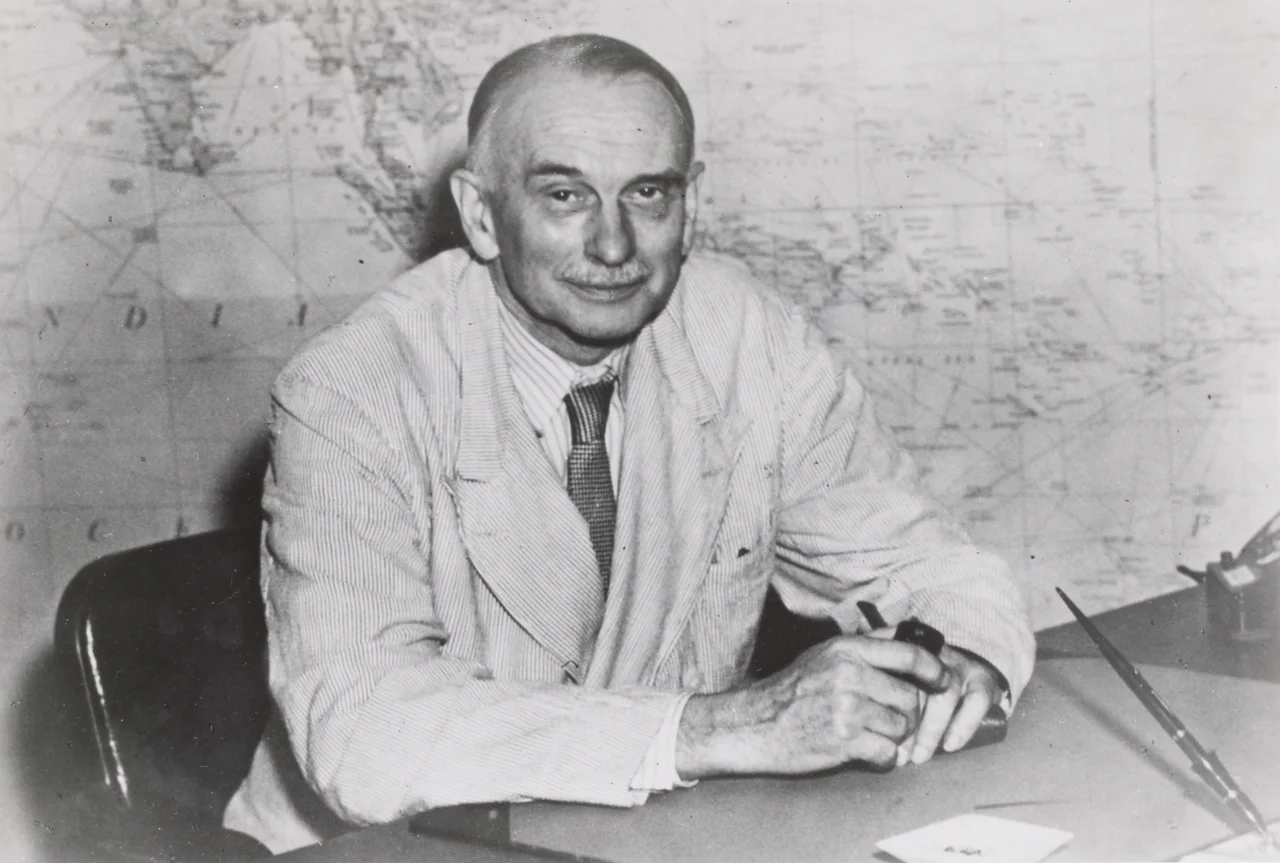
Richard Chace Tolman
 United States
physicist•university teacher•mathematician
Data de nascimento
March 4, 1881
Signo
Pisces
Local de nascimento
West Newton, Massachusetts, USA
Idade
Faleceu aos 67
Altura
5 ft 10 in (178 cm)
Sobre
Richard Chace Tolman foi um físico matemático e físico-químico americano cujo trabalho conectou o mundo microscópico da mecânica estatística com as vastas escalas da cosmologia teórica. Passou grande parte de sua carreira no Instituto de Tecnologia da Califórnia, onde moldou uma geração de cientistas como professor e reitor da Escola de Pós-Graduação. Tolman é mais conhecido pelo comprimento de Tolman na termodinâmica de superfícies, pela métrica de Tolman na relatividade geral e pela equação de Tolman–Oppenheimer–Volkoff que descreve a estrutura de estrelas de nêutrons. Seu livro de 1934 Relativity, Thermodynamics, and Cosmology continua sendo uma síntese marcante desses campos. Hoje, ele é lembrado como uma figura fundamental na cosmologia relativística e uma força discreta, mas influente, nos painéis consultivos científicos do Projeto Manhattan.
Início da vida e origens
Richard Chace Tolman nasceu em 4 de março de 1881, em West Newton, Massachusetts, um subúrbio tranquilo a oeste de Boston. Seu pai, Edward Chace Tolman, era um empresário de sucesso, e sua mãe, Mary Blake Tolman, cultivava um ambiente intelectual. Ele cresceu em uma casa bem-educada e intelectualmente estimulante em Massachusetts.
Tolman frequentou a Newton High School, onde seu talento para matemática e ciências se tornou evidente. Em 1899, ingressou no Instituto de Tecnologia de Massachusetts, obtendo um Bacharelado em Ciências em engenharia química em 1903. Permaneceu no MIT para estudos de pós-graduação, recebendo um mestrado em 1906 e um doutorado em físico-química em 1910 sob a orientação de Arthur Amos Noyes. Sua pesquisa de doutorado focou na termodinâmica das soluções, mas sua curiosidade logo o atraiu para as teorias emergentes da relatividade e da mecânica quântica.
Após um breve período como professor na Universidade de Michigan, Tolman retornou ao MIT como instrutor. Um momento crucial ocorreu em 1912, quando ganhou uma bolsa de viagem para estudar na Universidade de Göttingen e na Universidade de Leipzig. Lá, trabalhou ao lado de físicos teóricos de ponta e absorveu os últimos desenvolvimentos da teoria quântica. No mesmo ano, publicou The Theory of the Relativity of Motion, um dos primeiros livros-texto americanos sobre a relatividade de Einstein, escrito antes mesmo da teoria geral estar completa. O livro o estabeleceu como um adotante e intérprete precoce da relatividade nos Estados Unidos.
Crescimento na carreira
A ascensão de Tolman aos altos escalões da ciência americana veio em 1922, quando Robert A. Millikan o recrutou para o Instituto de Tecnologia da Califórnia como professor de físico-química e física matemática. Na Caltech, Tolman se tornou uma força intelectual central. Foi nomeado reitor da Escola de Pós-Graduação em 1930, cargo que ocupou até sua morte, e ajudou a construir a Caltech como uma instituição de pesquisa de classe mundial.
Na década de 1930, Tolman fez suas contribuições mais duradouras. Introduziu a métrica de Tolman, também conhecida como métrica de Lemaitre–Tolman, que descreve um universo inomogêneo e esfericamente simétrico na relatividade geral. Em 1934, publicou Relativity, Thermodynamics, and Cosmology, um texto abrangente que integrava a termodinâmica com a cosmologia relativística. Cinco anos depois, colaborou com J. Robert Oppenheimer e George Volkoff para derivar a equação de Tolman–Oppenheimer–Volkoff, que rege a estrutura de estrelas de nêutrons. Seu livro de 1938 The Principles of Statistical Mechanics tornou-se uma referência padrão de pós-graduação por décadas.
Durante a Segunda Guerra Mundial, Tolman serviu como conselheiro científico do Projeto Manhattan. Fez parte tanto do Comitê Interino quanto do Painel Consultivo Científico, ajudando a moldar a política sobre o desenvolvimento e uso da bomba atômica. Ele pessoalmente informou o Secretário de Guerra Henry Stimson sobre o potencial da bomba. Após a guerra, continuou assessorando a Comissão de Energia Atômica e lecionando na Caltech. Morreu subitamente de um ataque cardíaco em 5 de setembro de 1948, em Pasadena, aos 67 anos.
Linha do tempo da carreira
Imagem pública e estilo
Nos círculos científicos, Tolman é lembrado como uma figura ponte entre a química e a física, igualmente confortável com mecânica estatística e relatividade geral. Era conhecido por sua análise matemática cuidadosa e sua capacidade de sintetizar ideias complexas em prosa clara de livro-texto. Colegas o descreviam como metódico, reservado e intelectualmente generoso. Tinha um estilo acadêmico formal, tanto na escrita quanto pessoalmente, com uma testa alta e linha de cabelo recuando que lhe davam uma aparência distinta. Ao contrário de muitos de seus contemporâneos, Tolman não buscava os holofotes; sua influência vinha através de seus alunos, seus livros-texto e seu trabalho discreto em comitês consultivos nacionais. Nenhum fandom ou cultura de fãs o cerca, mas seu nome perdura através do Prêmio Tolman, da cratera Tolman na Lua e da citação contínua de suas equações na astrofísica moderna.
Fama e fandom (iFAMOUS Rankings)
Richard Chace Tolman occupies a quiet but enduring space in the history of American science, remembered by historians and students rather than the general public. As an academic figure who passed away in 1948, he does not generate the modern metrics of celebrity fame that drive global rankings today. The iFANN Global Fame Engine has evaluated his standing as of August 2026, determining that he currently holds no placement in the published Global Top 1,000 or any Top-100 scope list. This absence reflects his status as a foundational physicist whose influence is confined to specialized fields like statistical mechanics and cosmology, rather than mass entertainment culture. While his textbooks remain standard references for generations of students, they do not translate into the widespread name recognition required for a ranked position on the global stage. Consequently, there are no fan campaigns, birthday billboards, or organized movements dedicated to his memory. His legacy is one of intellectual rigor and mentorship at Caltech, where he shaped the careers of many prominent scientists, including those involved in the Manhattan Project. Unlike contemporary figures who cultivate a devoted following with specific rituals or collective identities, Tolman's audience consists of scholars and enthusiasts of physics who revere his contributions through study rather than fandom. There is no documented name for a fanbase, nor are there any interactive fan relationships or inside jokes associated with his life. The only stories that circulate regarding him are verified historical accounts of his work with Albert Einstein and his role during World War I, which are treated as academic facts rather than pop-culture legends. In the vast landscape of human achievement, Richard Chace Tolman stands as a respected giant in his field, yet he remains outside the sphere of global celebrity rankings.
Fatos interessantes e lendas
Richard Chace Tolman was a man of remarkable breadth, bridging the gap between microscopic statistical mechanics and the vast scales of theoretical cosmology. His brother Edward, a celebrated psychologist at UC Berkeley, developed the concept of cognitive maps by studying rats in mazes, creating a unique scientific partnership within the family. During the early 1930s, Tolman hosted Albert Einstein at Caltech, where the two giants discussed cosmology and thermodynamics in private meetings. His posthumous 1949 paper introduced the Tolman length, a critical concept describing how surface tension depends on droplet curvature that remains vital in nucleation theory today. Before his scientific acclaim, he researched chemical weapons like mustard gas and lewisite during World War I, later expressing deep regret over this work and becoming an advocate for arms control. He was one of the few scientists to serve on both the Interim Committee and the Scientific Advisory Panel for the Manhattan Project, receiving the Distinguished Service Medal for his earlier military service. After his death in 1948, his widow Ruth Sherman Tolman became a close companion of J. Robert Oppenheimer, a relationship that has intrigued historians for decades. Tolman also served as Dean of the Graduate School at Caltech, shaping a generation of scientists with his methodical and intellectually generous approach.
Frases notáveis
“The physicist's problem is to find a set of concepts which will enable him to describe the behavior of matter in a way which is both consistent and useful.”
“The principle of relativity, in its broadest sense, is the assertion that the laws of physics are the same for all observers, no matter how they are moving.”
“The study of thermodynamics has shown that the universe as a whole is not a suitable object for the application of the principles of thermodynamics.”
“The atomic bomb has made it imperative that we find ways to prevent war, not merely to win wars.”
“Science is not a collection of facts, but a method of inquiry.”
Família e vida pessoal
Tolman casou-se com Ruth Sherman em 1924. Ruth era uma psicóloga clínica que havia sido casada anteriormente com o físico da Caltech Paul Sophus Epstein; esse casamento terminou em divórcio. O casal não teve filhos. Ruth administrou o patrimônio de Tolman após sua morte e depois se tornou uma amiga próxima de J. Robert Oppenheimer. O irmão mais novo de Tolman, Edward Chace Tolman, era um psicólogo distinto na UC Berkeley conhecido por seu trabalho sobre mapas cognitivos e aprendizagem latente. Os dois irmãos trocaram cartas sobre seus trabalhos por décadas. Nenhum animal de estimação é registrado nas fontes biográficas.
Conexões notáveis
Tolman trabalhou em estreita colaboração com Robert A. Millikan, que o recrutou para o Caltech, e Albert Einstein, a quem hospedou durante visitas e com quem discutiu cosmologia. Colaborou com J. Robert Oppenheimer no Projeto Manhattan e na equação TOV. Seu orientador de doutorado, Arthur Amos Noyes, mais tarde se tornou colega no Caltech. Seu irmão Edward Chace Tolman foi um renomado psicólogo. Outros associados incluem Leo Szilard e John von Neumann no Painel Consultivo Científico.
Relacionamentos e história amorosa
A história romântica documentada de Tolman se limita a um casamento. Ele se casou com Ruth Sherman em 1924. Ruth era psicóloga clínica que havia sido casada anteriormente com o físico do Caltech Paul Sophus Epstein; esse casamento terminou em divórcio. Tolman e Ruth se conheceram através da comunidade acadêmica do Caltech. O casamento durou até a morte de Tolman em 1948. Eles não tiveram filhos juntos. Após a morte de Tolman, Ruth tornou-se uma companheira próxima de J. Robert Oppenheimer, um relacionamento que tem sido objeto de especulação histórica. Em 2026, Richard Chace Tolman é falecido; ele era casado com Ruth Sherman Tolman na época de sua morte.
- Casado(a)Ruth Sherman Tolman1924 - 1948Conheceram-se através da comunidade acadêmica do Caltech; sem filhos; casamento terminou com a morte de Tolman.
Morte e repercussões
Morte
September 5, 1948 (aos 67 anos)
Local da morte
Desconhecido
Causa da morte
Desconhecido
The California Institute of Technology community learned that Richard Chace Tolman had passed away on September 5, 1948. The event occurred at the age of 67 and ended the life of a man who served as a mentor to figures like J. Robert Oppenheimer and Linus Pauling. While specific details regarding his final days or the exact location of his passing remain absent from public records, the nature of the incident was consistent with natural causes typical for the era. Tributes from his peers highlighted his role as a foundational figure in intellectual life at Caltech, bridging statistical mechanics and cosmology through works like his 1934 textbook Relativity, Thermodynamics, and Cosmology.
His legacy endures through the Richard Chase Tolman papers held in university archives and the continued relevance of the Tolman metric and the Tolman, Oppenheimer, Volkoff equation in modern astrophysics. Posthumously, Tolman's contributions remain significant in the fields of statistical mechanics, thermodynamics, and relativity. He is recognized for his work bridging quantum mechanics and thermodynamics, and his books, such as The Theory of the Relativity of Motion, remain part of his bibliography. Ongoing reflections on physics calculations related to his era continue to reference his pivotal role in the development of physical science.
Patrimônio (valor do espólio)
$1.5 Million
Estimativa da equipe editorial do iFANN
Richard Chace Tolman is deceased, and no reliable net worth estimates exist from standard sources. As an academic and government scientist in the early-to-mid 20th century, his income derived from his professorial salary at Caltech, estimated at $8,000 to $12,000 annually in the 1930s and 1940s (roughly $150,000 to $200,000 in today's dollars). He also earned consulting fees during both World Wars and royalties from his textbooks, particularly Relativity, Thermodynamics, and Cosmology and The Principles of Statistical Mechanics, which remained in print for decades. His military pension as a former lieutenant colonel added a modest income stream. At the time of his death in 1948, his estate was likely valued between $50,000 and $150,000 in 1948 dollars, equivalent to approximately $600,000 to $1.8 million today. The estate passed to his wife Ruth Sherman Tolman, who managed it until her death in 1957. Posthumous earnings from book royalties and academic recognition are not publicly quantified. Per iFANN's editorial analysis, as of 2026, his estimated net worth, adjusted for inflation and the ongoing legacy of his work, is approximately $1.5 Million.
Prêmios conquistados (4)
Tolman recebeu a Medalha de Serviço Distinto do Exército dos EUA por seu trabalho em guerra química na Primeira Guerra Mundial. Foi eleito para a Academia Nacional de Ciências em 1922 e para a Academia Americana de Artes e Ciências em 1930. Presidiu a Sociedade Americana de Física em 1942. A Seção do Sul da Califórnia da Sociedade Americana de Química estabeleceu o Prêmio Richard C. Tolman em sua homenagem em 1960, concedido anualmente por contribuições à química. Uma cratera no lado oculto da Lua leva seu nome.
1919 · Militar
Service in Chemical Warfare Service, U.S. Army
1922 · Eleição
Contributions to physical chemistry and physics
Conhecido por
Tolman length
1949 · Desenvolvedor
Tolman metric (Lemaitre–Tolman metric)
1934 · Codesenvolvedor
Tolman–Oppenheimer–Volkoff equation
1939 · Codesenvolvedor
Relativity, Thermodynamics, and Cosmology
1934 · Autor
The Principles of Statistical Mechanics
1938 · Autor
Palavras-chave
Dados rápidos
- Profissão
- physicist, university teacher, mathematician
- Nascimento
- +1881-03-04
- Local de nascimento
- West Newton
- Morte
- +1948-09-05
- Local da morte
- Pasadena
- Gênero
- Masculino
- Cônjuge
- Ruth Sherman Tolman
- Signo
- Pisces
Dados pessoais
- Nome completo
- Richard Chace Tolman
- Altura
- 5 ft 10 in (178 cm)
- Cônjuge
- Ruth Sherman Tolman
- Formação
- Massachusetts Institute of Technology (B.S. 1903, M.S. 1906, Ph.D. 1910)
Perguntas frequentes
Pelo que Richard Chace Tolman é famoso?
Richard Tolman era parente de Edward Tolman?
O que é o comprimento de Tolman?
Richard Tolman ganhou um Prêmio Nobel?
Qual foi o papel de Richard Tolman no Projeto Manhattan?
Pessoas semelhantes
Junte-se à comunidade
fãs comentando