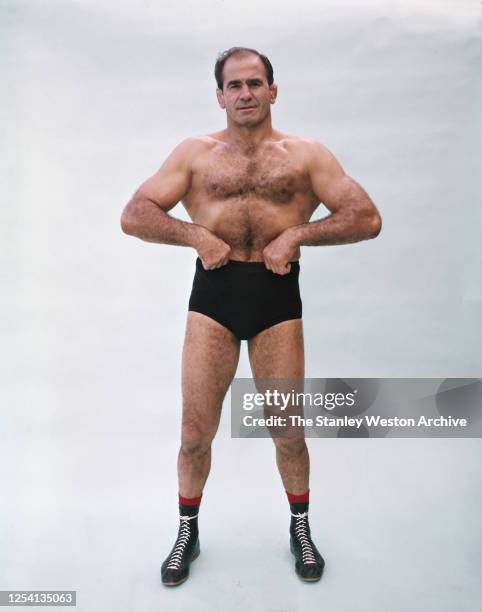
Lou Thesz
 United States
Also known as: Aloysius Martin Thesz, Tetsujin, God of Wrestling
Data de nascimento
April 24, 1916
Signo
Taurus
Local de nascimento
Banat, Michigan, USA
Idade
Faleceu aos 86
Altura
6 ft 0 in (183 cm)
Sobre
Lou Thesz foi um lutador profissional e treinador americano, amplamente considerado um dos maiores lutadores da história e o último campeão mundial globalmente aceito. Nascido Aloysius Martin Thesz em 24 de abril de 1916, em Banat, Michigan, ele dominou o esporte por décadas com um estilo técnico baseado em submissão, enraizado no catch wrestling. Thesz venceu o NWA World Heavyweight Championship três vezes, mantendo-o por um total combinado de 3.749 dias — mais do que qualquer outro. Conhecido como um verdadeiro "shooter", ele podia derrotar legitimamente oponentes se uma luta se tornasse real. No Japão, ele era reverenciado como o "Deus da Luta" e "Tetsujin" (Homem de Ferro) por seu condicionamento e habilidade. Thesz também treinou gerações de lutadores japoneses e artistas marciais mistos ao lado de Karl Gotch e Billy Robinson. Ele foi introduzido em vários halls da fama, incluindo a turma inaugural do George Tragos/Lou Thesz Professional Wrestling Hall of Fame, que ele ajudou a estabelecer. Fãs e historiadores o celebram como o padrão ouro do wrestling profissional.
Início da vida e origens
Lou Thesz cresceu em St. Louis, Missouri, onde seu pai Martin, um imigrante alemão e ex-lutador competitivo, começou a treiná-lo aos seis anos. Martin era rigoroso e disciplinado, acreditando que o wrestling era um caminho para uma vida melhor. Lou frequentou escolas públicas de St. Louis, mas deixou a educação formal cedo para se concentrar no wrestling. Quando adolescente, venceu o campeonato amador de wrestling da YMCA e, aos 16 anos, conquistou o Campeonato Amador do Estado do Missouri na categoria 175 libras. Essa vitória chamou a atenção dos promotores. Ele então treinou no St. Louis Wrestling Club sob Tom Packs, aprendendo a arte do wrestling profissional e aprimorando suas habilidades como um shooter legítimo.
Crescimento na carreira
Lou Thesz fez sua estreia profissional aos 16 anos em St. Louis em 1932. Ele venceu seu primeiro grande título, o Missouri State Heavyweight Championship, em 1934. Em 1936, conquistou o AWA World Heavyweight Championship, seu primeiro título mundial. Um ano depois, venceu o NWA World Heavyweight Championship, iniciando seu primeiro reinado. O segundo reinado de Thesz na NWA começou em 1948, quando derrotou Orville Brown em uma luta de unificação que consolidou múltiplos títulos mundiais. Ele manteve o cinturão continuamente por 7 anos e 8 meses — um dos reinados mais longos da história. Em 1952, defendeu o título contra a lenda japonesa Rikidozan em Tóquio, uma luta que ajudou a popularizar o wrestling profissional no Japão. Thesz reconquistou o título da NWA pela terceira e última vez em 1957, mantendo-o até 1963, quando perdeu para Buddy Rogers. Ele continuou lutando internacionalmente até os anos 1970, particularmente no Japão, onde se tornou um ícone cultural. Posteriormente, serviu como treinador principal no CACC Snake Pit Japan, treinando uma nova geração de lutadores em catch wrestling.
Linha do tempo da carreira
Imagem pública e estilo
Lou Thesz era conhecido por sua aparência atlética e elegante e seu comportamento sério e sem rodeios. Ele usava calções e botas de luta clássicos, contrastando com os personagens extravagantes que surgiram depois. A mídia e os fãs universalmente o retratam como um "shooter" — um lutador legítimo que realmente sabia lutar. Suas lutas eram técnicas, baseadas em submissão e metódicas, enfatizando habilidades reais de grappling em vez de entretenimento. No Japão, ele era reverenciado como o "Deus da Luta" e "Tetsujin" (Homem de Ferro). Fãs de Thesz frequentemente estudam suas lutas por conhecimento técnico, e ele é celebrado em comunidades de catch wrestling. Contas de legado nas mídias sociais postam fotos históricas, clipes de lutas e citações de sua autobiografia, mantendo sua memória viva entre historiadores do wrestling.
Fama e fandom
Lou Thesz remains the bedrock of professional wrestling history, a figure whose legacy is preserved not through viral social media campaigns or organized fan clubs, but through the enduring institutions he helped build. The wrestling community itself serves as his primary fandom, treating him as the ultimate standard of technical excellence and integrity. This reverence is institutionalized in the George Tragos/Lou Thesz Pro Wrestling Hall of Fame, established specifically to honor his name and induct new generations of talent, and the annual Lou Thesz Award presented by the Cauliflower Alley Club, which recognizes individuals who embody his character. From local honors in Waterloo, Iowa, to global recognition in the WWE Hall of Fame, his influence permeates every era of the sport. Fans do not chant his name with a specific slogan or gather for digital billboards; instead, they revere him as the last globally accepted world champion and the man who refused to compromise his legitimacy for entertainment. His story is one of quiet dominance, where the legend of being the only man who could legitimately defeat anyone in the ring cemented his status as the "God of Wrestling" in Japan and the gold standard in America. While modern stars chase fame, Thesz built a foundation that still supports the industry today. According to iFANN's Global Fame Engine evaluation conducted in August 2026, Lou Thesz does not currently hold a placement in the published rankings, including the Global Top 1,000 or any Top-100 scope list. Consequently, no specific ordinal rank or score is assigned to his current global standing.
Fatos interessantes e lendas
The signature move known as the "Thesz Press," a running knee drop to a prone opponent, was named by fans rather than the wrestler himself. A strict teetotaler and non-smoker, Thesz maintained his legendary physique through daily training and once turned down lucrative offers to throw matches, preserving his integrity as a legitimate competitor. He wrestled his final match at age 74 in 1990, defeating a much younger opponent, and authored the classic autobiography "Hooker: An Authentic Wrestler's Adventures Inside the Bizarre World of Professional Wrestling." Beyond the ring, he helped train early mixed martial artists, including members of the original UFC and Pancrase organizations. A widely retold story from his career highlights his reputation as the undisputed "real" world heavyweight champion; legends claim that if Thesz felt disrespected, he would actually attack opponents, a narrative verified by his background as an amateur wrestler and his refusal to work matches unless necessary. Another persistent tale from his 1937 title win against Everett Marshall describes the moment he launched a career defined by dominance, often referenced as the beginning of the "Thesz Era." These stories are not mere folklore but historical facts that underscore his status as the greatest technician to ever grace the ring.
Frases notáveis
“I never threw a match in my life. If I was supposed to lose, I'd make the other guy earn it.”
“Wrestling is not a fake sport. It's a simulated sport. There's a difference. The moves are real. The athleticism is real. The only thing that's predetermined is the winner.”
“Thesz Press was just a knee drop. I didn't name it. The fans did. I just did what worked.”
“I trained every day of my life. When other wrestlers were drinking and carousing, I was in the gym. That's why I lasted so long.”
“The business changed. It became about entertainment, not wrestling. That's fine, but don't call it what I did.”
Família e vida pessoal
Lou Thesz nasceu de Martin Thesz, um imigrante alemão e sapateiro que havia sido lutador competitivo na Alemanha, e sua esposa. A família mudou-se para St. Louis quando Lou era criança. Ele se casou com Dorothy Thesz em 1949, e eles permaneceram juntos até sua morte em 2002. Tiveram dois filhos: um menino e uma menina. Dorothy gerenciou muitos aspectos de sua carreira e ajudou a preservar seu legado. Thesz era conhecido por sua disciplina e regime de treinamento rigoroso, valores incutidos por seu pai. Ele não tinha outros irmãos mencionados em registros públicos.
Conexões notáveis
Lou Thesz treinou e trabalhou com muitas figuras lendárias. Karl Gotch e Billy Robinson foram seus parceiros de treino e colegas shooters, estabelecendo juntos o catch wrestling no Japão. Ele enfrentou Rikidozan em uma luta histórica em 1952 que o tornou uma lenda no Japão. Thesz derrotou Orville Brown em uma luta de unificação em 1948 e perdeu o título da NWA para Buddy Rogers em 1963. Ele orientou Antonio Inoki e Yoshiaki Fujiwara, que se tornaram ícones do wrestling japonês. Seu primeiro promotor foi Tom Packs.
Relacionamentos e história amorosa
Lou Thesz foi casado três vezes. Seu primeiro casamento, por volta de 1940, terminou em divórcio por volta de 1948; pouco se sabe publicamente sobre essa relação, e nenhum filho foi registrado. Em 1949, ele se casou com Dorothy Thesz, que se tornou sua companheira para toda a vida. Eles permaneceram juntos até sua morte em 2002. Dorothy foi sua companheira constante ao longo de sua carreira e anos posteriores, gerenciando muitos aspectos de sua vida profissional e ajudando a preservar seu legado. Eles tiveram dois filhos: um filho e uma filha. Thesz era notoriamente reservado sobre sua vida pessoal, e nenhum outro relacionamento de alto perfil, noivados ou supostos pares são confirmados por fontes confiáveis. Em 2026, Thesz está falecido, e no momento de sua morte, ele era casado com Dorothy.
- Casado(a)Unknown1940 - 1948Primeiro casamento; pouco se sabe publicamente. Terminou em divórcio.
- Casado(a)Dorothy Thesz1949 - 2002Relação mais longa; casado até sua morte. Teve dois filhos. Dorothy gerenciou sua carreira e legado.
Morte e repercussões
Morte
April 28, 2002 (aos 86 anos)
Local da morte
St. Joseph, Missouri, USA
Causa da morte
Natural causes due to old age
The wrestling world's reverence for Lou Thesz remains vivid, anchored by the annual Lou Thesz Award presented by the Cauliflower Alley Club and the ongoing inductions into the George Tragos/Lou Thesz Pro Wrestling Hall of Fame in Waterloo, Iowa. Recent tributes continue to highlight his impact, with Bret Hart scheduled to receive the award in June 2026, while lost footage of his legendary matches resurfaced in 2025 to remind new generations of his technical mastery. These honors cemented a legacy that outlasted his physical presence, ensuring his name remained central to discussions on professional wrestling history. Thesz passed away on April 28, 2002, at the age of 86 in St. Joseph, Missouri, the city where he had lived for much of his life and maintained significant influence over the sport.
While specific details about his immediate last public appearance or the medical events leading up to April 28 remain unreported, the community accepted the event without dispute. Public reaction was characterized by deep respect from peers and institutions alike, solidifying his status as one of the sport's most influential figures. The family kept funeral proceedings private, though his widow, Charlie Thesz, remained active in sharing his story well into the 2020s, noting their long marriage in interviews years after his passing. Posthumously, Thesz received numerous honors including inductions into the WWE Hall of Fame and the National Wrestling Hall of Fame, preserving his contributions for future athletes.
Patrimônio (valor do espólio)
$2 Million
Estimativa da equipe editorial do iFANN
Updated for 2026, iFANN currently estimates Lou Thesz's estate value at $2 Million. During his career, he was one of the highest-paid wrestlers of his era, earning an estimated $100,000 to $200,000 annually at his peak in the 1950s, equivalent to $1-2 million today. His income came from match fees, promotional appearances, exhibitions, and training fees as head coach at the CACC Snake Pit Japan. Since his death in 2002, the estate has earned ongoing revenue from royalties on DVD releases and streaming of classic matches, licensing of his name and likeness for wrestling video games (such as the WWE 2K series), and merchandise like T-shirts and posters. The estate also earns from documentary and interview licensing. Thesz's intellectual property rights are managed by his children. The estate's income is modest but steady, driven by the nostalgia market for classic wrestling.
Prêmios conquistados (5)
Lou Thesz foi introduzido em vários halls da fama, incluindo a turma inaugural do George Tragos/Lou Thesz Professional Wrestling Hall of Fame em 1979, que ele ajudou a estabelecer. Ele também foi introduzido no WCW Hall of Fame (1993), Wrestling Observer Newsletter Hall of Fame (1996), Professional Wrestling Hall of Fame and Museum (2002) e no WWE Hall of Fame Legacy Wing (2016). Ele recebeu homenagens do Cauliflower Alley Club por suas contribuições vitalícias ao wrestling.
1979 · Indução
Career
1993 · Indução
Career
Conhecido por
NWA World Heavyweight Championship
1937 · Campeão
NWA World Heavyweight Championship
1948 · Campeão
NWA World Heavyweight Championship
1957 · Campeão
Palavras-chave
Dados rápidos
Dados pessoais
- Nome completo
- Aloysius Martin Thesz
- Altura
- 6 ft 0 in (183 cm)
- Cônjuge
- Dorothy Thesz
- Filhos
- Two (son and daughter)
Perguntas frequentes
Qual era o patrimônio de Lou Thesz?
Quantos anos Lou Thesz tinha quando morreu?
Lou Thesz era um lutador real?
Lou Thesz teve filhos?
Para quem Lou Thesz perdeu seu título?
Pessoas semelhantes
Junte-se à comunidade
fãs comentando