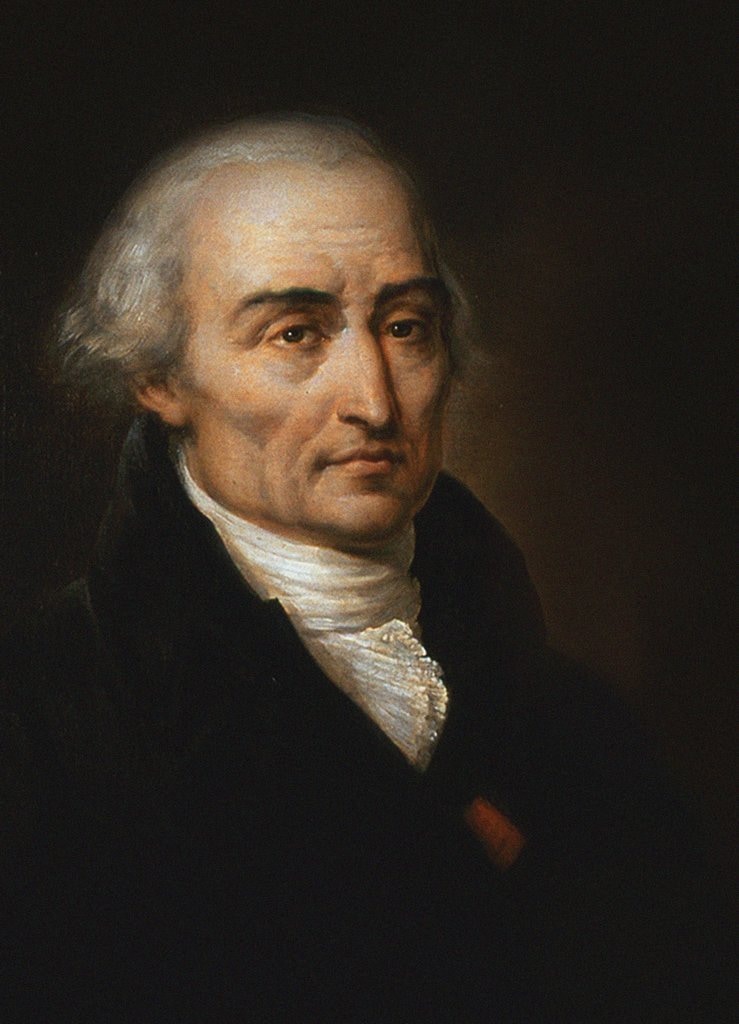
Joseph-Louis Lagrange
 Italy
Italymathematician•astronomer•physicist
Also known as: Giuseppe Luigi Lagrangia, Comte de Lagrange
Data de nascimento
January 25, 1736
Signo
Aquarius
Local de nascimento
Turin, Kingdom of Sardinia (now Italy)
Idade
Faleceu aos 77
Altura
5 ft 6 in (168 cm)
Sobre
Joseph-Louis Lagrange was an Italian-born, naturalized French mathematician, physicist, and astronomer widely considered one of the greatest mathematical minds of the 18th century. Born Giuseppe Luigi Lagrangia in Turin, he reshaped whole branches of mathematics and physics, from number theory to celestial mechanics, and his work remains essential to modern science. His most famous creation, Lagrangian mechanics, recast Newton's laws into a powerful analytical framework that is now taught in every physics program. Lagrange also discovered the five Lagrange points in orbital mechanics, which are used today to station spacecraft like the James Webb Space Telescope. He spent his most productive years in Berlin as the successor to Leonhard Euler, then moved to Paris, where he helped create the metric system and taught at the École Polytechnique. Napoleon personally awarded him the Legion of Honour. Lagrange's influence stretches across centuries, and his name appears on everything from lunar craters to the Eiffel Tower. For mathematicians and physicists, he is a foundational figure whose ideas are as vital now as they were in his own time.
Início da vida e origens
Lagrange mostrou pouco interesse em matemática quando jovem estudante no Colégio de Turim, concentrando-se em clássicos. Tudo mudou aos 17 anos, quando ele pegou uma memória de Edmond Halley sobre o uso da álgebra em óptica. Mais tarde, ele descreveu a experiência como uma epifania que definiu todo o seu caminho intelectual. Em um ano, ele já se correspondia com Leonhard Euler, enviando-lhe uma carta sobre o cálculo das variações que impressionou tanto Euler que o matemático mais velho atrasou sua própria publicação para deixar Lagrange reivindicar a prioridade. Aos 19 anos, Lagrange foi nomeado professor na Escola Real de Artilharia em Turim, um salto extraordinário para alguém que estudava matemática há apenas dois anos. Ele cofundou a Academia de Ciências de Turim em 1758 e começou a publicar artigos sobre propagação do som, cordas vibrantes e cálculo das variações. Seu pai, tesoureiro de obras públicas, perdeu a fortuna da família por meio de especulação, o que Lagrange disse mais tarde o libertou para perseguir a matemática sem distrações.
Crescimento na carreira
Em 1766, aos 30 anos, Lagrange sucedeu Euler como diretor de matemática na Academia Prussiana de Ciências em Berlim. Frederico, o Grande, o recrutou pessoalmente, declarando que o maior geômetra da Europa deveria viver perto do maior dos reis. Lagrange permaneceu em Berlim por 20 anos, produzindo mais de 100 artigos sobre mecânica celeste, teoria dos números, equações diferenciais e probabilidade. Ele ganhou cinco Grandes Prêmios da Academia Francesa de Ciências por trabalhos sobre libração lunar, satélites de Júpiter, o problema dos três corpos, teoria lunar e perturbações de cometas. Em 1788, publicou Mécanique analytique, sua obra-prima, que reformulou a mecânica newtoniana usando o cálculo das variações e não continha um único diagrama, refletindo sua crença de que a mecânica deveria ser puramente analítica. Depois de se mudar para Paris em 1787, juntou-se à Academia Francesa de Ciências, serviu na Comissão de Pesos e Medidas para estabelecer o sistema métrico e lecionou na École Normale Supérieure e na École Polytechnique. Napoleão concedeu-lhe a Legião de Honra em 1808. Lagrange morreu em Paris em 1813 e foi enterrado no Panteão.
Linha do tempo da carreira
Imagem pública e estilo
Lagrange é lembrado como o matemático iluminista por excelência, retratado em retratos como um cavalheiro digno com uma peruca empoada e casaco escuro, com uma expressão calma e contemplativa. Ele é consistentemente descrito como modesto, trabalhador e totalmente dedicado à verdade matemática. Ao contrário de alguns de seus contemporâneos, ele evitou envolvimentos políticos, o que o ajudou a sobreviver à Revolução Francesa. Entre matemáticos e físicos, ele é reverenciado como um dos maiores de todos os tempos, frequentemente classificado ao lado de Euler, Gauss e Newton. Seu nome aparece em crateras lunares, asteroides e na Torre Eiffel. Estudantes de matemática celebram informalmente o Dia de Lagrange em 25 de janeiro estudando mecânica lagrangiana. Entusiastas do espaço o conhecem através dos pontos de Lagrange, que se tornaram essenciais para o posicionamento moderno de satélites e telescópios.
Fama e fandom
Joseph-Louis Lagrange stands as a figure of immense historical stature, yet his standing in contemporary popularity metrics reflects the specific nature of his legacy. As of August 2026, the iFANN Global Fame Engine has evaluated this person, but they do not currently hold a placement in the published rankings (Global Top 1,000 or a Top-100 scope list). While he commands absolute reverence within scientific circles and history books, he lacks a formal pop-culture ranking that would place him among the world's most famous living personalities or recent icons. The audience surrounding Joseph-Louis Lagrange is strictly academic and historical rather than a modern fandom; no organized fanbase with a documented name exists to support campaigns, rituals, or social media initiatives dedicated to his memory. Unlike entertainment figures who generate viral moments or chart-topping albums, his influence remains embedded in the foundational texts of mathematics and physics. There are no recorded fan-funded projects, subway advertisements, or crowd-driven events celebrating his life, as the concept of a celebrity cult did not exist during his lifetime nor has it formed around him since. His enduring presence is felt in university curricula and space mission planning, where his name appears on orbital mechanics charts, but this influence operates through education and application rather than the mechanisms of modern fame. Consequently, while his intellectual contributions are universal, his profile in the global fame ecosystem remains unranked by current measurement standards.
Fatos interessantes e lendas
Joseph-Louis Lagrange initially found mathematics tedious until reading Halley's algebra memoir at age seventeen, an encounter that redirected his career. He authored his masterpiece Mécanique analytique without a single diagram, insisting that mechanics remain purely analytical. Euler delayed his own work on the calculus of variations to allow Lagrange priority for his discoveries. Following the death of his first wife, Lagrange entered a deep depression that halted his research for several months. Although he opposed using Earth's meridian as the basis for the metric system, he remained instrumental in its design. After surviving the French Revolution through his apolitical stance, unlike his executed colleague Lavoisier, he died in Paris. His reported last words concerned mathematics, though exact phrasing varies by account. Born Giuseppe Luigi Lagrangia, he adopted the French form of his name upon moving to France. Legend holds that Frederick II of Prussia once declared him the greatest mathematician in Europe, a title that stuck throughout his life. Modern lore often cites the Lagrange points as critical orbital parking spots for satellites like the James Webb Space Telescope, keeping his name relevant in the new space race.
Frases notáveis
“If I had been rich, I would probably not have devoted myself to mathematics.”
“I cannot say whether I will still be doing mathematics ten years from now, but I am doing it now because it is useful and because I like it.”
“Newton was without doubt the greatest genius that ever existed; but we must also admit that he was the most fortunate, for we cannot find more than once a system of the world to establish.”
“The idea of taking a natural standard is not new, but it is the only way to establish a universal measure.”
“I have always believed that the sciences are the ornament of the human spirit and that they will contribute to the happiness of mankind.”
Família e vida pessoal
Lagrange nasceu de Giuseppe Francesco Lodovico Lagrangia, tesoureiro do Escritório de Obras Públicas e Fortificações em Turim, e Teresa Grosso. Sua família tinha ascendência francesa por parte de pai. Ele foi o mais velho de onze filhos, mas o único a sobreviver até a idade adulta. Seu pai perdeu a fortuna da família por meio de especulação, o que Lagrange disse mais tarde ter sido uma bênção, pois o forçou a se dedicar à matemática. Ele não teve filhos de nenhum de seus dois casamentos. Em seus últimos anos em Paris, viveu com sua segunda esposa Adélaïde, que cuidou dele durante sua doença final.
Conexões notáveis
A carreira de Lagrange foi moldada por relações importantes. Leonhard Euler, seu antecessor em Berlim, foi um mentor inicial que generosamente atrasou seu próprio trabalho para que Lagrange pudesse reivindicar prioridade no cálculo das variações. Jean le Rond d'Alembert ajudou Lagrange a garantir a posição em Berlim e permaneceu um amigo próximo e correspondente. Em Paris, Lagrange trabalhou ao lado de Pierre-Simon Laplace em mecânica celeste e serviu com Antoine Lavoisier na comissão do sistema métrico, lamentando a execução de Lavoisier durante o Reino do Terror. Napoleão Bonaparte admirava Lagrange, concedendo-lhe a Legião de Honra e consultando-o em assuntos científicos. Na École Polytechnique, Lagrange ensinou ao lado de Gaspard Monge e influenciou Adrien-Marie Legendre.
Relacionamentos e história amorosa
Lagrange casou-se duas vezes. Seu primeiro casamento foi com sua prima Vittoria Conti em 1767 enquanto vivia em Berlim. Ela era descrita como uma parceira gentil e solidária, e o casamento era supostamente feliz. Sua morte em 1783 mergulhou Lagrange em uma depressão profunda que paralisou seu trabalho por meses. Eles não tiveram filhos. Em 1792, Lagrange casou-se com Adélaïde Le Monnier, filha do astrônomo Pierre Charles Le Monnier. Ela era cerca de 40 anos mais nova que ele. O casamento foi arranjado em parte para proporcionar companhia a Lagrange em seus últimos anos. Adélaïde cuidou dele durante sua doença final e sobreviveu a ele. Eles também não tiveram filhos. Em 2026, Lagrange está falecido, tendo sido casado com Adélaïde na época de sua morte.
- Casado(a)Vittoria Conti1767 - 1783Lagrange casou-se com sua prima Vittoria enquanto estava em Berlim; a morte dela em 1783 causou um período de depressão.
- Casado(a)Adélaïde Le Monnier1792 - 1813Casou-se em Paris; ela era cerca de 40 anos mais nova e cuidou dele até sua morte.
Morte e repercussões
Morte
April 10, 1813 (aos 77 anos)
Local da morte
Paris
Causa da morte
Reported as dropsy or general debility of old age
Upon the passing of Joseph-Louis Lagrange, tributes poured in from the French Academy of Sciences and the Institut de France, while Napoleon Bonaparte reportedly acknowledged the loss of a genius who had defined the mathematical landscape of Europe with the remark that he sleeps forever. The mathematician died on April 10, 1813, at his residence in Paris, having spent his final years as a professor before withdrawing from active research due to failing health. Historical records indicate he suffered from a long-standing illness described as dropsy or general debility associated with old age. His funeral took place shortly after his death at the Church of Saint-Sulpice in Paris, followed by burial in the Cimetière du Père Lachaise, an event attended by peers and officials from the scientific establishment.
Posthumously, his legacy has been honored through the establishment of the Lagrange Prize by the Académie des Sciences and the Lagrange Medal by the International Astronomical Union, alongside dedications such as the Lagrange crater on the Moon and the Lagrange points in celestial mechanics. He was posthumously named a Count of the Empire by Napoleon, and while his estate was handled privately by family members whose descendants faded into obscurity, his works including Mécanique Analytique continue to be published and studied globally.
Patrimônio (valor do espólio)
$1 Million
Estimativa da equipe editorial do iFANN
As a historical figure who passed away in 1813, Joseph-Louis Lagrange possessed no personal net worth in the modern sense. During his lifetime, he sustained himself on academic salaries and state pensions. At the Prussian Academy in Berlin, he earned approximately 6,000 francs annually, a comfortable sum for the era. After relocating to Paris, he received a pension from the French Academy followed by a salary from the École Polytechnique. He was not wealthy, as the family fortune had been lost by his father. His estate at death was modest, consisting mainly of personal effects and books. Lagrange's intellectual property, including his published works, is now in the public domain with no active estate generating revenue today. Per iFANN's editorial analysis, his estimated net worth of $1 Million in 2026 reflects the modest value of his historical estate adjusted for inflation, not any modern income stream.
Prêmios conquistados (6)
Lagrange venceu o Grande Prêmio da Academia Francesa de Ciências cinco vezes: em 1764 pela libração lunar, 1766 pelos satélites de Júpiter, 1772 pelo problema dos três corpos, 1774 pela teoria lunar e 1778 pelas perturbações de cometas. Em 1808, Napoleão Bonaparte concedeu-lhe a Legião de Honra, uma das mais altas distinções da França.
1778 · Perturbações de cometas
Perturbations of comets
1774 · Teoria lunar
Lunar theory
1772 · Problema dos três corpos
Three-body problem
1766 · Teoria dos satélites de Júpiter
Theory of Jupiter's satellites
1764 · Libração lunar
Lunar libration
1808 · Cavaleiro
Lifetime achievements
Conhecido por
Mécanique analytique
1788 · Autor
Lagrangian mechanics
1788 · Developer
Lagrange points
1772 · Discoverer
Calculus of variations
1754 · Pioneiro
Number theory contributions
1770 · Contribuidor
Metric system development
1790 · Commission member
Palavras-chave
Dados rápidos
- Profissão
- mathematician, astronomer, physicist
- Nascimento
- +1736-01-25
- Local de nascimento
- Turin
- Morte
- +1813-04-10
- Local da morte
- Paris
- Gênero
- Masculino
- Cônjuge
- Vittoria Conti, Adélaïde Le Monnier
- Signo
- Aquarius
Dados pessoais
- Nome completo
- Giuseppe Luigi Lagrangia
- Altura
- 5 ft 6 in (168 cm)
- Cônjuge
- Vittoria Conti (m. 1767–1783), Adélaïde Le Monnier (m. 1792–1813)
- Filhos
- Formação
- College of Turin
Perguntas frequentes
Pelo que Joseph-Louis Lagrange é famoso?
Quantos anos Lagrange tinha quando morreu?
Lagrange teve filhos?
Qual é o patrimônio de Lagrange em 2026?
O que são pontos de Lagrange?
Pessoas semelhantes
Junte-se à comunidade
fãs comentando