
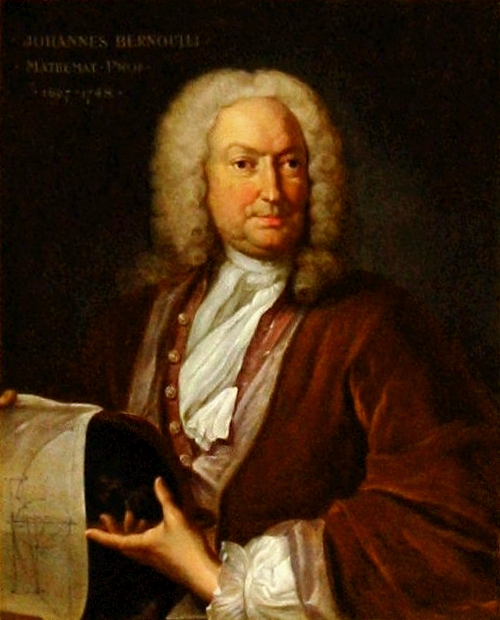
Johann Bernoulli
 Switzerland
mathematician•physicist•physician
Also known as: Jean Bernoulli, John Bernoulli
Data de nascimento
July 27, 1667
Signo
Sagittarius
Local de nascimento
Basel
Idade
Faleceu aos 80
Sobre
Johann Bernoulli foi um matemático, físico e médico suíço, nascido em 27 de julho de 1667, em Basileia. Ele pertencia à proeminente família Bernoulli, que produziu várias gerações de matemáticos. Johann é mais conhecido por seu trabalho fundamental em cálculo infinitesimal, cálculo das variações e dinâmica de fluidos. Ele formulou o problema da braquistócrona e derivou o princípio de Bernoulli, que descreve o comportamento do fluxo de fluidos. Sua correspondência com Leibniz ajudou a disseminar o cálculo pela Europa. Johann também ensinou Leonhard Euler, orientando um dos maiores matemáticos da história. Ele morreu em 1º de janeiro de 1748, aos 80 anos.
Início da vida e origens
Johann nasceu em uma próspera família de Basileia; seu pai Nicolaus era um boticário, e seu avô havia atuado no comércio de especiarias. Seu pai esperava que Johann assumisse o negócio da família, mas Johann foi atraído por atividades intelectuais. Ele se matriculou na Universidade de Basileia para estudar medicina, uma profissão respeitável que satisfazia os desejos de seu pai. Enquanto estudava medicina, Johann dedicava secretamente tempo à matemática, aprendendo o novo cálculo diretamente dos escritos de Leibniz e de seu irmão mais velho Jakob, que ocupava uma cátedra de matemática na universidade. Seus primeiros interesses incluíam a aplicação do cálculo à mecânica, óptica e curvas, como reflexão e refração da luz e trajetórias ortogonais. Esses anos formativos o viram mudar da medicina para a matemática, levando a seu primeiro trabalho matemático sério na década de 1690.
Crescimento na carreira
O avanço de Johann ocorreu na década de 1690 com seu trabalho no problema da braquistócrona, a curva de descida mais rápida sob a gravidade, que ele resolveu em 1696. Esse problema tornou-se a base do cálculo das variações. Ele continuou a aplicar o cálculo à mecânica, óptica e equações diferenciais. Em 1718, publicou um tratamento sistemático do cálculo das variações em Histoire de l'Académie Royale des Sciences, estabelecendo-o como uma disciplina coerente. Suas obras completas, Opera Johannis Bernoullii, foram publicadas em quatro volumes em 1742. Como professor, ele orientou Leonhard Euler em Basileia, influenciando profundamente o trabalho posterior de Euler. Ele também ensinou o Marquês de L'Hôpital, cujo livro sobre cálculo diferencial se baseou fortemente nas aulas de Bernoulli. Os esforços de Johann ajudaram a estabelecer o cálculo leibniziano como o padrão em toda a Europa.
Linha do tempo da carreira
Imagem pública e estilo
Johann Bernoulli é lembrado como um estudioso brilhante, mas combativo, intensamente competitivo com seu irmão Jakob. Seu trabalho publicado é técnico, expresso em latim e na notação matemática da análise moderna inicial. Relatos modernos enfatizam seu papel na disseminação do cálculo leibniziano e sua mentoria a Leonhard Euler. Não há fandom organizado; o interesse vem principalmente de matemáticos e historiadores da ciência. Comentadores contemporâneos às vezes o retratam humoristicamente, mas isso reflete sua voz, não a dele.
Fama e fandom
The Swiss mathematician Johann Bernoulli stands as a towering, albeit distant, figure in the annals of science rather than a contemporary celebrity. In August 2026, the iFANN Global Fame Engine evaluated his enduring legacy and confirmed that he currently holds no placement in the published rankings, meaning he does not appear in the Global Top 1,000 or any specific scope list. This absence from the charts reflects his status as an Enlightenment-era academic whose influence is measured in textbooks and historical texts rather than modern social metrics or fan engagement. Unlike pop icons who command organized followings with official names and ritualistic behaviors, Bernoulli has no documented fandom name. His audience consists exclusively of historians, mathematicians, and students who engage with his work through rigorous study rather than fan campaigns, birthday tributes, or digital communities. There are no fan-funded projects, subway ads, or charity drives dedicated to him, as the concept of a mass public interacting with a deceased scholar did not exist in his time. The few mentions of his birth on July 27, 1667, appearing sporadically on social media, serve merely as educational reminders rather than signs of an active cult following. While modern hobbyist writers sometimes dub him 'the drama queen of mathematics' due to his intense rivalry with his brother Jakob, this label describes a historical personality trait rather than a fan-created identity. His relationship with the public was strictly professional, limited to his role as a professor at the University of Basel and his correspondence with peers. Today, his fame remains static, preserved in the quiet reverence of academia where his contributions to calculus and fluid dynamics continue to shape scientific thought without the noise of a modern fanbase.
Fatos interessantes e lendas
Johann and his brother Jakob were among the first people to learn calculus directly from Leibniz's original writings. Before Leonhard Euler standardized notation, some mathematicians used the letter 'b' instead of 'e' for the base of the natural logarithm, reflecting Johann's early recognition of the constant's unique properties. He is often credited with discovering that e represents the limit of (1 + 1/n)^n as n approaches infinity. His son Daniel Bernoulli later solved the St. Petersburg paradox, illustrating the family's multi-generational influence on probability theory. Modern hobbyist writing has described Johann as 'the drama queen of mathematics' due to his intense rivalry with Jakob. A legendary moment occurred when Johann posed the brachistochrone problem, challenging the greatest minds in Europe to find the curve of fastest descent. Isaac Newton reportedly solved the anonymous challenge overnight, famously stating, 'I recognize the lion by his claw.' Another dark chapter involves the bitter feud between the brothers; after Jakob died, Johann allegedly stole his notes and manuscripts to claim credit for discoveries regarding the law of large numbers. These intellectual conflicts defined his life, creating a legacy of high-stakes mathematical battles rather than crowd-fueled adoration.
Família e vida pessoal
Johann nasceu de Nicolaus Bernoulli, um boticário de Basileia, e sua esposa. Seu avô havia atuado no comércio de especiarias. Ele teve vários irmãos, notavelmente seu irmão mais velho Jakob Bernoulli, um importante matemático. Johann casou-se com Dorothea Falkner, e eles tiveram três filhos. Um filho, Daniel Bernoulli, tornou-se um famoso matemático e físico, conhecido pelo princípio de Bernoulli e pelo trabalho em probabilidade e hidrodinâmica. A família Bernoulli produziu várias gerações de matemáticos, frequentemente chamados de 'dinastia Bernoulli'.
Conexões notáveis
Johann Bernoulli está intimamente associado a seu irmão Jakob Bernoulli, com quem colaborou e competiu. Ele orientou Leonhard Euler, um dos maiores matemáticos de todos os tempos. Ele também correspondeu-se com Gottfried Wilhelm Leibniz, ajudando a disseminar o cálculo. Seu filho Daniel Bernoulli deu continuidade à tradição familiar. A família Bernoulli como um todo é sinônimo da matemática moderna inicial.
Relacionamentos e história amorosa
Johann Bernoulli casou-se com Dorothea Falkner, provavelmente no final da década de 1690. Eles tiveram três filhos juntos, incluindo o renomado matemático Daniel Bernoulli. O casamento durou até a morte de Johann em 1748. Nenhum outro relacionamento romântico é documentado em fontes históricas.
- Casado(a)Dorothea Falkner1697 - 1748Casou-se em Basileia; teve três filhos, incluindo Daniel Bernoulli.
Morte e repercussões
Morte
January 1, 1748 (aos 80 anos)
Local da morte
Basel, Switzerland
Causa da morte
Natural causes
The final days of Johann Bernoulli unfolded in the quiet academic halls of Basel, where he had spent a lifetime shaping the landscape of European mathematics. On January 1, 1748, the eighty-year-old scholar passed away within the city that had hosted his birth and his career at the University of Basel. Historical records from the era do not preserve a specific medical diagnosis or an autopsy report, reflecting the standard practice for natural deaths among scholars of the eighteenth century rather than any forensic investigation. The immediate reaction came through the dense network of correspondence between mathematicians across the continent, who acknowledged the loss of a central figure in the development of calculus and the calculus of variations.
His funeral was conducted in Basel, attended by family members including his son Daniel and academic colleagues, though no detailed public ceremony was recorded in surviving accounts. Posthumously, his legacy solidified through the publication of his collected works, Opera Johannis Bernoullii, which appeared in four volumes shortly after his death. Tributes manifested as the continued teaching of his methods to students like Leonhard Euler and the enduring application of principles named in his honor. His estate passed to his descendants, notably his son Johann II, who also pursued a distinguished career in mathematics. The mathematical community mourned the passing of a man whose rivalry with Leibniz and mentorship of future giants helped define the scientific age.
Patrimônio (valor do espólio)
Johann Bernoulli morreu em 1748, muito antes das estimativas modernas de patrimônio líquido. Sua renda provinha de posições acadêmicas e patrocínio típicos de estudiosos do século XVIII. Não existem registros financeiros confiáveis para estimar sua riqueza. Seu legado intelectual, no entanto, é incomensurável.
Prêmios e condecorações
View 2 records, honours and achievementsConhecido por
Brachistochrone problem
1696 · Solved
Calculus of variations
1718 · Systematized
Bernoulli's principle
1738 · Derived (via son Daniel)
Palavras-chave
Fontes
Dados rápidos
- Profissão
- mathematician, physicist, physician
- Nascimento
- +1667-07-27
- Local de nascimento
- Basel
- Morte
- +1748-01-01
- Local da morte
- Basel
- Gênero
- Masculino
- Cônjuge
- Dorothea Falkner
- Signo
- Sagittarius
Dados pessoais
- Nome completo
- Johann Bernoulli
- Cônjuge
- Dorothea Falkner
- Filhos
- Three sons, including Daniel Bernoulli
- Formação
- University of Basel (medicine, self-taught in mathematics)
Perguntas frequentes
Quem foi Johann Bernoulli?
Pelo que Johann Bernoulli é famoso?
Johann Bernoulli ganhou algum prêmio?
Johann Bernoulli era parente de Jacob Bernoulli?
Quando Johann Bernoulli morreu?
Pessoas semelhantes
Junte-se à comunidade
fãs comentando