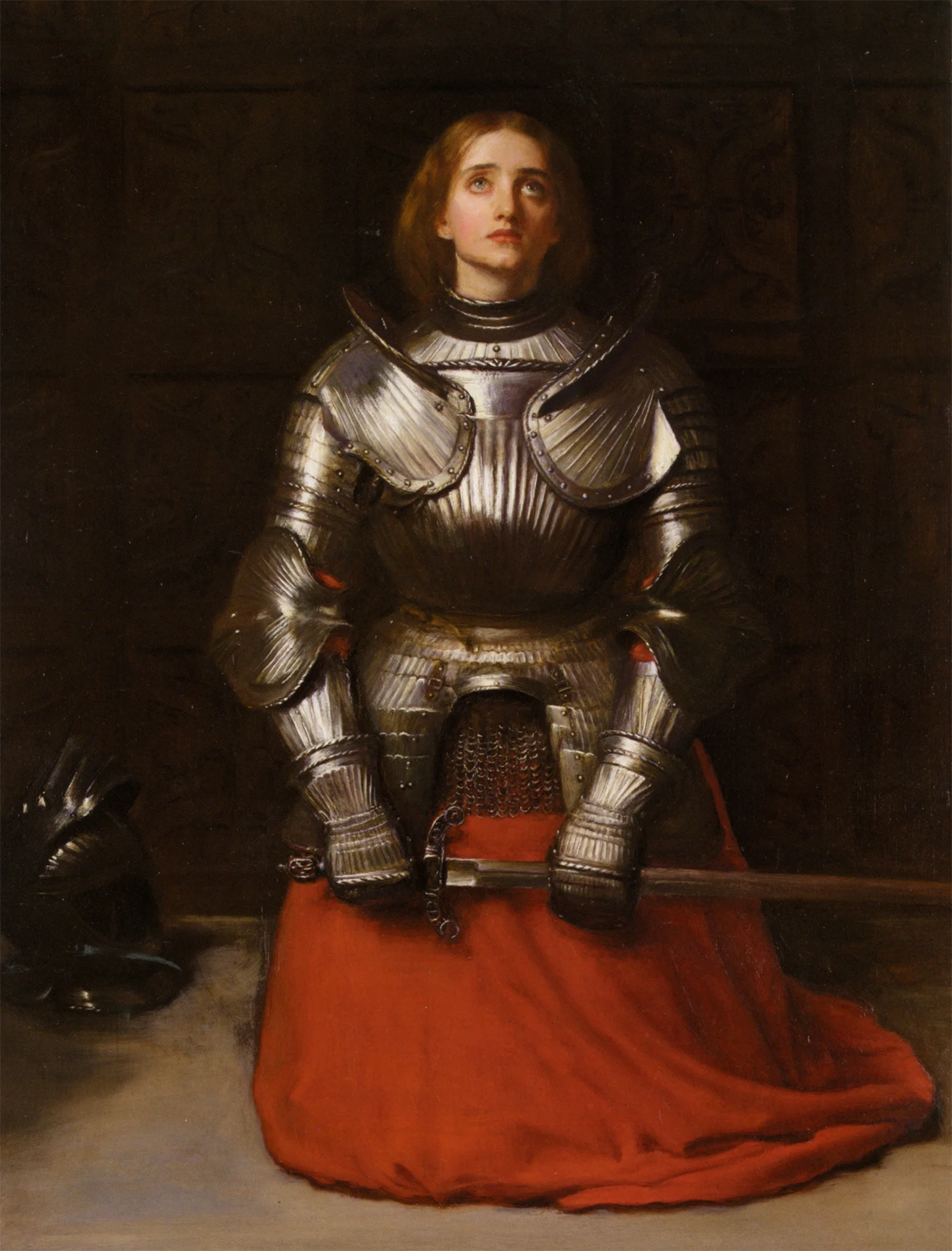
Joan of Arc
 France
military personnel•religious leader
Also known as: The Maid of Orléans, Jeanne d'Arc, Saint Joan of Arc
Data de nascimento
January 6, 1412
Signo
Capricorn
Local de nascimento
Domrémy-la-Pucelle
Idade
Faleceu aos 19
Altura
5 ft 0 in (152 cm)
Sobre
Joan of Arc was a national heroine of France and a canonized Catholic saint, remembered as the teenage peasant girl who helped turn the tide of the Hundred Years' War. Born around 1412 in the village of Domrémy, she claimed to receive visions from saints and the archangel Michael instructing her to drive the English from France and see the disinherited Charles VII crowned king. That conviction, extraordinary in a young woman of no rank, propelled her from rural obscurity to the center of a nation's struggle.
Her legend rests on a stunning few years of action. Granted an audience with Charles and given a role in the army, she helped lift the siege of Orléans and inspired a demoralized French force to a string of victories that opened the road to Reims, where Charles was crowned. Captured by Burgundian forces and handed to the English, she was tried by a church court and burned at the stake in 1431, not yet twenty years old. Decades later her conviction was overturned, and centuries after that she was declared a saint.
Joan endures as one of history's most compelling figures, a symbol of faith, courage, and patriotism whose story has inspired countless retellings in books, films, and art. Her feast day is May 30, and she is the patron saint of soldiers, prisoners, and France.
Início da vida e origens
Joana cresceu em Domrémy, uma pequena vila na região de Lorraine, nordeste da França, durante a Guerra dos Cem Anos. Seus pais, Jacques d'Arc e Isabelle Romée, eram agricultores arrendatários que criavam gado e cultivavam lavouras. A vila ficava no Ducado de Bar, cujo povo permaneceu leal à facção Armagnac, apesar de estar cercado por territórios pró-borgonheses. Em 1425, Domrémy foi atacada e o gado roubado, endurecendo o sentimento local contra os ingleses e seus aliados borgonheses.
Joana nunca aprendeu a ler ou escrever. Sua mãe a ensinou habilidades domésticas como costura e fiação, e ela ajudava o pai nos campos e cuidava dos animais. A família frequentava a igreja regularmente e Joana recebeu uma forte educação religiosa. Por volta dos 13 anos, ela começou a ter visões e a ouvir vozes que acreditava serem divinas. Ela relatou ter visto São Miguel Arcanjo, Santa Catarina e Santa Margarida, que inicialmente a instruíram a ser boa e ir à igreja. Com o tempo, as vozes se tornaram mais urgentes, dizendo a ela que tinha uma grande missão: expulsar os ingleses da França e ver o Delfim Carlos coroado rei em Reims.
Aos 16 anos, Joana decidiu agir. Ela se aproximou do comandante local em Vaucouleurs, Robert de Baudricourt, solicitando uma escolta para levá-la à Corte Real. Ele a dispensou duas vezes, mas ela persistiu e eventualmente obteve uma audiência com o Delfim em Chinon no início de 1429.
Crescimento na carreira
Joana chegou a Chinon em fevereiro de 1429 e convenceu Carlos VII a permitir que ela se juntasse ao esforço de guerra. Teólogos em Poitiers a examinaram e não encontraram mal, então ela recebeu armadura, um estandarte com a flor-de-lis e os nomes Jesus e Maria, e um cavalo branco. Sua primeira grande ação ocorreu no Cerco de Orléans em abril-maio de 1429. Liderando tropas francesas desmoralizadas, ela as inspirou a levantar o cerco em nove dias, um ponto de virada na guerra. A vitória lhe rendeu o apelido de A Donzela de Orléans.
Após Orléans, Joana liderou a campanha do Vale do Loire, capturando Jargeau e vencendo a Batalha de Patay em junho de 1429. Essas vitórias abriram o caminho para Reims, onde Carlos VII foi coroado rei em 17 de julho de 1429, com Joana ao seu lado segurando seu estandarte. Em maio de 1430, durante um confronto em Compiègne, ela foi derrubada de seu cavalo e capturada por forças borgonhesas, que a venderam aos ingleses. Ela foi julgada por heresia por um tribunal eclesiástico em Rouen a partir de 9 de janeiro de 1431. Condenada por usar roupas masculinas e agir com base em visões demoníacas, ela foi queimada na fogueira em 30 de maio de 1431, aos 19 anos. Um julgamento de nulidade em 1456 anulou a condenação, e ela foi canonizada em 1920.
Linha do tempo da carreira
Imagem pública e estilo
Joana é tipicamente retratada em armadura com um estandarte branco ostentando a flor-de-lis, muitas vezes com cabelo curto e vestindo roupas masculinas. Ela é retratada como um símbolo de coragem, fé, patriotismo e convicção divina. Sua imagem foi interpretada em centenas de filmes, peças, livros e obras de arte, variando de mártir religiosa a ícone feminista a heroína militar. Católicos a veneram como santa, enquanto nacionalistas franceses a celebram como heroína. Celebrações anuais em seu dia de festa, 30 de maio, incluem peregrinações a Domrémy e Rouen, encenações históricas e conferências acadêmicas. Relatos educacionais focam na precisão histórica, enquanto relatos católicos enfatizam seu significado espiritual.
Fama e fandom
Joan of Arc commands a devotion that transcends the modern definition of fandom. There is no organized group calling themselves by a specific name, nor are there fan-funded subway ads or birthday billboards for the 15th-century peasant girl turned military leader. Instead, her following consists of devotees, historians, and cultural admirers who interact with her legacy through religious veneration and academic study. Her story serves as a narrative of resilience against occupation and injustice, inspiring individuals facing oppression to seek moral courage. Communities gather today not to stream a new single, but to reflect on themes of saintly patriotism and divine guidance in theatrical productions and theological discussions. This enduring reverence functions as a form of worship rather than celebrity worship, cementing her status as a symbol of freedom and independence across centuries. The iFANN Global Fame Rankings track this unique blend of historical weight and cultural consumption worldwide. Joan of Arc is currently the 368th most famous person in the world, holding steady from the previous cycle. She ranks as the 20th most famous person in France and stands as the 15th most famous person from France. In Europe, she holds the position of the 92nd most famous person in Europe. Within the pop culture sphere, she is recognized as the 72nd most famous person in Pop.
Fatos interessantes e lendas
Joan dictated her letters to scribes because she could not write herself. Her trial transcript remains one of the most complete medieval documents, preserving extensive eyewitness accounts of her proceedings. She wore men's clothing, a choice that became a central charge during her trial. The French royal family paid a ransom of 10,000 livres after her capture, yet the English refused to release her. Her birthplace, Domrémy, was renamed Domrémy-la-Pucelle in her honor. She correctly predicted the outcome of a military engagement at Orléans, which convinced Charles VII of her divine mission. A sword she claimed was guided by voices was discovered behind the altar of the church of Sainte-Catherine-de-Fierbois. Legends still retell how her presence lifted the siege of Orléans, turning the tide of the Hundred Years' War despite her lack of military training. The story of her martyrdom, where she refused to recant her visions even under threat of death, defines her tragic arc. A posthumous retrial in 1456 declared her innocent, leading to her canonization as a saint in 1920.
Frases notáveis
“I am not afraid; I was born to do this.”
“If I am not, may God put me there; and if I am, may God keep me there.”
“Hold the standard in the battle, and it will touch the king's person. The standard belongs to the king. And for love of the standard, do not let it fall.”
“God has pity on the French. He wishes them to be free.”
“I would rather die than do something which I know to be a sin, or to be against God's will.”
Família e vida pessoal
Joana nasceu de Jacques d'Arc, um agricultor e funcionário da vila, e Isabelle Romée, que lhe proporcionou educação religiosa. Ela tinha três irmãos mais velhos, Jean, Pierre e Jacques, e uma irmã mais velha chamada Catherine. A família morava em uma casa modesta em Domrémy e era profundamente cristã. Joana nunca se casou e não teve filhos. Ela fez um voto de castidade como parte de sua missão divina. Após sua morte, sua mãe e irmãos estiveram envolvidos na petição para o julgamento de nulidade.
Conexões notáveis
A história de Joana está profundamente ligada a Carlos VII, o Delfim que ela ajudou a coroar. Ela foi oposta pelo Bispo Pierre Cauchon, que presidiu seu julgamento. Robert de Baudricourt, o comandante local em Vaucouleurs, inicialmente rejeitou e depois aprovou sua missão. O Duque da Borgonha, Filipe o Bom, cujas forças a capturaram, e o Rei Henrique VI da Inglaterra, cuja reivindicação ela se opôs, foram adversários chave. Ela relatou visões de São Miguel, Santa Catarina e Santa Margarida.
Relacionamentos e história amorosa
Joana d'Arc nunca se casou e não teve relacionamentos românticos conhecidos. Registros históricos indicam que, por volta dos 16 anos, sua família arranjou um possível casamento, mas Joana recusou e contestou com sucesso o noivado em tribunal eclesiástico. Ela fez um voto de castidade como parte de sua missão divina. Não há registros históricos credíveis de quaisquer relacionamentos românticos ou sexuais. Como santa canonizada e figura histórica, ela não possui um status de relacionamento atual.
Morte e repercussões
Morte
May 30, 1431 (aos 19 anos)
Local da morte
Rouen, Normandy
Causa da morte
Execution by burning at the stake
Immediate mourning was absent in the streets of Rouen, where many viewed her as a traitor or witch rather than a martyr. The public spectacle concluded with her body consumed by flames, leaving only ashes that were cast into the Seine River to prevent veneration as relics. On May 30, 1431, she stood bound to a post in the Old Market Square following a mass at the church of Saint-Sauveur, reciting the name of Jesus as the fire took hold. While some later accounts suggested she may have been strangled before the flames fully consumed her, this remains an unconfirmed detail within the trial transcripts. The legal aftermath transformed her legacy through the Nullification Trial initiated in 1455 by Pope Callixtus III at the request of her mother, Isabelle Romée.
This inquiry annulled the original verdict of heresy seven years after her death, declaring the proceedings procedurally flawed and politically motivated. Her family focused their efforts on justice and the restoration of her honor, which the papal ruling ultimately secured. Centuries later, the Catholic Church canonized her as a saint on May 16, 1920, establishing her feast day on May 30. Modern tributes include annual vigils, memorial murals, and artistic works like the 1928 silent film The Passion of Joan of Arc, cementing her status as a co-patroness of France.
Patrimônio (valor do espólio)
$0
Estimativa da equipe editorial do iFANN
Joan of Arc died in 1431 with no personal wealth. Per iFANN's editorial analysis, her net worth is estimated at $0. As a historical and religious figure, she has no living net worth. The Catholic Church manages her legacy through the veneration of saints. No monetary value is assigned to her historical legacy.
Prêmios conquistados (1)
Joana d'Arc não recebeu honrarias formais durante sua vida. Postumamente, ela foi canonizada como santa pela Igreja Católica em 1920 e é reconhecida como heroína nacional da França.
1920 · Santidade
Life and martyrdom
Conhecido por
Siege of Orléans
1429 · Líder militar
Coronation of Charles VII
1429 · Inspirational figure
Hundred Years' War
1429-1430 · Comandante militar
Palavras-chave
Fontes
Dados rápidos
- Profissão
- military personnel, religious leader
- Nascimento
- January 6, 1412
- Local de nascimento
- Domrémy-la-Pucelle
- Morte
- May 30, 1431
- Local da morte
- Rouen
- Gênero
- Feminino
Dados pessoais
- Nome completo
- Jehanne d'Arc
- Altura
- 5 ft 0 in (152 cm)
- Formação
- No formal education; could not read or write
Perguntas frequentes
Joana d'Arc foi realmente queimada na fogueira?
Joana d'Arc realmente ouviu vozes?
Quantos anos tinha Joana d'Arc quando morreu?
Por que Joana d'Arc foi morta?
Joana d'Arc teve filhos?
Pessoas semelhantes
Junte-se à comunidade
fãs comentando