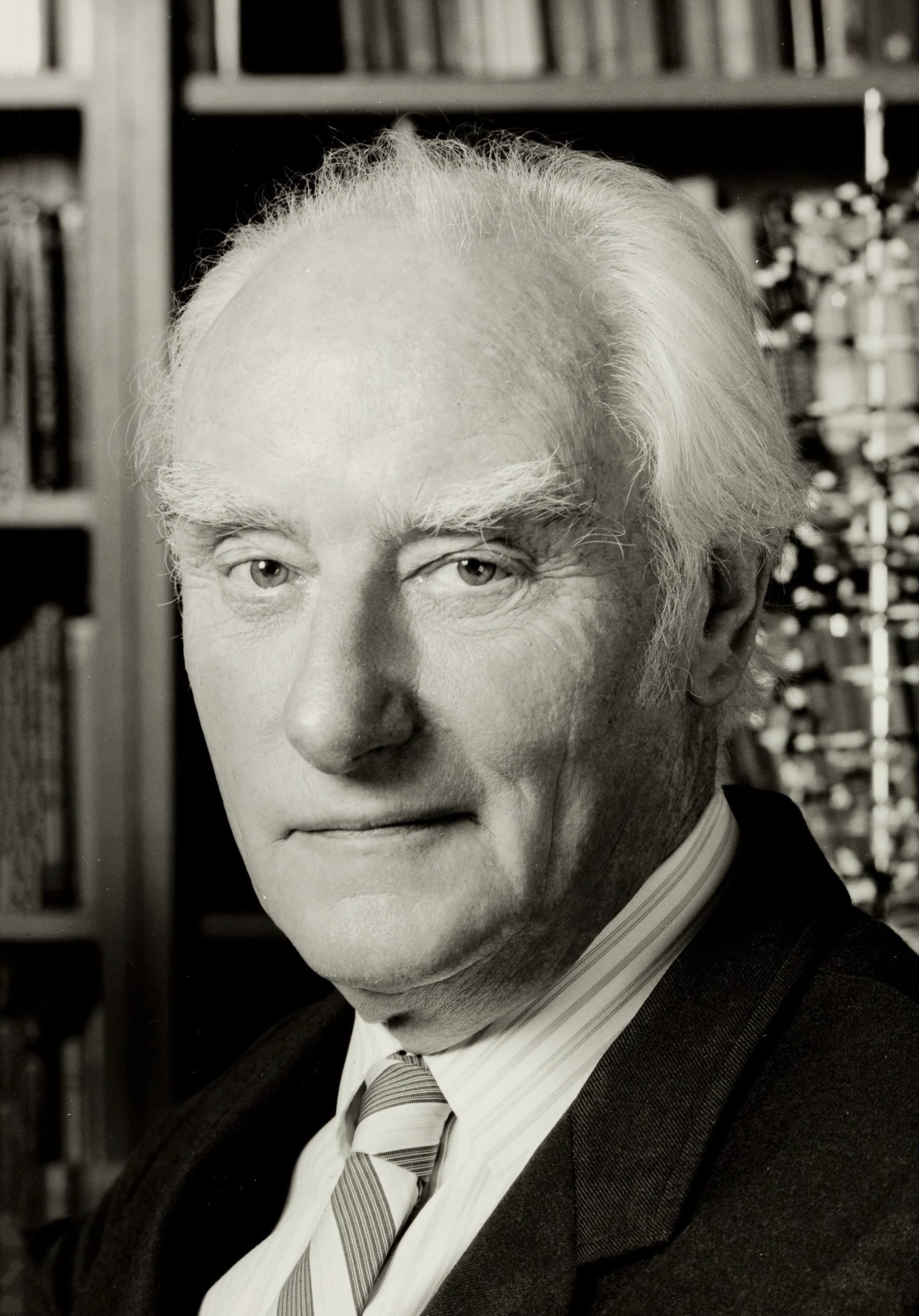
Francis Crick
 United Kingdom
molecular biologist•biophysicist•neuroscientist
Data de nascimento
June 8, 1916
Signo
Gemini
Local de nascimento
Northampton, England
Idade
Faleceu aos 88
Altura
6 ft (183 cm)
Sobre
Francis Harry Compton Crick foi um biólogo molecular, biofísico e neurocientista inglês, mais conhecido por codescobrir a estrutura de dupla hélice do DNA ao lado de James Watson em 1953. Esse avanço, baseado em dados de difração de raios X de Rosalind Franklin e Maurice Wilkins, rendeu a Crick, Watson e Wilkins o Prêmio Nobel de Fisiologia ou Medicina de 1962 e remodelou fundamentalmente a biologia. Crick também é lembrado por cunhar o termo dogma central para descrever o fluxo unidirecional da informação genética do DNA para o RNA e para as proteínas.
Após seu trabalho com o DNA, Crick voltou seu foco para a neurociência. Em 1976, mudou-se para o Instituto Salk de Estudos Biológicos em La Jolla, Califórnia, onde passou o resto de sua carreira explorando os correlatos neurais da consciência. Ele escreveu A Hipótese Surpreendente (1994), argumentando que a consciência surge inteiramente de processos físicos cerebrais. Crick permaneceu ativo em pesquisa até sua morte por câncer de cólon em 2004, editando um manuscrito em seu leito de morte. Seu legado vai além do laboratório: o Instituto Francis Crick em Londres, um centro de pesquisa biomédica de £700 milhões, inaugurado em 2016, dá continuidade à sua tradição de ciência ousada e interdisciplinar.
Início da vida e origens
Crick cresceu em Northampton, Inglaterra, onde seu pai administrava uma fábrica de sapatos. Quando criança, devorava a Enciclopédia Infantil, especialmente as seções de ciência e química, e realizava experimentos caseiros, incluindo uma tentativa fracassada de fazer seda artificial. Frequentou a Escola Primária de Northampton e, aos 14 anos, ganhou uma bolsa de estudos para a Mill Hill School em Londres, onde estudou genética mendeliana por conta própria, pois não era ensinada. Crick obteve um diploma de bacharelado com honras de segunda classe em física pela University College London em 1937 e começou a pesquisa de pós-graduação sobre viscosidade da água em altas temperaturas, um problema que mais tarde chamou de o mais chato imaginável. Seu doutorado foi interrompido quando uma bomba destruiu seu equipamento durante a Batalha da Grã-Bretanha. Durante a Segunda Guerra Mundial, trabalhou para o Almirantado Britânico projetando minas acústicas e magnéticas. Após a guerra, determinado a deixar o trabalho com armas, entrou na biologia, dizendo: O que realmente interessa é sobre o que você fofoca. Em 1947, juntou-se ao Laboratório de Pesquisa Strangeways em Cambridge, estudando os efeitos do magnetismo em células de pintinhos, e em 1949 mudou-se para a Unidade do Conselho de Pesquisa Médica no Laboratório Cavendish sob a orientação de Max Perutz para trabalhar em cristalografia de raios X de proteínas.
Crescimento na carreira
O momento crucial de Crick veio em 1951, quando conheceu James Watson no Laboratório Cavendish. Compartilhando um interesse intenso pela base molecular da hereditariedade, eles usaram as imagens de difração de raios X de Rosalind Franklin e os dados de Maurice Wilkins para construir um modelo do DNA. Em 28 de fevereiro de 1953, deduziram a estrutura de dupla hélice; seu artigo apareceu na Nature em 25 de abril de 1953. Por essa descoberta, Crick, Watson e Wilkins dividiram o Prêmio Nobel de Fisiologia ou Medicina de 1962. Crick obteve seu PhD em Cambridge em 1954 com uma tese sobre difração de raios X por hélices. Em 1961, com Sydney Brenner, demonstrou que o código genético é lido em tripletos. Ele também formulou o dogma central da biologia molecular. Em 1976, Crick mudou-se para o Instituto Salk em La Jolla, onde se voltou para a neurobiologia teórica e a pesquisa da consciência, coautorando A Hipótese Surpreendente (1994) com Christof Koch. Permaneceu no Salk até sua morte, editando um manuscrito em seu leito de morte.
Linha do tempo da carreira
Imagem pública e estilo
Crick é amplamente retratado como um cientista brilhante, intenso e às vezes arrogante, singularmente focado em resolver os maiores problemas da biologia. Ele abordava a ciência com pensamento afiado, analítico e frequentemente provocador. Na cultura popular, é uma figura central na história do DNA, presente em livros, documentários e filmes. A comunidade científica o reverencia, e o Instituto Francis Crick leva seu nome. Não há um fandom oficial, mas seu trabalho é celebrado na educação científica e em eventos como o Dia do DNA. Sua presença nas redes sociais é póstuma, gerenciada pelas contas do Instituto Crick.
Fama e fandom (iFAMOUS Rankings)
Francis Crick never had a fandom in the pop-culture sense, no fan club, no hashtag campaigns, no formal name for the enthusiasts who revere him. Instead, his most devoted followers are the thousands of scientists who work in his shadow, and the institution that bears his name, the Francis Crick Institute in London, serves as a living monument to his legacy. A niche but passionate community of science historians and biographers has recently rallied around his story, sparked by Matthew Cobb's 2025 biography, which drew reviews in The Economist, The New York Times, and Science, the closest thing to fan-driven media attention Crick has ever received.
As of August 2026, iFANN's Global Fame Engine has evaluated Francis Crick but he does not currently hold a placement in the published rankings, neither in the Global Top 1,000 nor in any Top-100 scope list. His fame, though immense within the scientific community, does not translate to the mass cultural metrics that drive modern celebrity rankings. His iconic moments, the 1953 double-helix model, the 1962 Nobel Prize, are documented history, not folklore, and his legend is being actively rewritten by scholars correcting the myth that he and Watson stole Rosalind Franklin's data. Crick's true fanbase is the global scientific research community, and his legacy continues to grow through the work of the institute that carries his name.
Fatos interessantes e lendas
Crick once said he was born again when he switched from physics to biology at age 31. He was an outspoken atheist and humanist. In the 1960s he privately speculated about directed panspermia, the idea that life on Earth might have been deliberately seeded by an advanced alien civilization. He collaborated with neuroscientist Christof Koch for over a decade on the neural correlates of consciousness. Crick's PhD was awarded in 1954, after his Nobel Prize-winning discovery. He was appointed to the Order of Merit in 1991, a British honour limited to 24 living members.
One of the most enduring legends of Crick's career is the moment he and James Watson announced their discovery of the double helix in the Eagle pub in Cambridge, with Crick declaring they had found 'the secret of life', a story still retold by scientists and historians. Another iconic moment is his later shift to neuroscience in the 1970s, a move that puzzled some colleagues but is now seen as visionary. Recent scholarship has also revisited the long-held accusation that Crick and Watson stole Rosalind Franklin's data, with a 2025 Nautilus article arguing the 'theft' narrative is a distortion of what actually happened, a piece of cultural mythology that continues to evolve.
Frases notáveis
“You, your joys and your sorrows, your memories and your ambitions, your sense of personal identity and free will, are in fact no more than the behavior of a vast assembly of nerve cells and their associated molecules.”
“What you are really interested in is what you gossip about.”
“The difference between my lecture and your book is that my lecture had a lot more intellectual content and nothing like so much gossip.”
“We have discovered the secret of life.”
Família e vida pessoal
Crick casou-se duas vezes. Sua primeira esposa foi Ruth Doreen Dodd; eles se casaram em 1940 e se divorciaram em 1947. Tiveram um filho, Michael Francis Compton Crick, nascido em 1940. Em 1949, Crick casou-se com Odile Speed, uma estudante de arte que conheceu enquanto trabalhava no Laboratório Strangeways. Tiveram duas filhas, Gabrielle e Jacqueline. Odile foi uma parceira solidária ao longo de sua carreira, e permaneceram juntos até a morte de Crick em 2004. A família morou em Cambridge e depois em La Jolla, Califórnia. O pai de Crick, Harry, administrava uma fábrica de sapatos; sua mãe, Annie Elizabeth Wilkins, era ex-professora primária.
Conexões notáveis
James Watson foi o principal colaborador de Crick na estrutura do DNA. Maurice Wilkins dividiu o Prêmio Nobel com eles. Os dados de raios X de Rosalind Franklin (Foto 51) foram essenciais para a descoberta. Sydney Brenner trabalhou com Crick no código de tripletos. Christof Koch colaborou com Crick na pesquisa da consciência. Max Perutz chefiava a Unidade do MRC no Cavendish, onde Crick trabalhava.
Relacionamentos e história amorosa
Crick casou-se com sua primeira esposa, Ruth Doreen Dodd, em 1940. Eles tiveram um filho, Michael, antes de se divorciarem em 1947. Em 1949, casou-se com Odile Speed, uma estudante de arte. Eles tiveram duas filhas, Gabrielle e Jacqueline, e permaneceram juntos até a morte de Crick em 2004. Odile foi um apoio constante ao longo de sua carreira. Em 2026, Francis Crick é falecido; ele era casado com Odile Crick na época de sua morte.
- Casado(a)Ruth Doreen Dodd1940 - 1947Primeira esposa. Eles tiveram um filho, Michael. Divorciaram-se em 1947.
- Casado(a)Odile Speed1949 - 2004AtualSegunda esposa. Eles tiveram duas filhas, Gabrielle e Jacqueline. Permaneceu casada até a morte de Crick.
Morte e repercussões
Morte
July 28, 2004 (aos 88 anos)
Local da morte
La Jolla, California, USA
Causa da morte
Colorectal cancer
Francis Crick spent his final days working at the Salk Institute for Biological Studies in La Jolla, California. He died on July 28, 2004, at the age of 88 after a long illness with colorectal cancer that had complicated his health in his later years. The scientific community responded with immediate tributes from the Nobel Prize organization and the Royal Society, while peers like James Watson mourned the loss of a thinker who uniquely bridged physics, chemistry, and biology. Major publications including Nature and The New York Times published retrospectives celebrating his shift from genetics to neuroscience and his work on consciousness. No public funeral service or burial location was ever confirmed, as Crick maintained a private personal life throughout his career. Posthumous recognition included the establishment of the Francis Crick Institute in London in 2015 and the publication of Matthew Cobb's biography Cric: A Mind in Motion in November 2025. Academic journals revisited his contributions with special issues examining his later work on the conscious brain.
Patrimônio (valor do espólio)
$5–10 Million
Estimativa da equipe editorial do iFANN
iFANN currently estimates Francis Crick's estate at $5–10 million as of 2026. His personal wealth at death was modest for a Nobel laureate, under $10 million. The estate's primary value comes from book royalties, licensing of his image and name, and ongoing sales of his scientific publications. The Francis Crick Institute, a £700 million research centre named after him, is not owned by the estate. Annual revenue from intellectual property is in the low six figures. The estate is managed by his family, including his son Michael. Since Crick's death in 2004, the estate has seen steady but modest income, with occasional boosts from new biographies or media projects.
Prêmios conquistados (5)
Crick ganhou o Prêmio Nobel de Fisiologia ou Medicina em 1962 pela estrutura do DNA. Ele também recebeu a Medalha Copley da Royal Society (1975), o Prêmio Albert Lasker (1960), o Prêmio Charles Leopold Mayer (1961) e o Prêmio Internacional Gairdner (1962).
1962 · Fisiologia ou Medicina
Discovery of the molecular structure of DNA
1975 · Ciência
Elucidation of the structure and function of DNA
Conhecido por
Discovery of DNA double helix
1953 · Codescobridor
Central dogma of molecular biology
1958 · Originator
Triplet nature of genetic code
1961 · Codescobridor
The Astonishing Hypothesis
1994 · Autor
Palavras-chave
Fontes
Dados rápidos
- Profissão
- molecular biologist, biophysicist, neuroscientist
- Nascimento
- June 8, 1916
- Local de nascimento
- Northampton, England
- Morte
- July 28, 2004
- Local da morte
- San Diego, Califórnia, EUA
- Gênero
- Masculino
- Cônjuge
- Odile Crick
- Signo
- Gemini
Dados pessoais
- Nome completo
- Francis Harry Compton Crick
- Altura
- 6 ft (183 cm)
- Cônjuge
- Odile Crick
- Filhos
- Michael Francis Compton Crick, Gabrielle Crick, Jacqueline Crick
- Formação
- University College London (BSc in Physics, 1937); Cambridge University (PhD, 1954)
Perguntas frequentes
Francis Crick era casado?
Qual era o patrimônio de Francis Crick?
Quantos anos Francis Crick tinha quando morreu?
Francis Crick teve filhos?
Francis Crick ainda está vivo?
Pessoas semelhantes
Junte-se à comunidade
fãs comentando