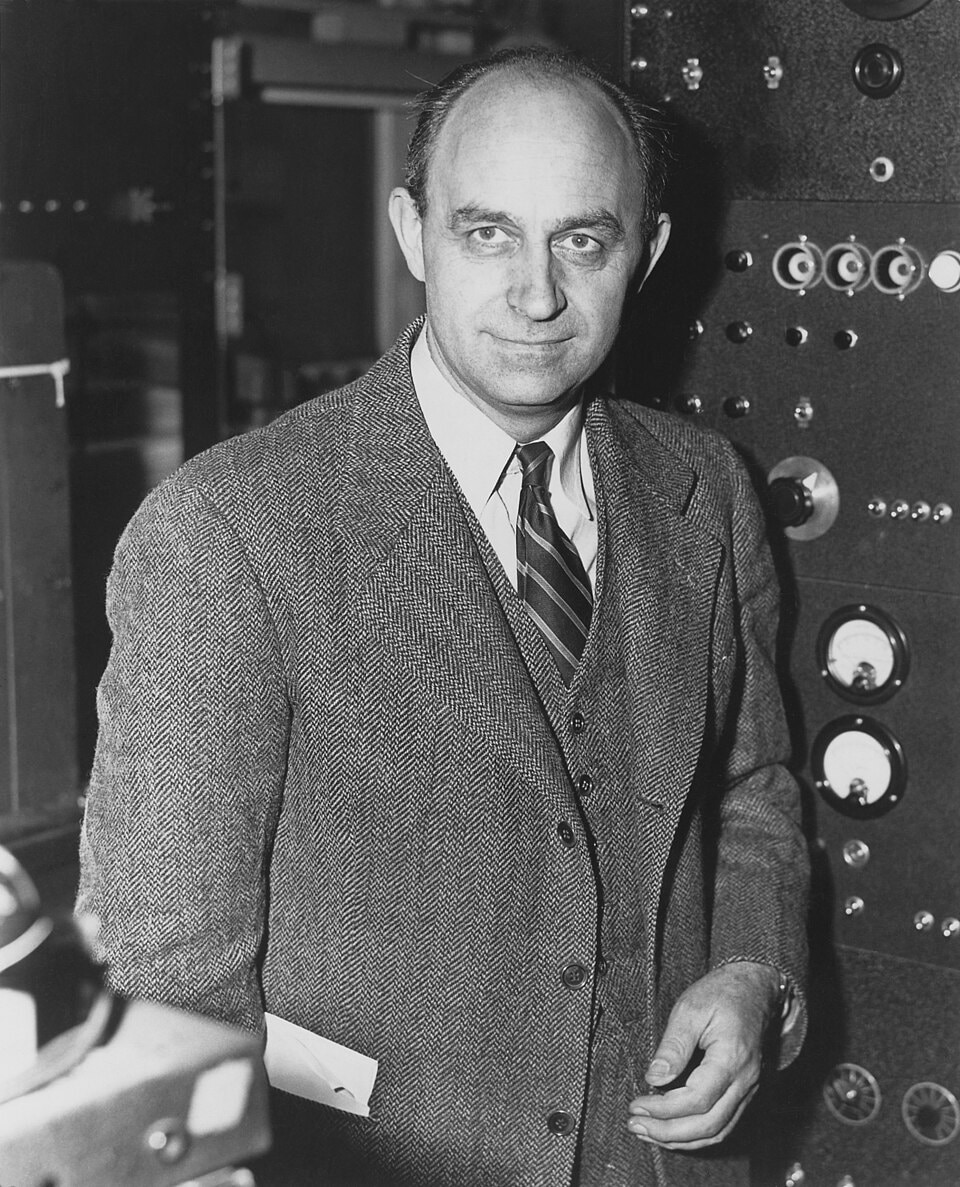
Enrico Fermi
 Italy
Italyphysicist•theoretical physicist•nuclear physicist
Data de nascimento
September 29, 1901
Signo
Libra
Local de nascimento
Rome, Italy
Idade
Faleceu aos 53
Altura
5 ft 9 in (1.75 m)
Sobre
Enrico Fermi was an Italian-American physicist widely regarded as one of the most brilliant scientists of the 20th century. He is best known for building the world's first artificial nuclear reactor, Chicago Pile-1, and for his pivotal role in the Manhattan Project. Fermi won the 1938 Nobel Prize in Physics for his demonstrations of new radioactive elements produced by neutron irradiation and for discovering nuclear reactions caused by slow neutrons. His work laid the foundation for the nuclear age, and he is celebrated for his rare mastery of both theoretical and experimental physics.
Fermi's contributions span multiple fields. He formulated the Fermi-Dirac statistics, which describe particles called fermions, and developed a theory of beta decay that postulated the existence of the neutrino. His discovery that slow neutrons are more effective in nuclear reactions revolutionized nuclear physics. After emigrating to the United States in 1938, he joined the Manhattan Project, where he led the team that achieved the first self-sustaining nuclear chain reaction on December 2, 1942. Today, his legacy is honored through the Fermi National Accelerator Laboratory, the Enrico Fermi Award, and the Fermi Paradox, which stems from a casual question he posed about extraterrestrial life.
Início da vida e origens
Fermi nasceu em Roma, filho de Alberto Fermi, inspetor-chefe do Ministério das Comunicações, e Ida de Gattis, professora primária. Sua infância foi marcada por tragédia quando seu irmão mais velho, Giulio, morreu repentinamente de um abscesso na garganta em 1915. A perda o levou ainda mais aos estudos. Ele descobriu uma paixão pela física e matemática lendo livros antigos de uma banca de mercado no Campo de' Fiori, aprendendo conceitos complexos sozinho. Aos 14 anos, já projetava pequenos motores elétricos e estudava tratados de mecânica analítica.
Fermi encontrou um espírito afim em seu amigo Enrico Persico, com quem passava horas discutindo problemas de física. Depois de se destacar nos estudos, ganhou uma bolsa para a prestigiosa Scuola Normale Superiore de Pisa. Obteve seu diploma de graduação em 1922 e um doutorado em física em 1923 pela Universidade de Pisa. Sua tese de doutorado sobre o espalhamento de raios X já demonstrava seu brilhantismo precoce. Um momento crucial ocorreu quando ele conseguiu um cargo de professor de física matemática na Universidade de Florença em 1924. Então, em 1926, desenvolveu as leis estatísticas que governam partículas que obedecem ao princípio de exclusão de Pauli, hoje conhecidas como estatística de Fermi-Dirac, o que imediatamente o estabeleceu como um físico teórico de ponta. No mesmo ano, tornou-se professor titular de física teórica na Universidade de Roma La Sapienza, posição criada especificamente para ele.
Crescimento na carreira
A carreira de Fermi é uma série de descobertas fundamentais. Em 1933-34, ele propôs uma teoria do decaimento beta postulando a existência do neutrino e formulou a interação de Fermi, descrevendo a força nuclear fraca. Em 1934, descobriu que bombardear elementos com nêutrons lentos é muito mais eficaz do que usar nêutrons rápidos, levando à descoberta da radioatividade induzida por nêutrons. Esse trabalho lhe rendeu o Prêmio Nobel de Física em 1938. Ele usou o dinheiro do prêmio para fugir da Itália fascista e se mudar para os Estados Unidos.
Em 1942, na Universidade de Chicago, Fermi liderou a equipe que projetou e construiu o Chicago Pile-1, o primeiro reator nuclear artificial do mundo. Em 2 de dezembro de 1942, ele alcançou a primeira reação nuclear em cadeia autossustentável. No Laboratório de Los Alamos, chefiou a Divisão F, trabalhando nos aspectos teóricos da bomba termonuclear. Esteve presente no teste Trinity em 16 de julho de 1945, onde famosamente estimou o rendimento da bomba soltando pedaços de papel durante a onda de choque. Após a guerra, tornou-se professor no Instituto de Estudos Nucleares da Universidade de Chicago e serviu no Comitê Consultivo Geral da Comissão de Energia Atômica, onde se opôs fortemente ao desenvolvimento da bomba de hidrogênio. Continuou pesquisas em física de partículas, estudando píons, múons e raios cósmicos até sua morte em 1954.
Linha do tempo da carreira
Imagem pública e estilo
Fermi é retratado como o cientista quintessencial do século XX: intenso, focado, com entradas no cabelo, óculos e um cachimbo frequentemente na boca. Ele é conhecido por sua incrível clareza de pensamento e sua capacidade de resolver problemas complexos com cálculos simples. A mídia e os biógrafos enfatizam sua dupla expertise em teoria e experimento, chamando-o de "papa da física". É consistentemente descrito como um gênio, um solucionador de problemas brilhante e um líder calmo e racional sob pressão.
Não existe um fandom formal, mas ele é reverenciado por físicos, historiadores da ciência e estudantes de engenharia. Os problemas de Fermi são um pilar do ensino de física e engenharia, e o Paradoxo de Fermi é um tópico importante na ciência popular e na ficção científica. Perfis institucionais no Fermilab e museus publicam sobre seu legado com um tom de reverência e fascínio educacional.
Fama e fandom (iFAMOUS Rankings)
Enrico Fermi stands as a towering figure in the annals of science, yet his global fame operates on a different frequency than modern pop icons. As of August 2026, the iFANN Global Fame Engine has evaluated this legendary physicist, but he does not currently hold a placement in the published rankings, meaning no specific ordinal position or score is assigned to him within the top tiers of global celebrity. This absence from the charts reflects his unique status as a historical giant whose influence permeates every physics classroom and laboratory rather than dominating tabloid headlines or social media feeds. While he lacks a formal fanbase with an official name or organized campaigns, the intellectual community reveres him with a devotion that transcends typical fandom. His legacy is sustained by the enduring utility of his theories, which serve as the blueprint for modern technology, and by the cultural mythology surrounding his life. The story of his lunchtime query about extraterrestrial life remains a staple of scientific lore, retold by generations of students and researchers who find wonder in his simple question. Unlike celebrities who rely on public appearances, Fermi's presence is felt through the invisible architecture of his discoveries, creating a silent but profound connection with anyone who understands the universe.
Fatos interessantes e lendas
Enrico Fermi possessed a remarkable ability to estimate quantities using simple calculations, a skill now taught globally as Fermi problems. At the Trinity test, he estimated the bomb's yield to be 10 kilotons of TNT by dropping small pieces of shredded paper and measuring how far they were blown by the shockwave. His estimate was remarkably close to the actual yield of 18.6 kilotons. During a lunch discussion with colleagues in 1950, he famously asked, "But where is everybody?" when discussing the probability of extraterrestrial life. This led to the Fermi Paradox. He is one of the very few physicists who was a world-class master of both theoretical and experimental physics. He learned English by reading scientific journals and listening to the radio, but he always spoke with a strong Italian accent. The element fermium (atomic number 100) is named after him. A central piece of cultural mythology involves the "Fermi Paradox," a question regarding the apparent contradiction between the high probability of extraterrestrial civilizations and the lack of evidence for them. This concept originated from a famous lunch conversation in 1950 at the Los Alamos National Laboratory in New Mexico. Another iconic moment occurred on December 2, 1942, at the University of Chicago, where Fermi led a team to successfully initiate the world's first artificial nuclear chain reaction using Chicago Pile-1. This event is widely cited as the birth of the nuclear age. While not a singular performance event, Fermi's Golden Rule and Fermi-Dirac statistics constitute his enduring intellectual legend, underpinning modern technology including smartphones and particle colliders.
Frases notáveis
“If I could remember the names of all these particles, I would have been a botanist.”
“It is no good to try to stop knowledge from going forward. Ignorance is never better than knowledge.”
“There are two possible outcomes: if the result confirms the hypothesis, then you've made a measurement. If the result is contrary to the hypothesis, then you've made a discovery.”
Família e vida pessoal
Fermi casou-se com Laura Capon em 19 de julho de 1928. Laura era filha de um proeminente oficial naval judeu italiano. Tiveram dois filhos: uma filha, Nella (nascida em 1931), e um filho, Giulio (nascido em 1936), nomeado em homenagem ao falecido irmão de Fermi. A família fugiu da Itália em 1938 devido às leis raciais do regime fascista que visavam Laura. Fermi era um homem dedicado à família, embora seu trabalho frequentemente consumisse seu tempo. Morreu de câncer no estômago em 28 de novembro de 1954, em Chicago, Illinois.
Conexões notáveis
Fermi trabalhou em estreita colaboração com J. Robert Oppenheimer, o diretor científico do Projeto Manhattan, e mais tarde testemunhou em seu favor. Ele colaborou com Leo Szilard no Chicago Pile-1. Liderou a divisão que trabalhava na bomba termonuclear de Edward Teller, embora mais tarde se opusesse ao seu desenvolvimento. Sua esposa, Laura Fermi, foi sua biógrafa. Sua filha, Nella Fermi, tornou-se uma historiadora proeminente.
Relacionamentos e história amorosa
Fermi casou-se com Laura Capon em 19 de julho de 1928. Eles se conheceram através de amigos em comum em Roma, onde Laura era estudante de literatura de uma família judia abastada. Tiveram dois filhos, Nella e Giulio. Laura foi sua parceira e biógrafa, escrevendo Atoms in the Family sobre a vida deles. O casamento foi estável e durou até sua morte em 28 de novembro de 1954. Nenhum outro relacionamento romântico público é documentado por fontes históricas confiáveis. Não há registros de casos, noivados antes de Laura ou romances de alto perfil. Sua vida foi quase exclusivamente dedicada ao trabalho e à família.
- Casado(a)Laura Fermi1928 - 1954Eles se conheceram através de amigos em comum em Roma. Laura era estudante de literatura de uma família judia abastada. Tiveram dois filhos, Nella e Giulio. Ela foi sua parceira e biógrafa.
Morte e repercussões
Morte
November 28, 1954 (aos 53 anos)
Local da morte
Chicago, Illinois
Causa da morte
Stomach cancer
The scientific community reacted with immediate and profound solemnity to the loss of Enrico Fermi, recognizing him as an architect of the atomic age whose untimely death deprived the world of one of its most brilliant and productive physicists. Tributes poured in from peers and institutions alike, cementing his status as a titan of the twentieth century while Physics Today published a feature titled "Enrico Fermi 1901, 1954" to mark the occasion. The news confirmed that the physicist had passed away at his home in Chicago, Illinois, on November 28, 1954, following a battle with stomach cancer that had been diagnosed in 1953 after surgery for a tumor.
Despite treatment attempts, the condition proved fatal, and his final days were spent recovering from the progression of the disease before he succumbed. His funeral remained a private affair attended by family members and close colleagues from the University of Chicago and the Manhattan Project, reflecting the personal nature of his passing rather than a state-sponsored ceremony. Following the service, his ashes were interred at Forest Home Cemetery in Chicago. Posthumously, Fermi has been honored through numerous dedications and educational initiatives that continue to shape modern physics. The Enrico Fermi Institute was established at the University of Chicago, and the Fermi National Accelerator Laboratory in Batavia, Illinois, bears his name as a premier center for particle research.
The U.S. Department of Energy presents the annual Enrico Fermi Award to recognize outstanding contributions to nuclear science, while a scholarship foundation supports students in the field. His intellectual legacy endures through the Fermi Paradox, which remains a subject of intense discussion and publication decades later.
Patrimônio (valor do espólio)
$2 Million
Estimativa da equipe editorial do iFANN
Enrico Fermi was a salaried academic and government scientist who did not amass a significant personal fortune. His net worth at death was modest, and per iFANN's editorial analysis, the current estate value is estimated at $2 Million as of 2026. The estate earns modest royalties from his books, such as Thermodynamics and Nuclear Physics, and from patent rights, though the U.S. government took over most of his nuclear patents in 1944. The Fermi estate is managed by his descendants and is not a commercial enterprise, with no significant annual income stream beyond book royalties and personal property.
Prêmios conquistados (6)
Fermi ganhou o Prêmio Nobel de Física em 1938 por seu trabalho sobre radioatividade induzida por nêutrons. Ele também recebeu a Medalha Hughes (1942), a Medalha Franklin (1947), o Prêmio Rumford (1953) e a Medalha Max Planck (1954). O Prêmio Enrico Fermi foi criado em sua homenagem, e ele foi seu primeiro agraciado postumamente em 1954.
1938 · Física
Demonstrations of new radioactive elements produced by neutron irradiation and discovery of nuclear reactions brought about by slow neutrons
1942 · Física
Contributions to the development of the atomic bomb and nuclear physics
Conhecido por
Chicago Pile-1 (first nuclear reactor)
1942 · Lead designer
Manhattan Project
1944 · Head of F Division
Nobel Prize in Physics
1938 · Destinatário
Fermi-Dirac statistics
1926 · Desenvolvedor
Beta decay theory (neutrino postulate)
1933 · Desenvolvedor
Palavras-chave
Dados rápidos
- Profissão
- physicist, theoretical physicist, nuclear physicist
- Nascimento
- +1901-09-29
- Local de nascimento
- Rome
- Morte
- +1954-11-28
- Local da morte
- Chicago
- Gênero
- Masculino
- Cônjuge
- Laura Fermi
- Signo
- Libra
Dados pessoais
- Nome completo
- Enrico Fermi
- Altura
- 5 ft 9 in (1.75 m)
- Cônjuge
- Laura Fermi
- Filhos
- Nella Fermi (daughter), Giulio Fermi (son)
- Formação
- Scuola Normale Superiore in Pisa (undergraduate and doctorate)
Perguntas frequentes
Pelo que Enrico Fermi é famoso?
Como Enrico Fermi morreu?
O que é o Paradoxo de Fermi?
Enrico Fermi tinha esposa?
O que é o Prêmio Enrico Fermi?
Pessoas semelhantes
Junte-se à comunidade
fãs comentando