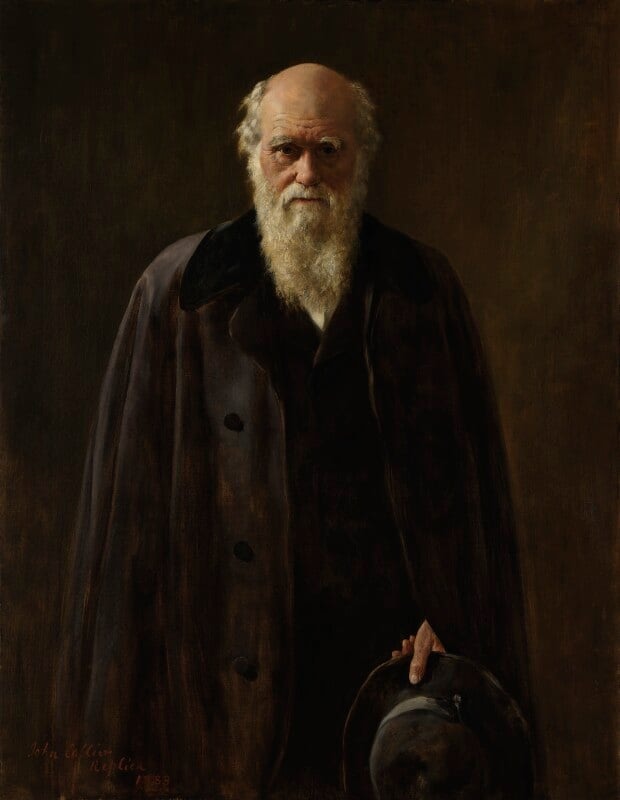
Charles Darwin
 United Kingdom
naturalist•geologist•biologist
Also known as: Charles Robert Darwin
Data de nascimento
February 12, 1809
Signo
Aquarius
Local de nascimento
Shrewsbury, England
Idade
Faleceu aos 73
Altura
5 ft 9 in (1.75 m)
Sobre
Charles Darwin was the English naturalist whose theory of evolution by natural selection transformed biology. His 1859 book On the Origin of Species laid out a mechanism for how species change over time, supported by decades of careful observation and analysis. Darwin's work remains the cornerstone of modern evolutionary biology, influencing genetics, ecology, and paleontology. He is widely regarded as one of the most influential scientists in history, with his ideas permeating both science and popular culture.
Darwin's approach was methodical and evidence-driven. He spent over twenty years developing his theory before publishing, amassing data from his famous voyage on HMS Beagle, experiments with plants and animals, and correspondence with fellow naturalists. His later works, including The Descent of Man (1871) and The Expression of the Emotions in Man and Animals (1872), extended his ideas to human evolution and psychology. Today, his legacy endures through ongoing research, museum exhibits, and public debate about science and religion.
Início da vida e origens
Darwin nasceu em uma família rica em Shrewsbury, Inglaterra. Seu pai Robert era um médico bem-sucedido, e sua mãe Susannah era filha de Josiah Wedgwood, fundador do império de cerâmica Wedgwood. Quando menino, Darwin mostrou grande interesse pela natureza, coletando besouros e explorando o campo, mas era um aluno medíocre na Shrewsbury School, um internato que enfatizava os clássicos.
Em 1825, aos dezesseis anos, Darwin matriculou-se na Universidade de Edimburgo para estudar medicina, seguindo os desejos de seu pai. Ele achava as aulas chatas e a cirurgia angustiante, mas prosperava fora da sala de aula, aprendendo taxidermia com um ex-escravo chamado John Edmonstone e participando de reuniões da Sociedade Pliniana, onde debatia história natural. Ele também estudou invertebrados marinhos ao longo do Firth of Forth.
Percebendo que Darwin não se tornaria médico, seu pai o enviou para o Christ's College, em Cambridge, em 1827, para estudar para um diploma de Bacharel em Artes com o objetivo de se tornar clérigo. Em Cambridge, Darwin encontrou sua verdadeira vocação. Ele fez amizade com o professor de botânica John Stevens Henslow, que se tornou um mentor e abriu portas para a elite científica. Darwin se formou em 1831, mas sua paixão pela história natural já havia se consolidado. Naquele mesmo ano, Henslow o recomendou como naturalista cavalheiro no HMS Beagle, um navio prestes a partir para um levantamento de cinco anos na América do Sul. O pai de Darwin inicialmente se opôs, mas seu tio Josiah Wedgwood II o convenceu a deixar Charles ir.
Crescimento na carreira
Darwin retornou da viagem do Beagle em 1836 com milhares de espécimes e cadernos cheios de observações. Ele rapidamente se estabeleceu como geólogo, publicando A Estrutura e Distribuição dos Recifes de Coral em 1842, que propôs uma teoria da formação de atóis ainda aceita. Ele também começou um estudo detalhado de cracas, passando oito anos classificando-as e produzindo quatro monografias.
No final da década de 1830, Darwin começou a desenvolver secretamente sua teoria da seleção natural. Ele leu o Ensaio sobre o Princípio da População de Thomas Malthus em 1838, o que lhe deu a ideia de que a competição por recursos favoreceria certas variações. Ele passou anos testando suas ideias por meio de experimentos de reprodução com pombos e estudando a variação de plantas e animais sob domesticação. Em 1858, recebeu uma carta de Alfred Russel Wallace delineando uma teoria muito semelhante. Seus trabalhos foram lidos conjuntamente na Sociedade Linneana em julho de 1858.
Darwin então se apressou em concluir A Origem das Espécies, publicado em novembro de 1859. A primeira edição de 1.250 cópias esgotou imediatamente. O livro gerou intenso debate, com Thomas Henry Huxley famosamente defendendo-o contra o Bispo Samuel Wilberforce. Darwin continuou publicando ao longo das décadas de 1860 e 1870, cobrindo tópicos desde a polinização de orquídeas até o comportamento das minhocas. Na época de sua morte em 1882, sua teoria havia ganhado ampla aceitação científica, embora a seleção natural como mecanismo primário só tenha sido totalmente estabelecida com a síntese moderna das décadas de 1930 e 1940.
Linha do tempo da carreira
Imagem pública e estilo
Darwin é universalmente reconhecido como um símbolo de investigação científica e coragem intelectual. Ele é frequentemente retratado como um cavalheiro vitoriano pensativo e barbudo, imagem solidificada por seus retratos posteriores. Na cultura popular, ele representa o triunfo da evidência sobre o dogma, e seu rosto aparece em tudo, desde camisetas até cédulas. Os Prêmios Darwin, uma honra irônica para pessoas que morrem de maneiras tolas, refletem sua associação com a seleção natural. Não há um fandom oficial, mas seu legado é celebrado por cientistas, educadores e organizações seculares em todo o mundo. Seu aniversário, 12 de fevereiro, é celebrado como o Dia de Darwin em muitos países.
Fama e fandom (iFAMOUS Rankings)
Charles Darwin stands as the 39th most famous person in United Kingdom, a position he holds steady according to the iFANN Global Fame Rankings. His global influence extends across the continent where he ranks as the 58th most famous person in Europe, a standing confirmed by the same rankings. Within the realm of intellectual and creative history, he is recognized as the 1st most famous person in Art & Design, a title anchored by the rankings. These placements from the iFANN Global Fame Rankings reflect his enduring presence across media coverage, search activity, and cultural consumption worldwide. While modern celebrities often cultivate organized followings, Darwin does not have a formal fandom name; his admirers are scientists, historians, and students rather than a fan club with a specific collective title. Engagement with his legacy takes the form of academic discourse, museum visits, and the study of his works like On the Origin of Species. There are no fan-funded projects or social media campaigns centered on his personal life, as he passed away long before the era of mass celebrity worship. Instead, his "followers" dedicate themselves to understanding his theories and validating his predictions through rigorous research.
Fatos interessantes e lendas
Charles Darwin suffered from chronic health problems throughout his adult life, including bouts of nausea, vomiting, heart palpitations, and fatigue. The exact cause remains unknown, with theories ranging from Chagas disease to panic disorder or lactose intolerance. He spent much of his time at home, working in his study or greenhouse, and relied on an extensive network of correspondents for information. He was an avid pigeon fancier and bred hundreds of varieties to study variation. He also experimented with carnivorous plants, measuring how much nitrogen they absorbed. Darwin was known for his patience: one experiment on seed germination in saltwater lasted over 40 years. He never used the word "evolution" in the first edition of Origin of Species, preferring "descent with modification." A legendary aspect of his daily routine involved the "Thinking Path" at Down House, where he paced back and forth for hours to work through complex ideas; recent studies in August 2026 validated that this walking habit boosted divergent thinking and creativity. Another enduring story from his life is the voyage on the HMS Beagle, which served as the origin story for his theory of natural selection, though biographers note his path to publication was fraught with hesitation. In August 2026, news broke confirming his 150-year-old prediction that certain alpine plants were carnivorous, cementing his status as a visionary who anticipated scientific discoveries decades ahead of their time.
Frases notáveis
“There is grandeur in this view of life, with its several powers, having been originally breathed into a few forms or into one.”
“A man who dares to waste one hour of time has not discovered the value of life.”
“The love for all living creatures is the most noble attribute of man.”
“Ignorance more frequently begets confidence than does knowledge.”
“I have called this principle, by which each slight variation, if useful, is preserved, by the term Natural Selection.”
Família e vida pessoal
Darwin casou-se com sua prima de primeiro grau Emma Wedgwood em 29 de janeiro de 1839. Eles tiveram dez filhos juntos, mas três morreram na infância: Mary Eleanor (1842), Charles Waring (1856) e outro bebê. Os filhos sobreviventes incluíam George (astrônomo), Francis (botânico), Horace (engenheiro), Leonard (soldado e político) e Henrietta (que ajudou a editar os trabalhos de Darwin). Darwin era um pai dedicado, frequentemente brincando com seus filhos e envolvendo-os em observações científicas. A família vivia em Down House, em Kent, onde Darwin conduzia grande parte de sua pesquisa. Emma era uma unitarista devota, e embora Darwin tenha se tornado cético em relação à religião, seu casamento permaneceu afetuoso e solidário apesar dessas diferenças.
Conexões notáveis
O trabalho de Darwin esteve profundamente entrelaçado com figuras-chave de sua época. O mentor John Stevens Henslow o recomendou para a viagem do Beagle. O geólogo Charles Lyell forneceu a estrutura uniformitarista que influenciou o pensamento de Darwin. O botânico Joseph Hooker foi um amigo próximo e confidente. Alfred Russel Wallace concebeu independentemente a seleção natural, levando Darwin a publicar. Thomas Henry Huxley, conhecido como "O Buldogue de Darwin", defendeu vigorosamente a teoria em debates públicos. Em casa, sua esposa Emma Wedgwood e seus filhos, particularmente Francis Darwin, apoiaram sua pesquisa.
Relacionamentos e história amorosa
Charles Darwin casou-se com sua prima de primeiro grau Emma Wedgwood em 29 de janeiro de 1839. O casal teve um relacionamento próximo e afetuoso, embora suas visões religiosas diferissem: Emma era uma unitarista devota, enquanto Darwin tornou-se cada vez mais agnóstico. Eles tiveram dez filhos juntos, três dos quais morreram na infância. Emma apoiou o trabalho de Darwin, muitas vezes ajudando-o em experimentos e cuidando dele durante suas frequentes doenças. O casamento durou até a morte de Darwin em 1882. Não há evidências de qualquer outro relacionamento romântico na vida de Darwin.
- Casado(a)Emma Wedgwood1839 - 1882Primos de primeiro grau; casados por 43 anos até a morte de Darwin; tiveram dez filhos juntos.
Morte e repercussões
Morte
April 19, 1882 (aos 73 anos)
Local da morte
Downe, Kent, England
Causa da morte
Insuficiência cardíaca
The death of Charles Darwin sent a profound ripple through the British establishment and the global scientific community, transforming a private passing into a national moment of reflection. Queen Victoria and the Prince of Wales immediately sent messages of condolence, while the Royal Society convened special memorial services to honor the man whose work had reshaped biology. Prominent peers like Thomas Huxley, Joseph Hooker, and Alfred Russel Wallace delivered eulogies that celebrated his contributions, and large gatherings of intellectuals attended events across London and Cambridge. This outpouring of respect solidified his status as a national hero despite lingering religious controversy.
Darwin passed away on April 19, 1882, at Down House in Downe, Kent, at the age of 73. His family physician and personal friend, Dr. William Gull, recorded the cause as heart failure after observing a rapid deterioration marked by acute pain and weakness. For decades, Darwin had suffered from chronic health issues, including symptoms consistent with Chagas disease acquired during his voyage on the HMS Beagle, which caused severe digestive distress and palpitations. He remained conscious until shortly before his final moments. His funeral took place on April 26, 1882, in Westminster Abbey, a rare distinction for a scientist.
The service, organized by the Royal Society, featured Mendelssohn's Elijah and was led by Dean Arthur Penrhyn Stanley, who framed Darwin's theories as compatible with Christian faith. He was buried in the north transept near Isaac Newton rather than his local parish church. Posthumously, his son Francis published his autobiography and extensive correspondence to preserve his intellectual legacy, while the Charles Darwin Foundation and Charles Darwin University later emerged to carry forward his name.
Patrimônio (valor do espólio)
$15 Million
Estimativa da equipe editorial do iFANN
Charles Darwin died in 1882 with an estate valued at about £150,000, equivalent to roughly $15 million today when adjusted for inflation. The bulk of his wealth came from inheritance and his wife's family money, rather than book sales. On the Origin of Species sold well but Darwin never became rich from it. His estate has continued to earn modest revenue from ongoing sales of his works, which remain in print and are widely studied. The rights to his writings are managed by his descendants and academic institutions. Per iFANN's editorial analysis, the estate's value is estimated at $15 Million as of 2026, primarily consisting of intellectual property and historical artifacts.
Prêmios conquistados (2)
Darwin recebeu a Medalha Real da Royal Society em 1853 por seu trabalho geológico, particularmente sua teoria dos recifes de coral. Esta foi a maior honraria que recebeu em vida. Ele também foi agraciado com a Medalha Wollaston pela Sociedade Geológica de Londres em 1859. Postumamente, seu legado foi homenageado através de inúmeras instituições e prêmios com seu nome, mas ele não ganhou prêmios competitivos adicionais.
1853 · Geologia
The Structure and Distribution of Coral Reefs
1859 · Geologia
Geological contributions
Conhecido por
On the Origin of Species
1859 · Autor
Theory of Evolution by Natural Selection
1858 · Codescobridor
The Descent of Man
1871 · Autor
HMS Beagle Voyage
1831 · Naturalist
Palavras-chave
Dados rápidos
- Profissão
- naturalist, geologist, biologist
- Nascimento
- +1809-02-12
- Local de nascimento
- Shrewsbury, England
- Morte
- +1882-04-19
- Local da morte
- Down House, Kent, England
- Gênero
- Masculino
- Cônjuge
- Emma Darwin
- Signo
- Aquarius
Dados pessoais
- Nome completo
- Charles Robert Darwin
- Altura
- 5 ft 9 in (1.75 m)
- Cônjuge
- Emma Darwin
- Filhos
- 10 (3 died in infancy)
- Formação
- University of Edinburgh, Christ's College, Cambridge
Perguntas frequentes
Pelo que Charles Darwin é famoso?
Quantos anos Charles Darwin tinha quando morreu?
O que foi a viagem do HMS Beagle?
Charles Darwin se casou com sua prima?
O que é seleção natural?
Pessoas semelhantes
Junte-se à comunidade
fãs comentando