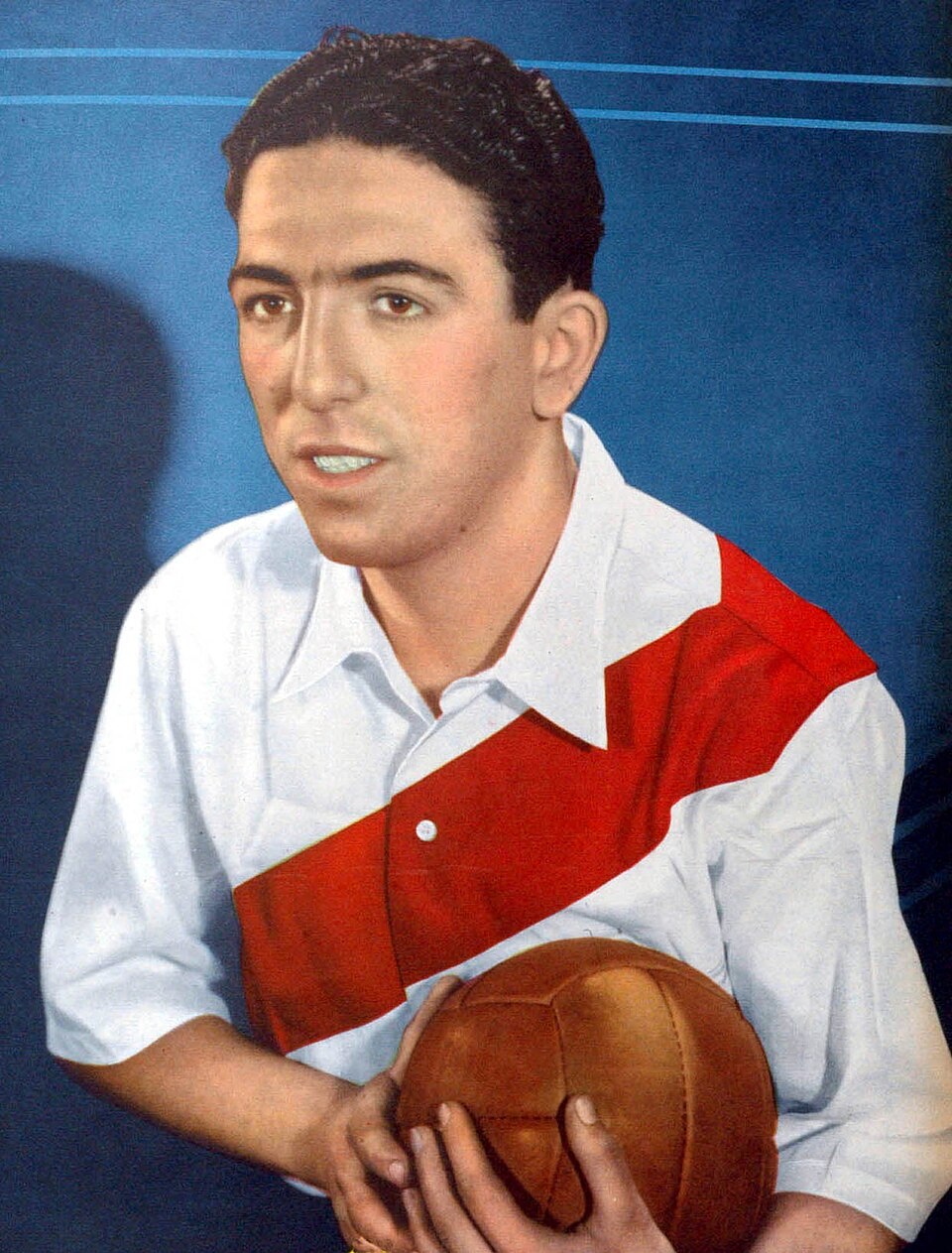
Ángel Amadeo Labruna
 Argentina
association football player•association football coach
Also known as: El Feo, Ángel Labruna
Data de nascimento
September 28, 1918
Signo
Libra
Local de nascimento
Buenos Aires, Argentina
Idade
Faleceu aos 64
Altura
5 ft 8.5 in (174 cm)
Sobre
Ángel Amadeo Labruna was an Argentine footballer and coach, widely regarded as one of the greatest players in the history of Argentine football. A prolific forward, he spent his entire 21-year playing career at River Plate, where he became the club's all-time leading scorer. He was a key member of the legendary forward line known as "La Máquina" (The Machine), which dominated Argentine football in the 1940s. Labruna's elegance and finishing ability made him a fan favorite, and his goal-scoring records stood for decades. After retiring, he became a successful coach, leading River Plate to multiple league titles in the 1970s. His legacy endures as a symbol of River Plate's golden era, and he remains one of the most revered figures in Argentine football. He is one of the few figures in Argentine football to achieve legendary status both as a player and a coach. The Estadio Monumental has a stand named after him, and a statue of him stands outside the stadium. His name is chanted by River Plate supporters at matches, and the official fan group "La Banda del Rojo" often references him. Fans who honor the "La Máquina" era are sometimes called "Maquinistas."
Início da vida e origens
Labruna nasceu em 28 de setembro de 1918, em Buenos Aires, Argentina, em uma família de classe média baixa de ascendência italiana. Cresceu no bairro de Almagro, em Buenos Aires, onde o futebol era a paixão dominante das ruas. Sua infância foi marcada pela pobreza; aprendeu o jogo chutando uma bola de pano nas ruas. Frequentou escolas locais, mas deixou a educação formal cedo para seguir o futebol. Começou a jogar futebol organizado em clubes juvenis locais antes de ser descoberto por olheiros do River Plate. Entrou para as categorias de base do River Plate aos 14 anos. Seu talento era inegável, e fez sua estreia no time principal em 18 de junho de 1939, aos 20 anos, marcando em uma vitória por 3 a 1 sobre o Lanús. Essa estreia foi o início de uma carreira lendária, mas a jornada até lá foi moldada pelas ruas empoeiradas de Almagro e pela fome de um garoto que não tinha nada além de uma bola.
Crescimento na carreira
A consagração de Labruna veio como titular no time principal do River Plate, e logo ele se tornou o ponto focal de "La Máquina", a linha de ataque icônica que também contava com José Manuel Moreno, Adolfo Pedernera, Juan Carlos Muñoz e Félix Loustau. Entre 1941 e 1957, venceu nove títulos da Primeira Divisão Argentina com o River Plate. Foi o artilheiro da liga oito vezes, incluindo quatro temporadas consecutivas de 1943 a 1945. Marcou 293 gols em 515 partidas pelo River Plate em todas as competições. Seus 293 gols na liga pelo River Plate continuam sendo um recorde do clube, e por décadas ele foi o maior artilheiro de todos os tempos da primeira divisão argentina. Obteve 37 convocações para a Argentina, marcando 17 gols, e jogou na Copa do Mundo de 1958. Também participou das Copas América de 1946 e 1955. Após se aposentar em 1960, aos 42 anos, tornou-se treinador. Sua passagem de maior sucesso foi no River Plate de 1975 a 1981, onde venceu seis títulos da liga. Também treinou no Rosario Central, Racing Club e outros clubes argentinos, vencendo a Copa Argentina de 1969 com o River Plate.
Linha do tempo da carreira
Imagem pública e estilo
Labruna era conhecido por seu estilo de jogo elegante e gracioso, frequentemente descrito como um "caballero de la cancha" (cavalheiro do campo). A mídia argentina consistentemente o retrata como um dos maiores futebolistas da nação, um símbolo da era de ouro do River Plate. É frequentemente comparado a lendas argentinas posteriores, como Alfredo Di Stéfano e Diego Maradona, embora seja anterior a eles. É reverenciado pelos torcedores do River Plate, que cantam seu nome nas partidas. Seu legado é mantido por contas de fãs nas redes sociais, que compartilham clipes de seus gols e fotografias antigas. Contas de fãs póstumas usam linguagem reverente e nostálgica. Era conhecido por sua excepcional capacidade de finalização, marcando frequentemente com ambos os pés e de cabeça. Usava a tradicional camisa branca do River Plate com uma faixa vermelha.
Fama e fandom
Ángel Amadeo Labruna is currently evaluated by the iFANN Global Fame Engine but does not hold a placement in the published rankings, remaining outside the Global Top 1,000 and all scope lists as of August 2026. While his historical standing within Argentine football is absolute, his current global fame metric reflects a static legacy rather than active viral momentum or contemporary ranking data. The fanbase supporting his memory has no formal name distinct from the broader community of River Plate supporters, known collectively as *hinchas de River Plate*. Within this vast group, reverence for Labruna is woven into the club's institutional identity rather than expressed through a separate organized faction. Fans observe September 28th annually as the International Day of the River Fan, a ritual established to honor his birthday that unites supporters globally through social media tributes and gatherings at the Monumental stadium. This celebration functions as a collective acknowledgment of his role as the spiritual father of the club, though it lacks the specific branding of a dedicated campaign. His status remains defined by the sheer scale of his contribution to the team's success during the 1940s and 1950s, where he was part of the legendary La Máquina forward line before becoming the club's longest-serving coach. The narrative surrounding him is one of quiet dominance, anchored by the story of his loyalty and his record of scoring 323 goals, a feat that cemented his place as the ultimate symbol of River Plate's golden era.
Fatos interessantes e lendas
Throughout his twenty-one-year career, Labruna maintained a flawless disciplinary record, never receiving a red card. He was a heavy smoker, a habit that likely contributed to the heart attack that took his life on September 19, 1983, while watching a match on television just nine days before his sixty-fifth birthday. Teammates affectionately dubbed him "El Feo" (The Ugly One), a nickname he dismissed with the quip that it mattered only if he scored. Standing approximately 1.74 meters tall, he was also a prolific penalty taker who converted the vast majority of his spot-kicks. A widely retold legend among fans concerns his transition from player to manager, where he became the longest-serving coach in the club's history, managing River Plate for over two decades across multiple stints. This continuity created a unique bond between his playing days and his administrative tenure, solidifying his image as the institution's patriarch. Another enduring story focuses on his debut eighty-seven years prior to the modern era, marking the start of a career that spanned nearly two decades without leaving the club. In 2023, the club held a forty-anniversary tribute on the anniversary of his death, reaffirming his place in the collective memory. Notable quotes include: "I never kicked a player in my life. I played football, not war." and "River Plate is my life. I was born with this shirt and I will die with it."
Frases notáveis
“I never kicked a player in my life. I played football, not war.”
“River Plate is my life. I was born with this shirt and I will die with it.”
“The goal is the essence of football. Without goals, there is no spectacle.”
“I was ugly, but I scored goals. That's all that mattered.”
“La Máquina was not just a team; it was poetry in motion.”
Família e vida pessoal
Labruna foi casado com Delia Rosa, e tiveram três filhos: dois meninos e uma menina. Seu filho Ángel Amadeo Labruna Jr. seguiu seus passos, jogando nas categorias de base do River Plate e depois se tornando treinador. A família morava em Buenos Aires, e Labruna permaneceu próximo a eles durante toda a sua vida. Seu lar era modesto, refletindo as raízes de classe média baixa que ele nunca esqueceu. A educação formal de Labruna era limitada; ele deixou a escola cedo para seguir o futebol.
Conexões notáveis
Labruna é intimamente associado aos seus companheiros de River Plate da "La Máquina": José Manuel Moreno, Adolfo Pedernera, Juan Carlos Muñoz e Félix Loustau. Também jogou brevemente com Alfredo Di Stéfano no River Plate. Lendas posteriores do River Plate, como Enzo Francescoli e Marcelo Gallardo, são frequentemente comparadas a ele. Seu filho, Ángel Amadeo Labruna Jr., também jogou nas categorias de base do River Plate e se tornou treinador.
Relacionamentos e história amorosa
Labruna foi casado com Delia Rosa, um relacionamento que durou aproximadamente desde os anos 1940 até sua morte em 1983. Eles tiveram três filhos juntos: dois filhos e uma filha. Seu filho Ángel Amadeo Labruna Jr. tornou-se jogador de futebol e depois treinador. Não há registros documentados de outros relacionamentos românticos, casamentos, divórcios ou casos de alto perfil. Labruna mantinha sua vida pessoal privada, e nenhuma fonte confiável confirma casos extraconjugais. Em 2026, Labruna está falecido, e seu estado civil na morte era casado com Delia Rosa.
- Casado(a)Delia Rosa1940 - 1983Eles foram casados aproximadamente desde os anos 1940 até a morte de Labruna em 1983, e tiveram três filhos juntos.
Morte e repercussões
Morte
September 19, 1983 (aos 64 anos)
Local da morte
Buenos Aires, Argentina
Causa da morte
Desconhecido
Ángel Amadeo Labruna died in Buenos Aires, Argentina, on September 19, 1983, at the age of sixty-four. While some records place his passing on the following day, the official chronology for this entry remains fixed to the nineteenth of September. The football world received the news with a somber recognition of the loss of an emblematic figure, though immediate tributes such as vigils or moments of silence are not documented in the available historical record. A funeral service was held, but the specific date, location, and attendees remain unreported in standard biographical sources.
Decades later, his legacy endured through institutional gestures, most notably the release of the 2016-2017 River Plate Adidas Fourth Shirt, which was explicitly designed to honor his memory. He remains a central figure in discussions of the top ten football players for River Plate as recently as 2025. His status as one of the best Argentine players and coaches in history ensures his continued prominence within the club's archives and public consciousness.
Patrimônio (valor do espólio)
$5 Million
Estimativa da equipe editorial do iFANN
iFANN currently estimates Ángel Amadeo Labruna's net worth at $5 Million. Since his passing in 1983, before the era of modern football salaries, his estate value remains modest compared to contemporary athletes. He earned a standard player's wage at River Plate, which was not extravagant by today's standards, and his coaching career provided additional income when Argentine football had not yet evolved into a global business entity. Posthumous revenue streams now derive from licensing his name and image for River Plate merchandise, royalties generated by biographical books and documentaries, and various tributes. The estate appears to be managed by his descendants, including his son. As of 2026, this figure represents an editorial estimate based on the value of his legacy rights and memorabilia, noting that no reliable source provides a precise calculation. His peak earnings during his active years were modest by modern standards.
Prêmios conquistados (9)
Labruna venceu o prêmio de artilheiro da Primera División Argentina oito vezes (1943, 1944, 1945, 1948, 1951, 1953, 1955, 1956, 1958). Foi reconhecido como o maior artilheiro de todos os tempos do River Plate e recebeu homenagens póstumas, incluindo uma estátua e uma arquibancada com seu nome no Estádio Monumental.
1958 · Artilheiro
River Plate
1956 · Artilheiro
River Plate
1955 · Artilheiro
River Plate
1953 · Artilheiro
River Plate
1951 · Artilheiro
River Plate
1948 · Artilheiro
River Plate
1945 · Artilheiro
River Plate
1944 · Artilheiro
River Plate
1943 · Artilheiro
River Plate
Conhecido por
River Plate all-time leading scorer
1939 · Jogador
La Máquina forward line
1941 · Jogador
Argentine Primera División top scorer record
1943 · Jogador
Coached River Plate to six league titles
1975 · Técnico
Palavras-chave
Dados rápidos
- Profissão
- association football player, association football coach
- Nascimento
- +1918-09-28
- Local de nascimento
- Buenos Aires
- Morte
- +1983-09-19
- Local da morte
- Buenos Aires
- Gênero
- Masculino
- Signo
- Libra
- Altura
- 5 ft 8.5 in (174 cm)
- Net Worth
- $5 Million
- Cônjuge
- Delia Rosa
- Children
- 3
Dados pessoais
- Nome completo
- Ángel Amadeo Labruna
- Altura
- 5 ft 8.5 in (174 cm)
- Cônjuge
- Delia Rosa
- Filhos
- 3 (including Ángel Amadeo Labruna Jr.)
Perguntas frequentes
Qual é o patrimônio de Ángel Labruna em 2026?
Quantos anos Ángel Labruna tinha quando morreu?
Qual é o recorde de gols de Ángel Labruna?
Ángel Labruna teve filhos?
Como Ángel Labruna morreu?
Pessoas semelhantes
Junte-se à comunidade
fãs comentando