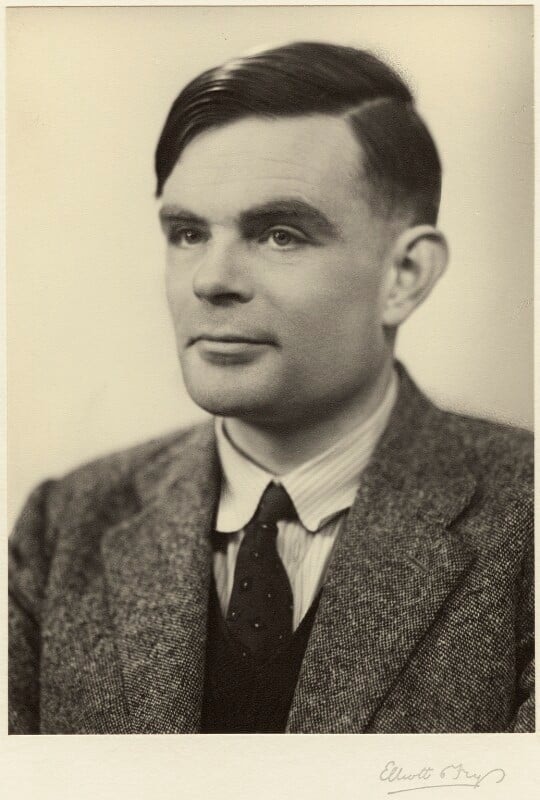
Alan Turing
 United Kingdom
Mathematician•computer scientist•cryptanalyst
Also known as: Alan Mathison Turing
Data de nascimento
June 23, 1912
Signo
Cancer
Local de nascimento
Maida Vale, London, England
Idade
Faleceu aos 41
Sobre
Alan Turing foi um matemático e cientista da computação britânico que estabeleceu as bases teóricas para a computação moderna e a inteligência artificial. Ele é mais conhecido por formalizar o conceito de computação através da máquina de Turing, um modelo que fundamenta todos os computadores digitais. Durante a Segunda Guerra Mundial, seu trabalho de decodificação em Bletchley Park, especialmente a quebra da cifra alemã Enigma, é creditado por encurtar a guerra e salvar milhões de vidas. Hoje, Turing é celebrado como o pai da ciência da computação teórica e um pioneiro da IA, com suas ideias ainda centrais para a pesquisa atual. Seu legado também carrega uma poderosa mensagem social, já que sua condenação por homossexualidade levou a décadas de injustiça, posteriormente reconhecida através de um perdão real e da lei Alan Turing.
Início da vida e origens
Alan Turing nasceu em Maida Vale, Londres, filho de Julius Mathison Turing, um funcionário público do Serviço Civil Indiano, e Ethel Sara Stoney, filha de um engenheiro ferroviário. Desde jovem, Turing mostrou sinais de inteligência excepcional, aprendendo a ler em três semanas e desenvolvendo interesse por números e quebra-cabeças. Na Sherborne School, sua abordagem não convencional à matemática frustrava os professores, mas ele encontrou um espírito afim em Christopher Morcom, um colega que compartilhava sua paixão pela ciência. A morte súbita de Morcom por tuberculose em 1930 devastou Turing e aprofundou sua determinação em entender a natureza da mente e da matéria. Após Sherborne, Turing estudou no King's College, Cambridge, onde se formou com honras de primeira classe em matemática em 1934. Seu artigo de 1936, "On Computable Numbers", introduziu a máquina de Turing, efetivamente estabelecendo as bases para todos os futuros computadores. Ele então se mudou para a Universidade de Princeton, onde obteve seu PhD em 1938 sob Alonzo Church, trabalhando em lógicas ordinais e no conceito de um hipercomputador.
Crescimento na carreira
O trabalho que definiu a carreira de Turing veio em Bletchley Park, o centro britânico de decodificação, onde chegou em 1939. Ele liderou a Hut 8, a seção responsável por decifrar mensagens navais alemãs da Enigma. Sua principal inovação foi a Bombe, um dispositivo eletromecânico que automatizava a busca por configurações da Enigma, acelerando enormemente a descriptografia. Em 1941, a equipe de Turing já lia regularmente as comunicações dos U-boats, dando aos Aliados uma vantagem crítica na Batalha do Atlântico. Após a guerra, Turing juntou-se ao National Physical Laboratory, onde projetou o Automatic Computing Engine (ACE), um dos primeiros projetos de computador com programa armazenado. Em 1948, mudou-se para a Universidade de Manchester, trabalhando no Manchester Mark I e explorando a inteligência artificial. Seu artigo de 1950, "Computing Machinery and Intelligence", propôs o Teste de Turing como um parâmetro para inteligência de máquinas. Em 1952, publicou um artigo sobre morfogênese, um modelo matemático para formação de padrões biológicos, que permanece influente na biologia do desenvolvimento.
Linha do tempo da carreira
Imagem pública e estilo
Turing é amplamente visto como um gênio trágico, uma mente brilhante cuja vida foi interrompida pelo preconceito social. Representações na mídia, como o filme de 2014 O Jogo da Imitação, enfatizam sua intensidade intelectual, estranheza social e heroísmo em tempo de guerra. Entre os cientistas da computação, ele é reverenciado como um pai fundador, com o Prêmio Turing frequentemente chamado de "Nobel da Computação". Sua perseguição o tornou um ícone na história LGBTQ+, e sua história é frequentemente citada em discussões sobre igualdade e justiça. A introdução de seu retrato na nota de £50 do Banco da Inglaterra em 2021 cimentou seu status como herói nacional. Fãs e admiradores frequentemente se reúnem em eventos do Dia de Turing e fóruns online, celebrando suas contribuições para a ciência e os direitos humanos.
Fama e fandom (iFAMOUS Rankings)
Alan Turing stands as a monumental figure whose influence transcends the quiet corridors of academia to dominate global consciousness. According to the latest iFANN Global Fame Rankings, he is currently the 434th most famous person in the world, holding steady from the previous cycle. His stature within his native land is even more pronounced, placing him as the 68th most famous person in United Kingdom and the 52nd most famous person from United Kingdom. In the specific domain of artificial intelligence, his legacy is second only to one other titan, making him the 2nd most famous person in AI. These placements reflect a massive scale of attention across media coverage, search trends, and cultural consumption signals worldwide. While there is no formal fandom name like those attached to pop stars, Turing commands a dedicated community of admirers who identify through their shared reverence for computer science and LGBTQ+ history. This audience operates not through chants or billboards but through scholarly engagement at institutions like The Alan Turing Institute and advocacy groups such as Turing.org.uk. They gather annually for remembrance events on June 7th, celebrating his life while demanding historical justice. Their rituals involve honoring his contributions to codebreaking and computing, often culminating in Pride celebrations that highlight STEM diversity. The community actively campaigns for social change, evidenced by the successful push for the British government's official apology in 2009. Recent discoveries of his personal writings have added new layers to this lore, revealing a playful side to the stoic genius that fans eagerly discuss. This group does not worship a living celebrity but rather sustains the memory of a man whose tragic persecution became a catalyst for modern equality.
Fatos interessantes e lendas
Alan Turing was an accomplished long-distance runner who finished fifth in the 1948 Olympic trials with a marathon time of 2:46:03. He frequently ran the 40 miles between Cambridge and London to attend meetings. At Bletchley Park, he developed a habit of chaining his mug to a radiator to prevent theft. Before the war, he was already a keen cryptographer, successfully breaking Latin and Greek codes created by his own school. Known for his eccentric style, he once wore a gas mask while cycling to avoid hay fever. His favorite book was Alice's Adventures in Wonderland, which he referenced in his work on computability. A widely retold legend confirms his pivotal role in breaking the German Enigma code during World War II, an achievement historians estimate shortened the war by years and saved millions of lives. Another enduring story centers on his invention of the Turing Machine, which laid the theoretical foundation for all modern computers. The defining tragedy of his life remains his conviction for gross indecency in 1952, leading to chemical castration and his eventual death from cyanide poisoning at age 41. Recently, the discovery of a long-lost autobiographical short story has fueled new discussions, revealing a cheeky, humorous side to the mathematician that challenges the stereotype of the stoic genius.
Frases notáveis
“We are not trying to make a machine think, but rather to investigate whether machines can be made to think.”
“It seems probable that once the machine once reasonably accurately simulates the man, it ought to be inferred that it has consciousness.”
“Those who can imagine anything, can create the impossible.”
Família e vida pessoal
O pai de Turing, Julius Mathison Turing, trabalhava para o Serviço Civil Indiano, e sua mãe, Ethel Sara Stoney, vinha de uma família de engenheiros. Ele tinha um irmão mais velho, John. A família passou grande parte da infância de Turing na Índia, mas ele e John foram deixados com famílias adotivas na Inglaterra enquanto seus pais permaneciam no exterior. Turing nunca se casou e não teve filhos. Viveu modestamente, muitas vezes em pensões ou acomodações universitárias. Em seus últimos anos, dividiu uma casa em Wilmslow com sua governanta. Não há registro de animais de estimação.
Conexões notáveis
O colaborador mais próximo de Turing em Bletchley Park foi Gordon Welchman, que ajudou a projetar a Bombe. Ele trabalhou sob Max Newman, um matemático que mais tarde apoiou sua carreira em Manchester. Christopher Morcom, seu amigo de escola, foi uma profunda influência emocional. Hugh Alexander, um colega decodificador, tornou-se amigo para toda a vida. Turing também se correspondia com Alonzo Church, seu orientador de PhD.
Relacionamentos e história amorosa
O vínculo emocional mais significativo de Turing foi com Christopher Morcom, um colega de escola em Sherborne. A morte súbita de Morcom em 1930 por tuberculose afetou profundamente Turing, e ele mais tarde escreveu à mãe de Morcom, expressando seu amor. Não há evidências de que o relacionamento fosse fisicamente romântico, mas foi profundamente formativo. Em 1951, Turing conheceu Arnold Murray, um jovem de Manchester. O relacionamento foi breve; Turing denunciou um roubo à polícia, o que levou à descoberta de sua orientação sexual. Ele foi preso e processado por indecência grave. Em 1954, Turing era solteiro na época de sua morte.
- NamoraramChristopher Morcom1927 - 1930Amigo próximo da escola; a morte de Morcom em 1930 afetou profundamente Turing.
- NamoraramArnold Murray1951 - 1952Relacionamento breve; levou à prisão de Turing por atos homossexuais.
Morte e repercussões
Morte
June 7, 1954 (aos 41 anos)
Local da morte
Wilmslow, Cheshire, England
Causa da morte
Cyanide poisoning
Decades after his passing, the Alan Turing Memorial in Sackville Park stands as a quiet landmark in Manchester, while the 2013 royal pardon and the subsequent "Turing's Law" transformed a legal scandal into a national reckoning. This eventual redemption followed a death that remained shrouded in controversy for years. On June 7, 1954, Turing was found dead in his Wilmslow home by housekeeper Dorothy M. Clarke, lying in bed beside an apple half-eaten and dipped in cyanide. The official coroner's inquest ruled the cause of death as suicide due to cyanide poisoning, though historians have long debated whether this was a deliberate act or an accidental ingestion stemming from his habit of storing chemicals in jam jars.
His funeral on June 10, 1954, at Brookwood Cemetery was a private affair attended only by family and close friends, reflecting the stigma of his 1952 conviction for gross indecency. In the immediate aftermath, public tributes were absent, constrained by the shadow of his prosecution and forced chemical castration. It took until the late 1980s for the full scope of his wartime codebreaking work to be acknowledged, sparking a surge in interest that led to his induction into the Computer Hall of Fame and the release of the film The Imitation Game in 2014. Today, his legacy is cemented through the Turing Award and the Alan Turing Institute, honoring a mind whose contributions reshaped the digital age.
Patrimônio (valor do espólio)
$1 Million
Estimativa da equipe editorial do iFANN
As a civil servant and academic, Turing earned a modest salary throughout his career. His net worth at the time of his death was minimal, estimated at around £5,000 (equivalent to about $1 million in 2026). Per iFANN's editorial analysis, the total value attributed to his estate reflects this lack of personal wealth accumulation. After his death, his estate was managed by his mother and brother. Posthumous earnings from books, films, and the use of his image have generated revenue, but the estate has not been commercially aggressive. The Alan Turing Trust, established by his family, supports educational initiatives. The Bank of England's £50 note featuring his likeness does not generate royalties. No major catalog sales or licensing deals have been reported. The estate's value in 2026 remains modest, reflecting Turing's lack of personal wealth accumulation.
Prêmios conquistados (1)
Alan Turing não recebeu grandes prêmios durante sua vida, pois seu trabalho era classificado e suas contribuições não foram reconhecidas publicamente até décadas depois. No entanto, ele foi homenageado postumamente com inúmeros elogios, incluindo o Prêmio Turing da ACM, frequentemente considerado a maior honraria da ciência da computação, que recebeu seu nome em 1966. O prêmio é concedido anualmente a indivíduos por contribuições de importância técnica duradoura para o campo da computação.
1966 · Nomeado em sua homenagem
Conhecido por
Turing machine
1936 · Inventor
Enigma codebreaking
1939 · Lead cryptanalyst
Turing Test
1950 · Proponente
ACE computer design
1945 · Designer
Morphogenesis theory
1952 · Autor
Palavras-chave
Dados rápidos
- Profissão
- Mathematician, computer scientist, cryptanalyst
- Nascimento
- June 23, 1912
- Local de nascimento
- Maida Vale, London, England
- Morte
- June 7, 1954
- Local da morte
- Wilmslow, Cheshire, England
- Gênero
- Masculino
- Signo
- Cancer
Dados pessoais
- Nome completo
- Alan Mathison Turing
- Formação
- King's College, Cambridge (BA, 1934); Princeton University (PhD, 1938)
Perguntas frequentes
Quem foi Alan Turing?
Qual foi a maior contribuição de Alan Turing?
Por que Alan Turing é famoso?
Como Alan Turing morreu?
O que é o Teste de Turing?
Pessoas semelhantes
Junte-se à comunidade
fãs comentando