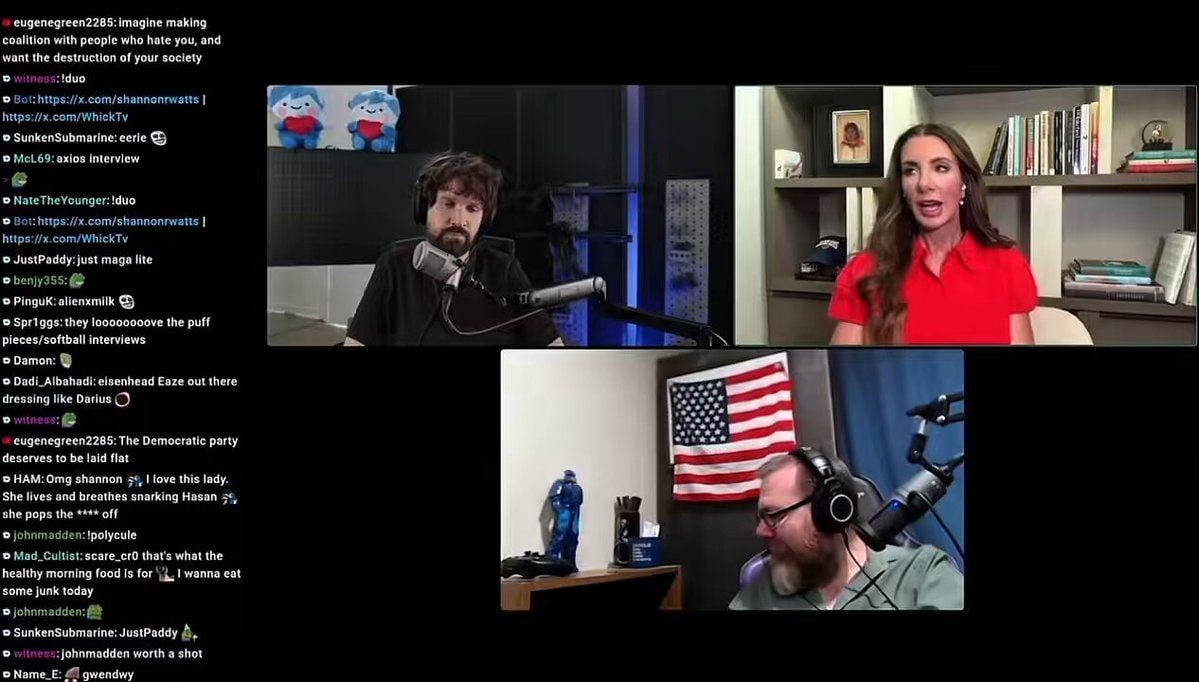
Shannon Watts and Destiny on Hasan and the Democratic Party
por Silvestre: Hasan Piker
The thing that got Shannon Watts paying attention to Hasan in the first place was Graham Plattner, back when she started saying publicly that he didn't look like a great Senate candidate. That drew pushback from the left, including from people like Mehdi Hassan who had been friendly with her for a long time, and she says Hassan Piker went around calling Plattner a fine candidate on the grounds that he supported Hamas. From there Watts frames Hasan as a threat to the Democratic Party's very existence, comparing how he operates to Blue MAGA. Her worry is the excuse-making: people bending over backwards to accommodate him inside the party, which she says normalizes both the behavior and the ethos. She calls him a misogynist, a racist, a bigot, basically what MAGA is while pretending to promote democratic ideals. The stream itself isn't her problem, nor the interviews. Her problem is whether he gets treated as someone worth campaigning with, someone with a say in policy, someone influencing leaders. There's a real fight over whether he's an acceptable surrogate or an extremist streamer parked on the party's outskirts, and she says she isn't sure which way it goes. Destiny's read on the messaging is that repetition wins regardless of whether the talking point is any good. His comparison: a studio audience at a sitcom. Everybody laughs, so you want to laugh too. They just repeat the same message verbatim. Watts also brings up the harassment, like a reporter telling Haley Stevens something about seeing her at the gallows, and argues the point of going after people is to drive them out of the conversation so it looks like everyone agrees. Friends of hers are weighing whether to leave social media over it. Her stated fear isn't Democrats flipping Republican, it's apathy, people tuning out and not showing up. She compares the GOP's message discipline to genetic code, where one cell carries it and the rest follow, and says the far left runs the same playbook.
Transcrição (en)
I mean, I didn't even know who Hassan Piker was until the whole Graham Plattner ordeal. You know, when I started to be vocal on Twitter about the fact that Graham Plattner did not seem like a great U.S. Senate candidate, that was, you know, when I started to get a ton of pushback from the left. And again, people like Mehdi Hassan, people who had been friendly to me for a long time. I saw Hassan Piker, you know, just saying all these different things about candidates. And one thing he said about Plattner was that he clearly was a supporter of Hamas and therefore he was a fine candidate in his book. I feel like he's an existential threat. And the left tells me that I'm overreacting. Because I see people being obsequious and bending over backwards to make excuses for him and to accommodate him in the party. I don't know what's true and what isn't, but even when he says stuff like AOC has talked to him about campaigning, The more normalized he becomes, the more that behavior and that ethos becomes normalized in the party. That is not a party I can be in. I can't be in a party with people who believe such horrible things or are moral. He's a misogynist. He's a racist. He a bigot He you know he is basically what MAGA is but pretending to promote democratic ideals And he really you know as you were talking about destiny like he a multimillionaire and obviously has a profitable career saying these incendiary things. I don't care if he has a stream. I don't care if he has people on and he interviews them. I do care if he is considered someone that you want to campaign with, if he's considered someone who has a say in the policy issues, that he's influencing leaders, that he's, I feel like there's a real battle for whether we're going to decide that he is an acceptable person that can be a surrogate, or if he is an extremist that is just going to be streaming and kind of on the outskirts of the party, that battle I think is happening right now. I see that seems to be very much in play, and I'm not sure which way it will go. One reporter to Haley Stevens told her, like, I'll see you at the gallows or something like that. These are people that will just harass you and call for your death and call for your destruction. Even if you acquiesce even if you endorse even if you campaign with their candidate And I guess I wonder you know you and I have said a couple times during this like that not the party I want to be in I think the risk is not that Dems like me become Republicans I would never vote Republican. I would never be part of the Republican Party. The risk is apathy. The risk is tuning out. The risk is not showing up and feeling like this. I've, you know, I've lost touch with reality here and I can no longer be part of this party that seems so far to my left or cares about issues that just aren't important to me. and so I'm going to tune out. And I think that's a concern. Well, you mentioned some of your friends are considering leaving social media, leaving the conversation because of this. And yes, it's not- And that's what they want us to do, I think. You know, I do think the reason that- That's the reason, yeah. That's the reason you go after us because they want us out of the conversation so they can say, look, everyone agrees with us. No one is speaking out against us. Well, that's because everyone who did, harassed and bullied until they left. They're so good at it. This is why I say if you're trying to figure out what the Republican Party believes, it's like it's like genes in a human body. Like you have the whole genetic code. If you get one of them, one cell, they all have all the messaging and they'll all repeat the exact same things. And it's the talking points over and over again. And the far left does it, too. They're really good at it. I know for a fact I haven't even seen this in your Twitter. But I know for a fact that somebody has probably tweeted at you when you've been fighting with Hassan and they said something along the lines of like what about Laura Loomer And it like where does this talking point even come from We don like we hate Laura Loomer Hassan and I had a two fight over this Yeah what do you mean nobody campaigning with Laura Loomer on the Democratic side this is even a good talking point but it doesn matter because if everybody hitting it right it's like a studio audience for a sitcom when they laugh you kind of want to laugh because everybody else is laughing and that's what they do they just repeat the same message verbatim everybody else sees it they kind of like chime in you feel like you're a part of a big group and then that's the way that it all functions it's very much it's very annoying and two one of the frustrating is the pod save guys did this too is because we don't have, I feel like, I feel like nobody has this macro view of how the media works, but they're seeing like the output at the end where they're trying to figure out like, I don't understand why this messaging worked and this messaging didn't. One of the things that this allows to happen, or maybe happens, you know, as a byproduct of this is people keep looking in the democratic party to assign blame to what I consider to be like a macro problem with the whole ecosystem. You all were talking about talking points and we need to have a, you know, better way to do that as a party. But what I was shocked by, and I think a good example of this was during the primary, the day before the election, when I started seeing leftists all saying that they had heard about this call from a pollster to Haley Stevens saying that she was definitely going to lose by a huge margin. And to me, that goes beyond like everyone saying the same talking points on purpose to everyone lying and undermining our own candidates on purpose. That's a stark red line.