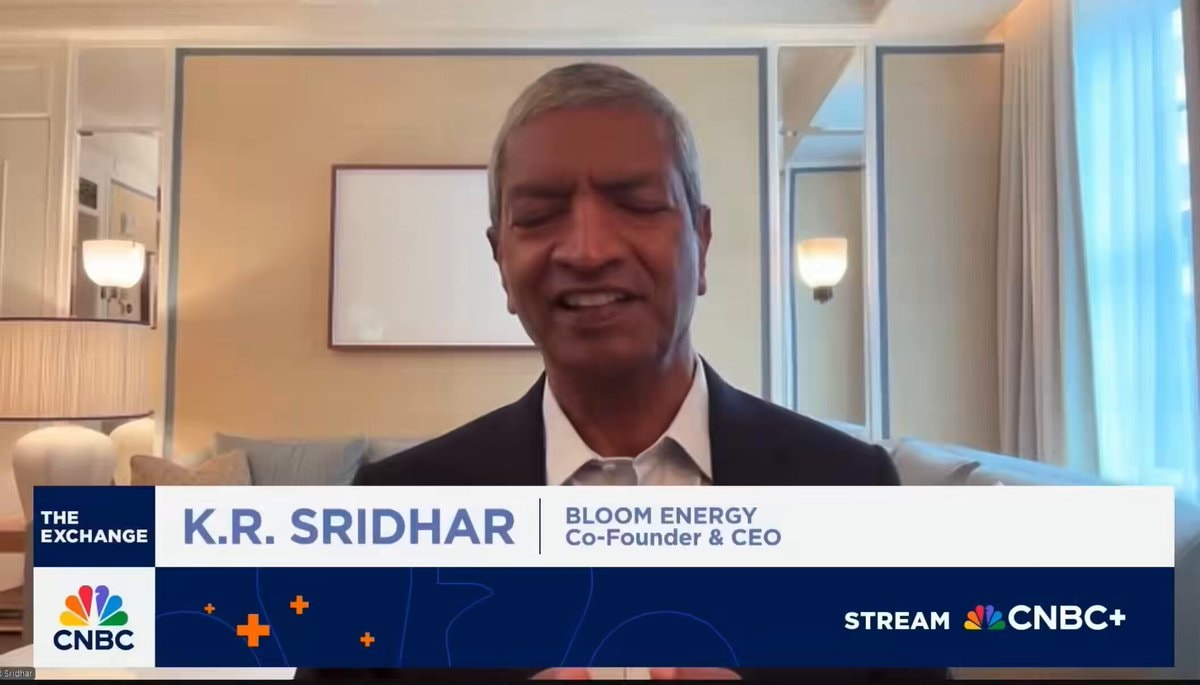
K.R. Sridhar Bloom Energy on AI Power Needs
por Tim Official: Brookfield Asset Management
The AI boom is running on the biggest energy fraud in history. Everyone is arguing about whether the chips are a bubble. But the real problem is one floor down, in the electricity that is supposed to make the whole thing physically real. And the smartest money on Wall Street is the one funding it. Here's what's going on right now: AI data centers cannot wait years for a grid connection, so they went behind the meter and started generating their own power on-site with fuel cells. One company became the face of that entire trade. Its stock is up more than 1,100% in a single year. It just posted its first billion-dollar quarter, $1.065 billion in revenue, a jump of 166%. In June, Brookfield quintupled its financing commitment to the company from $5 billion to $25 billion, part of a $100 billion AI infrastructure fund. Oracle expanded its own deal to 2.8 gigawatts. The message to the market was clean: The power problem is solved, and the giants are validating it with billions. Then a short seller named Hunterbrook pulled the audited filings on that company, Bloom Energy... What they found was a machine selling to ITSELF. In the fourth quarter of 2025, 74% of Bloom's revenue came from joint ventures Bloom partly owns alongside Brookfield. For all of 2025, around 44% came from related parties. Those joint ventures have names. They are called Bolt US JVCo LLC and ORC HoldCo LLC, both formed in August 2025. Bloom holds a single-digit stake in one and 15% in another, and Brookfield holds the rest. Bloom sells its fuel cells into these financing affiliates and books the revenue on the sale, even though the affiliate is not the customer actually burning the power. Its own auditor, Deloitte, flagged the arrangement as a critical audit matter. So the blowout growth the whole market is celebrating is, in large part, Bloom selling equipment to an entity its own financier controls. Then comes the backlog: Bloom markets a $20 billion order book. According to its audited filings, the binding obligations behind that number were roughly $492 million as of the first quarter of 2026. The headline and the actual contracts are separated by an entire order of magnitude. But the most damning part is the product itself: Hunterbrook pulled 15 years of public generation data. In New York, all 37 metered systems fell below Bloom's own efficiency benchmark at a median of just 20 months, and only one was on pace to survive the five years Bloom advertises. A part-owner of one New York project said Bloom paid them a multimillion-dollar penalty because the cells ran below the promised output. Bloom rejects all of it as false and misleading, stands behind its audited statements, and insists its supply chain does not depend on China. But the joint-venture accounting sits in public footnotes - and the market sided with Bloom anyway. The stock shrugged off both reports and climbed to record highs, because Brookfield and Oracle are sophisticated buyers writing real checks, and the fuel cells are running in the field today. Here is why this reaches far beyond one company: The power layer was the one part of the AI story that everyone treated as solid ground. The chips could be overvalued and the models could disappoint, but surely the electricity was real. If that electricity turns out to be a money loop wrapped around a product that degrades years early, then the foundation under a multi-trillion-dollar buildout is not what the market believes it is. And Brookfield just committed 25 billion more dollars to keep the loop spinning. The receipts have been public for over a month but Wall Street simply decided not to read them. Thoughts?
Transcrição (en)
This trend in AI and the spending and the infrastructure build and the benefits we're going to get is secular. It's going to last for a long time, number one. Number two, the immediate need for building the data center infrastructure between now and 2030 is going to be availability of power. This is on-site power in very, very large quantities, 50, 100 megawatts concentrated in a data center. And just today, the U.S. Secretary of Energy Chris Wright said between now and 2030, we need 100 gigawatts of firm, reliable power. That's not just going to come from the grid. A portion of it will come from the grid. The rest of it has to be on-site power. That on-site power, powering these data centers, is necessary because if you just look at the hyperscalers and their investments in the U.S. in the year 2025, it's closer to $2 billion of capex every single day, weekday and weekend. All that infrastructure, all that capex needs power, and lots of them. And that's where we come in. We are the best choice for on-site power, and we have a technology moat bigger than anybody else, and we are the right solution at the right time for this vital project and program that's important for the country and the world.