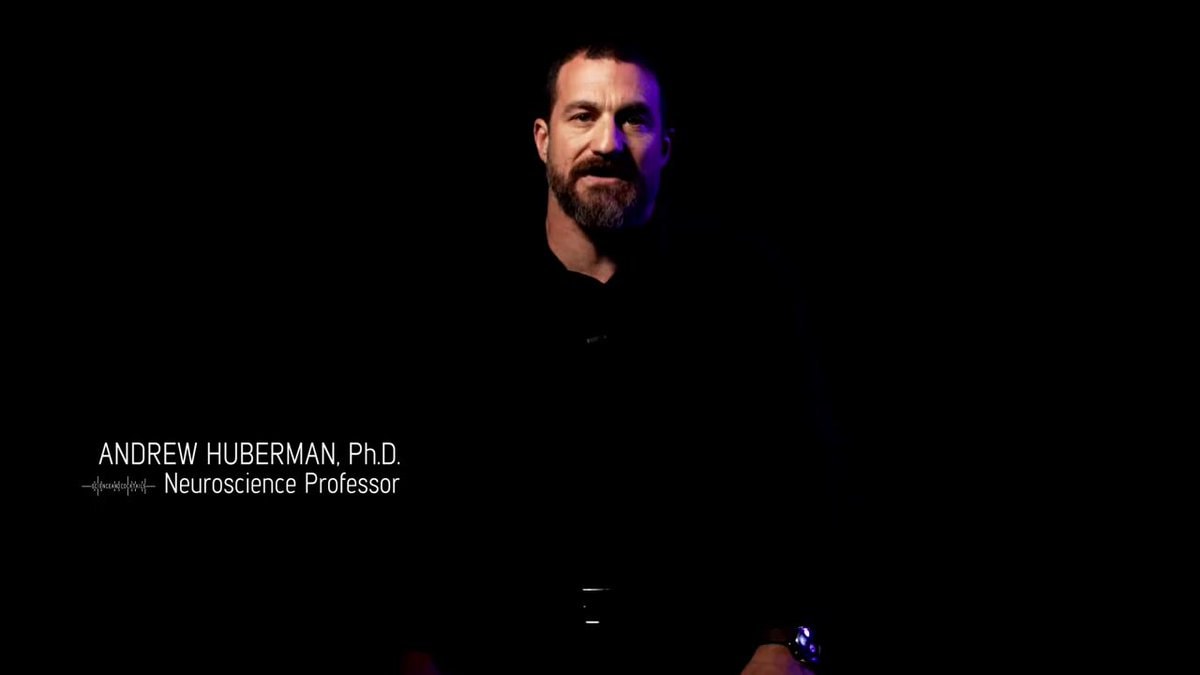
Andrew Huberman on neuroplasticity and prediction maps
por Katrina Karan: Health
Your nervous system is a prediction machine constantly building maps of what’s coming next, and neuroplasticity is how it updates those maps. Early in life you can soak up new wiring passively, but around 25 the whole mechanism flips, after that it demands high-friction focus and aggressive repetition to shift the patterns at your synapses. The one brutal exception is a traumatic or fearful event, which can rewire the system in a single occurrence. The upside is you can deliberately reshape those connections so the event loses its charge, but you have to do the work. Andrew Huberman lays out the science without fluff #Health
Transcrição (en)
Neuroplasticity is a huge deal, in particular for human beings, because neuroplasticity is the way that we continue to shape our understanding of the outside world. Your nervous system's main job is to make predictions about what's going to happen in the outside world and to be able to respond in an adaptive way. It's really a prediction machine. So neuroplasticity, this change of the nervous system in response to experience, is the way that your nervous system updates its maps of prediction. If we were to play a sport or a game or Or maybe even you would subject me to an experiment, or I would subject you to an experiment, where you would be rewarded for intentionally looking in the opposite direction of a sound, for instance, like that. If you did that enough times and with enough focus and attention, you would get so-called neuroplasticity. Those maps would shift and change such that a week later, a month later, maybe even 10 years later, if you heard a click over there, there's a higher probability that you would look in the opposite direction. We also have maps of prediction for things like emotional responses, how we think people will respond if we do A or B, how we think a person will respond or act if their face happens to be in a particular way or their skin tone. So we're constantly updating these maps. Neuroplasticity is the way we update those maps. And just to put a little bit of meat and detail on what neuroplasticity is, we have neurons, which are nerve cells. We have other cell types in our nervous system but those nerve cells have an incredible capacity to change their patterns of connections Their points of connection are actually little spaces called synapses And synapses are where these different neurons transfer electrical and chemical information between each other. And basically your entire experience, what you sense, what you perceive, what you think, what you feel, and what you're able to do or not do is dictated by those patterns of electrical activity and chemicals. neuroplasticity is literally changes in the patterns of connections between those neurons. So if you think about something like Google Maps, it's one way, but if you build a new road, there's a new road there. Neuroplasticity is essentially like building new roads. The mechanisms of neuroplasticity are quite different early in life. You can learn passively just by experience. Kids could learn several languages even without an accent up until about age 12, and then it gets much more difficult to learn languages without an accent. Then at some point, right about the age of 25, the whole process shifts. Neuroplasticity still can occur, but the whole mechanism for how it occurs changes. It takes more deliberate focus. There's one exception to that, which is the bad stuff. Typically, a traumatic or fearful event only takes once to reshape your nervous system. The good news is there are things that you can do to reshape your nervous system, additional plasticity to change those connections so that the traumatic or fearful event is no longer traumatic or fearful.