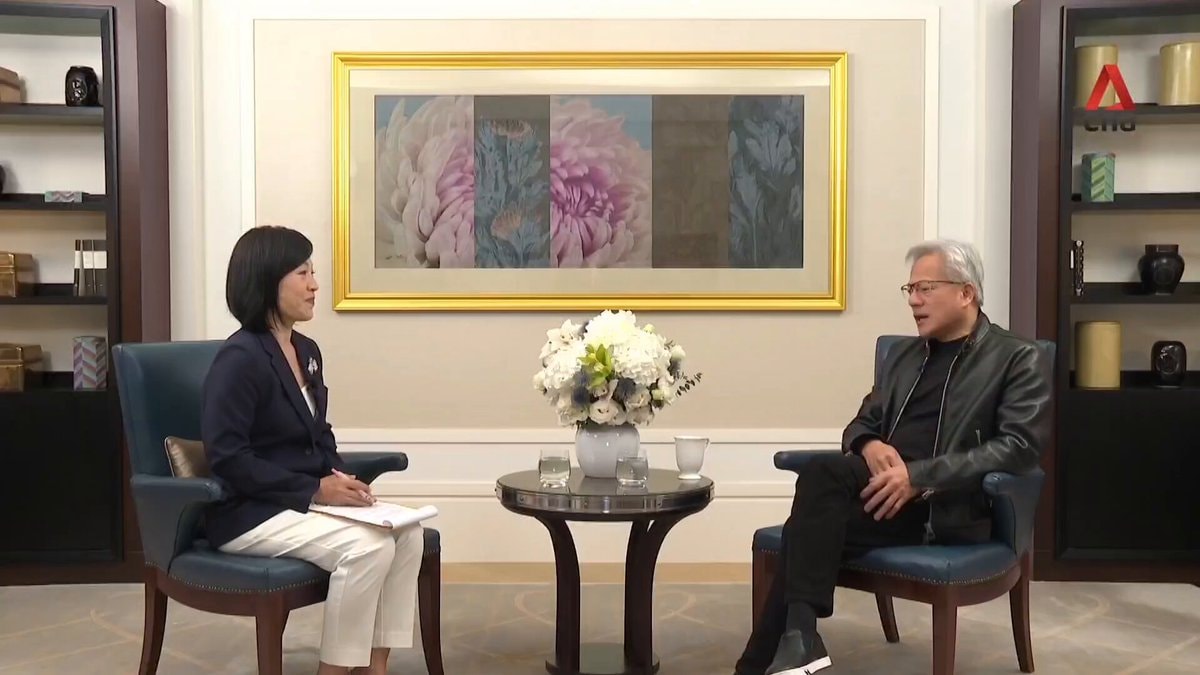
Tim Cook Jensen Huang Tsinghua board
por Tim Official: Elon Musk
America's most powerful CEOs have spent years advising Xi Jinping's university. The Pentagon has now opened investigations into the arrangement. Tim Cook, Elon Musk, Mark Zuckerberg, Jensen Huang, Satya Nadella, Jamie Dimon, and Larry Fink all serve on the advisory board of Tsinghua University in Beijing. That is the same university that trains China's military AI leadership. It is also the same university that the US Defense Counterintelligence Security Agency officially flagged in 2018 for seeking export-controlled American materials. Tim Cook joined the board in 2013 and became its chairman in 2019. He has been running it for seven years. The story only broke this week because Jensen Huang quietly joined the same board, and somebody finally connected the dots on who else was already sitting at the table. Tsinghua is not a normal university. It runs eight military research labs on its campus. It has signed a formal strategic cooperation agreement with the Chinese Navy. And its leadership has publicly committed to advancing the CCP's strategy of military-civilian fusion in artificial intelligence. Tsinghua-affiliated researchers have contributed to Chinese hypersonic weapons, fourth-generation nuclear weapons technology, and advanced semiconductor breakthroughs. A House investigation last year named the university as one of the primary pipelines transferring American research into China's defense industrial base. This is the institution being advised by the men who run Apple, Tesla, Meta, Nvidia, Microsoft, JPMorgan, and BlackRock. The board has existed since 2000. The names on it have been publicly listed on Tsinghua's own website the entire time, but nobody in Washington raised a single public concern for years. Senator Jim Banks said he is launching an investigation. Laura Loomer filed a formal complaint with the Department of War. But here is the bigger question this exposes. The US government has spent the last four years building the most aggressive technology export control regime in modern history. It has banned Nvidia chips from China, blacklisted Chinese tech companies, indicted smugglers, and spent billions to prevent AI from reaching the Chinese military. In March, the co-founder of Supermicro, Nvidia's biggest hardware partner, got charged for smuggling 2.5 billion dollars in Nvidia servers to Chinese buyers through a Southeast Asian shell company. And the entire time these controls were being built, the CEOs being asked to comply with them were listed as advisors to the school the controls were designed to protect against. The list sat on a public website for anyone to see. Either every administration since George W. Bush knew about this arrangement and said nothing. Or nobody in Washington bothered to check a publicly available advisory board list for over a decade. Both options are equally insane. And now look at the timing. Jensen Huang flew to Beijing with Trump in May. Days after he returned, he accepted the Tsinghua board seat. He did this while simultaneously sitting on Trump's Council of Advisors on Science and Technology and while Nvidia chips remain banned from sale to China. And he is not making a private career decision here. This is a man being used as a diplomatic asset between Washington and Beijing while pretending the export controls he publicly supports actually work. The same logic applies to every name on that board. Tim Cook is not advising Tsinghua as a hobby. Larry Fink is not on that board for academic interest. Jamie Dimon is not flying to Beijing for the food. These men have spent years operating the most powerful informal diplomatic channel between American capital and the Chinese state. It was listed publicly and hiding in plain sight the entire time. And the only reason anyone is talking about it now is because Jensen Huang joined three days ago but failed to keep it a secret.
Transcrição (en)
I was there with 16, I think, other CEOs, and it represents quite a large collection of great companies, from consumer electronics, of course, to industrials and automotive and all the way to financials and biotech. And so it was a large, large collection of industry that was represented. And the conversations were, one, really, really welcomed. President Xi, Premier Li Qiang were extremely welcoming, and they spoke about cooperation and a stable relationship and that China would be an open market and even more wide open than before, encouraged investment. and then we were there to really represent the United States, support the president. And they had wonderful meetings. They were extremely cordial. The feelings were great and the pomp and circumstance and all of the festivities were quite impressive. But that was basically it. I was there for a couple of days. We didn't sleep for a couple of days. And then when President Trump left to go back home, I went to old town Beijing to enjoy some nice meals.