
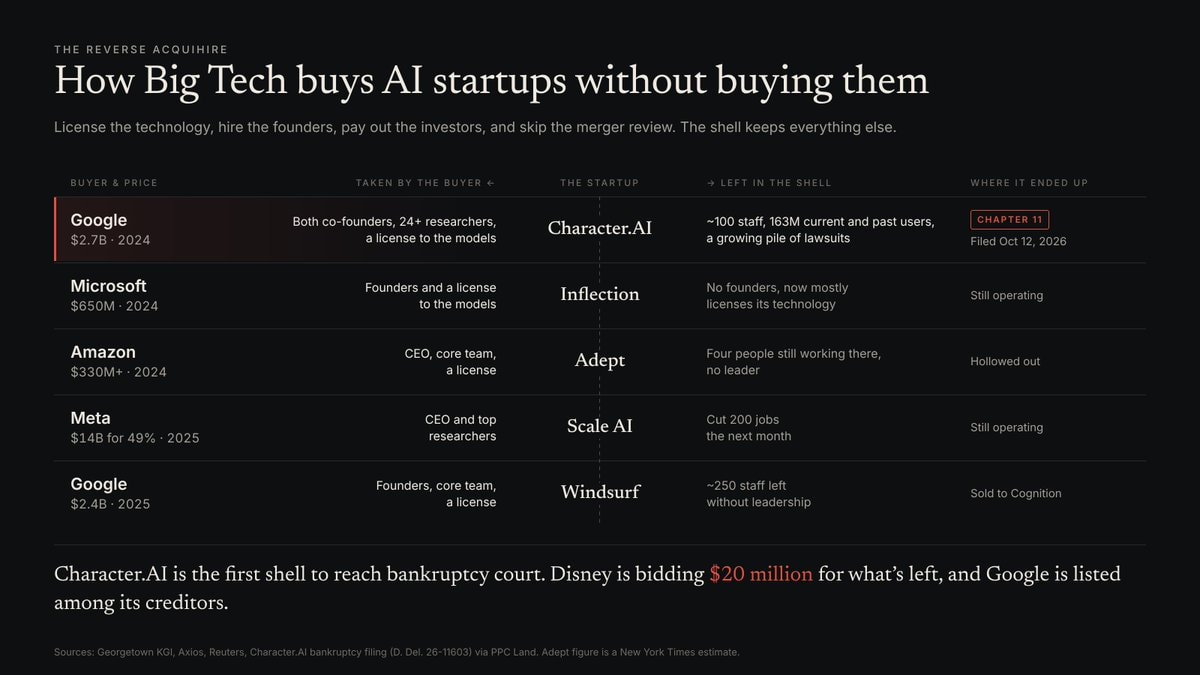
@tim_officialThis finally exposed the AI industry's dirtiest trick. Google paid $2.7 billion for everything valuable at http://Character.AI, and the 163 million users and the lawsuits stayed behind in the shell that just went bankrupt. Now Disney is buying what's left for $20 million, and Google is listed as one of the creditors. This is the first collapse of a deal structure Big Tech has used all over the AI industry, and I'd be shocked if it's the last. The trick works in four moves: In August 2024, Google paid $2.7 billion for a non-exclusive license to http://Character.AI's models and hired back its co-founders, Noam Shazeer and Daniel De Freitas, along with more than two dozen researchers. On paper, Google NEVER bought the company. Part of that money bought out the venture investors at around a $2.5 billion valuation, up from $1 billion a year earlier. So the investors got paid, the founders went to Google, and Google walked away with the technology. What stayed behind was about 100 employees, a platform with millions of users, and a growing pile of lawsuits. The company no longer had the money to train its own models, so it ran on open-source ones instead. And because the deal was built as a license and a hiring spree instead of an acquisition, it never went through a merger review. The New York Times reported that people involved in these deals cited a desire to sidestep regulatory scrutiny. Then the bill came due: In January, Google and http://Character.AI agreed to settle lawsuits in four states accusing the chatbots of harming minors, including a case tied to a teenager's suicide. In May, Pennsylvania sued over a bot that presented itself as a licensed psychiatrist. Kentucky now shows up in the bankruptcy as a litigation claimant, and the company itself cites potential litigation liabilities as a reason it couldn't keep funding the business. Monday's filing in Delaware puts both its assets and its liabilities somewhere between $50 million and $100 million. Google sits on the list of top unsecured creditors, owed $4,148,944. The filing also counts about 163 million current and past users. The company says they aren't creditors and plans to notify them with a blog post, citing the cost of anything more. The filings don't say what happens to their chats in the sale. Disney's $20 million gets the intellectual property. Last month Disney also hired http://Character.AI's former CEO, Karandeep Anand, as its first CTO. And this setup is spreading across the industry: Microsoft paid $650 million to license Inflection's models and take its founders. Amazon did it with Adept, and four people were left working there. Google did it again with Windsurf for $2.4 billion. Meta paid $14 billion for 49% of Scale AI and took its CEO. So I see ONE business model running through all of it. Big Tech pays the investors, takes the brains, and licenses the technology. The users, the lawsuits, and the bills stay inside a shell with no founders and no money. When that shell fails, a bankruptcy court decides who gets paid, and everyone suing waits in line behind the lawyers and the vendors. The structure is the problem, and it's fixable with one rule: When a tech giant pays to license a startup's technology and hires its founders, regulators should review it as the acquisition it is, and the buyer should inherit the startup's legal liabilities. Until that rule exists, every startup Big Tech licenses this way is a company designed to leave its problems behind.
Ver publicação original







Ainda não há comentários. Seja o primeiro!