
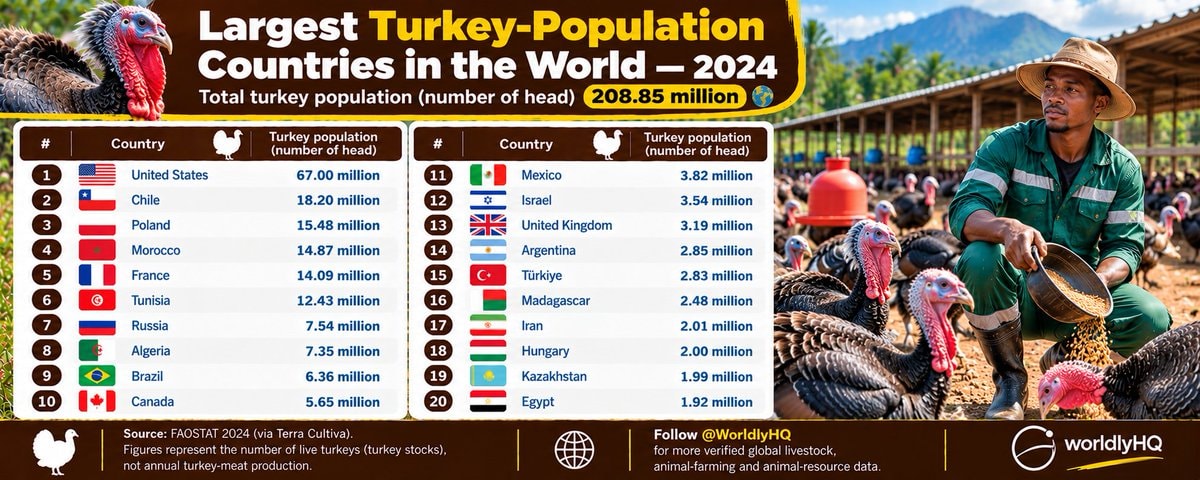
@timofeyHonesty time, the global turkey stock numbers for 2024 are actually wild when you look at the raw head counts instead of just meat production stats. The United States dominates this specific category with 67.00 million live turkeys recorded that year. Chile comes in second place holding onto 18.20 million birds while Poland sits third with a solid 15.48 million in their stocks. Morocco isn't far behind with 14.87 million and France rounds out the top five with 14.09 million live turkeys counted in 2024. Tunisia follows next with 12.43 million before we drop down to Russia's 7.54 million and Algeria's 7.35 million. Brazil brings up the rear of the double digits with 6.36 million and Canada has 5.65 million on the list. Mexico reported 3.82 million live turkeys while Israel had 3.54 million and the United Kingdom recorded 3.19 million. Argentina holds 2.85 million and Türkiye is right there with 2.83 million which puts them at fifteenth globally. Madagascar reported 2.48 million and Iran had a population of 2.01 million before Hungary hit exactly 2.00 million. Kazakhstan came in with 1.99 million and Egypt rounded out the twenty countries with 1.92 million live turkeys. All these figures represent the number of live turkeys specifically rather than annual meat output and come from FAOSTAT 2024 data presented by Terra Cultiva. Across the sixty-five countries with comparable observations available, the total global population of live turkeys reached approximately 208.85 million head. The United States alone accounts for roughly thirty-two point one percent of that entire calculated total based on national observations. These numbers should be read as statistical estimates since official data might not exist everywhere and imputed values were used where needed. Turkey farming remains crucial for rural incomes and commercial operations because it drives demand for feed, veterinary services, hatcheries, transport, processing and marketing channels. The sector supports the poultry-meat industry through breeding and processing while providing a significant source of animal protein for consumers worldwide.
Ver publicação original





Ainda não há comentários. Seja o primeiro!