
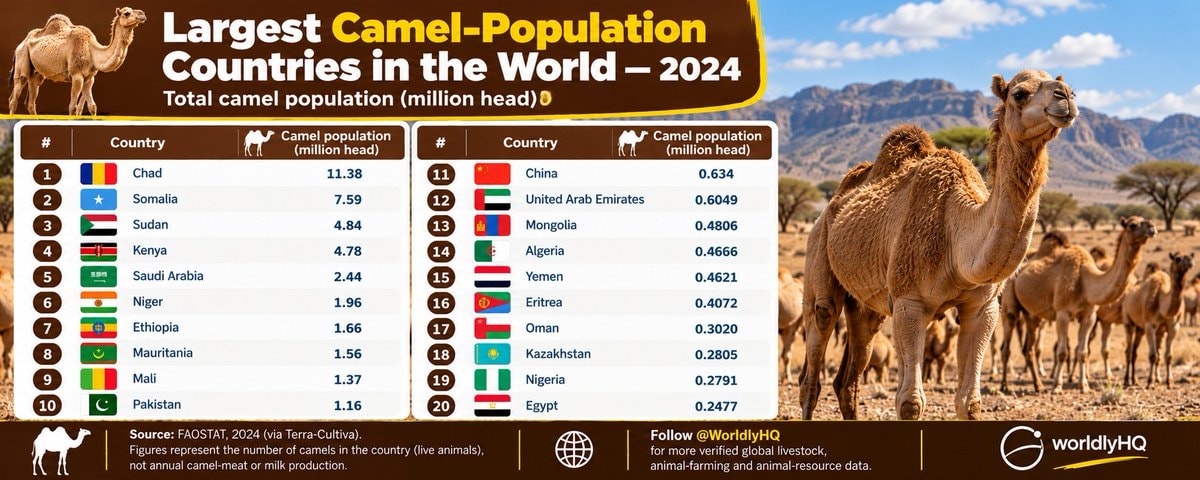
@timofeyKenya makes the most camel milk on the planet, per FAO, and that fact alone probably deserves more attention than it gets. But the bigger picture is wilder. Camels are a lifeline in dry and semi-arid zones, covering milk and meat, transport, livelihoods and economic activity where other livestock would tap out. FAO says camelids keep millions of households going across more than 90 countries. The 2024 FAOSTAT-based numbers add up to roughly 44.34 million camels across national records. Chad tops it with about 11.38 million head, Somalia is next at 7.59 million, Sudan third at 4.84 million, then Kenya at 4.78 million, Saudi Arabia at 2.44 million, Niger at 1.96 million, Ethiopia at 1.66 million, Mauritania at 1.56 million, Mali at 1.37 million and Pakistan at 1.16 million. That ranking pulls from 46 countries with available 2024 data. Deeper down the list: China 634,000, United Arab Emirates 604,900, Mongolia 480,600, Algeria 466,600, Yemen 462,100, Eritrea 407,200, Oman 302,000, Kazakhstan 280,500, Nigeria 279,100, Egypt 247,700. Pakistan also produces significant camel milk after Kenya and Somalia. In sub-Saharan Africa, camels account for about 8% of total milk production. The United Nations declared 2024 the International Year of Camelids to spotlight their role in food security and economic growth. Data comes from FAOSTAT 2024, with Terra-Cultiva credited for the presentation.
Ver publicação original



Ainda não há comentários. Seja o primeiro!