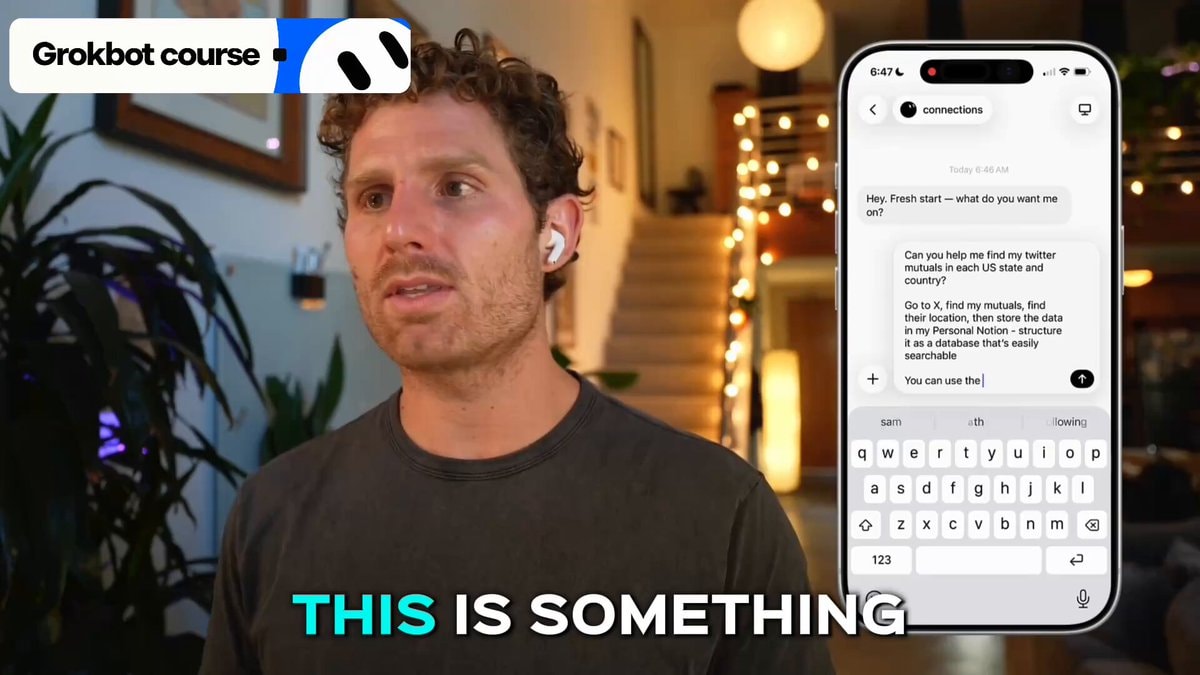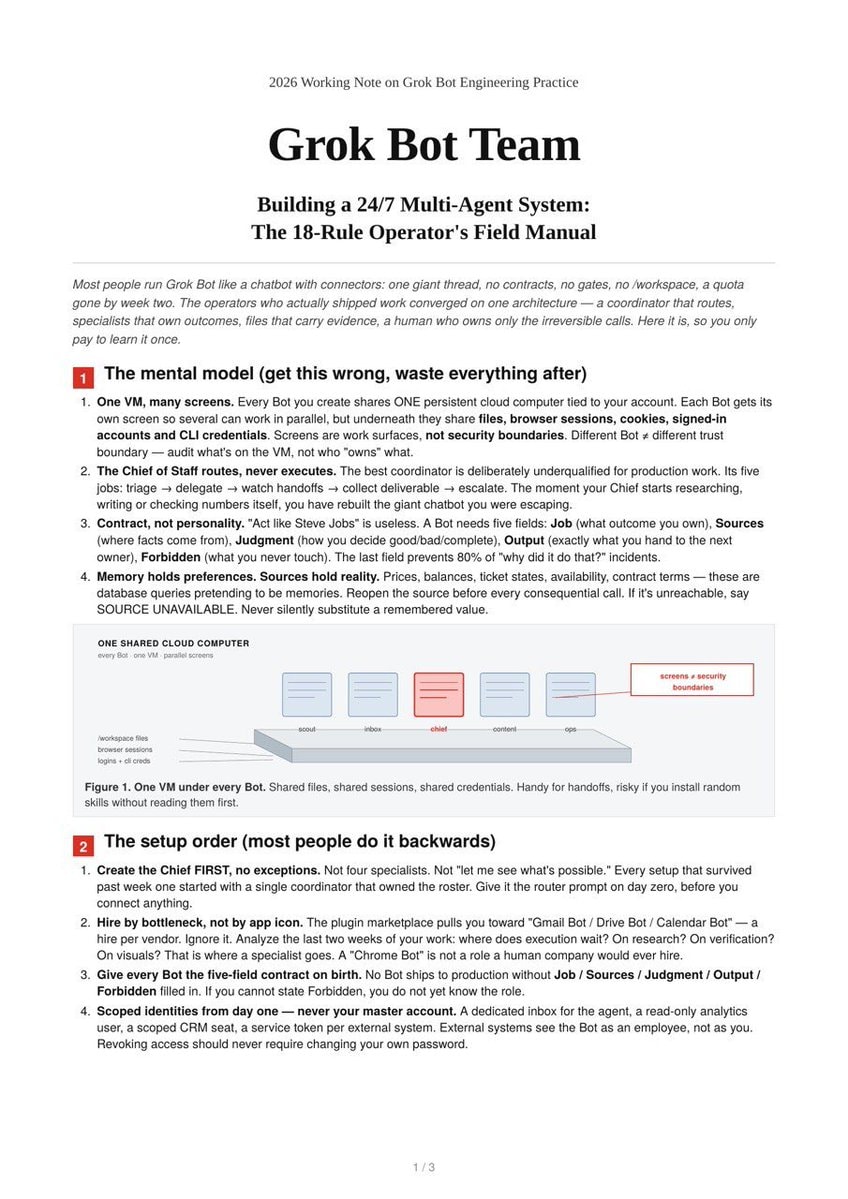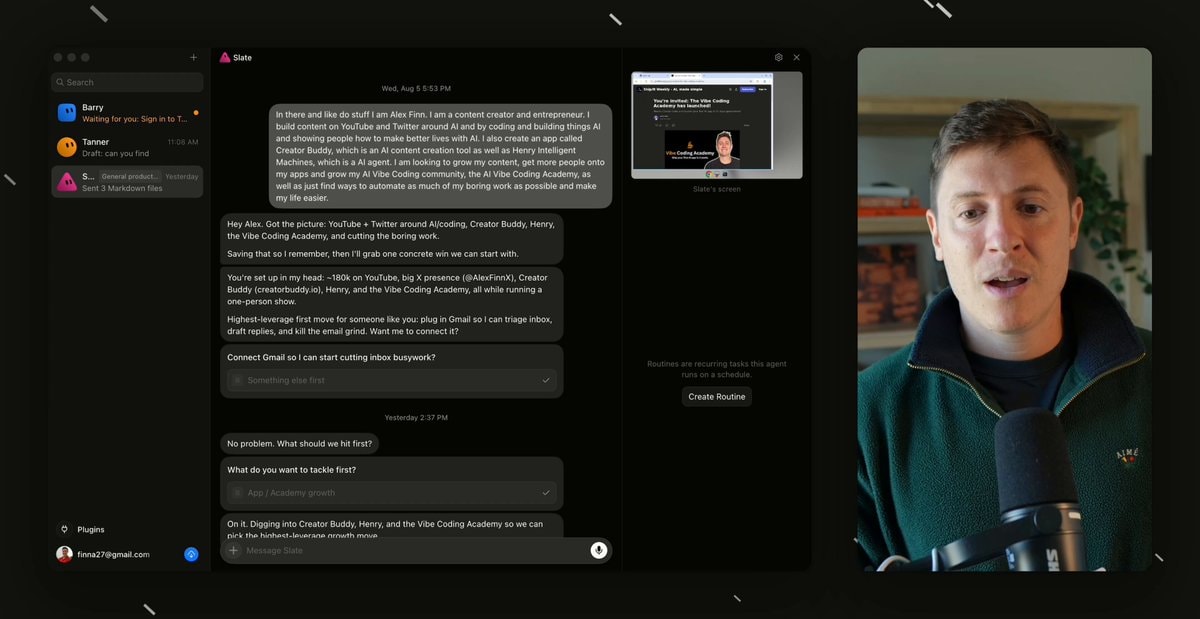
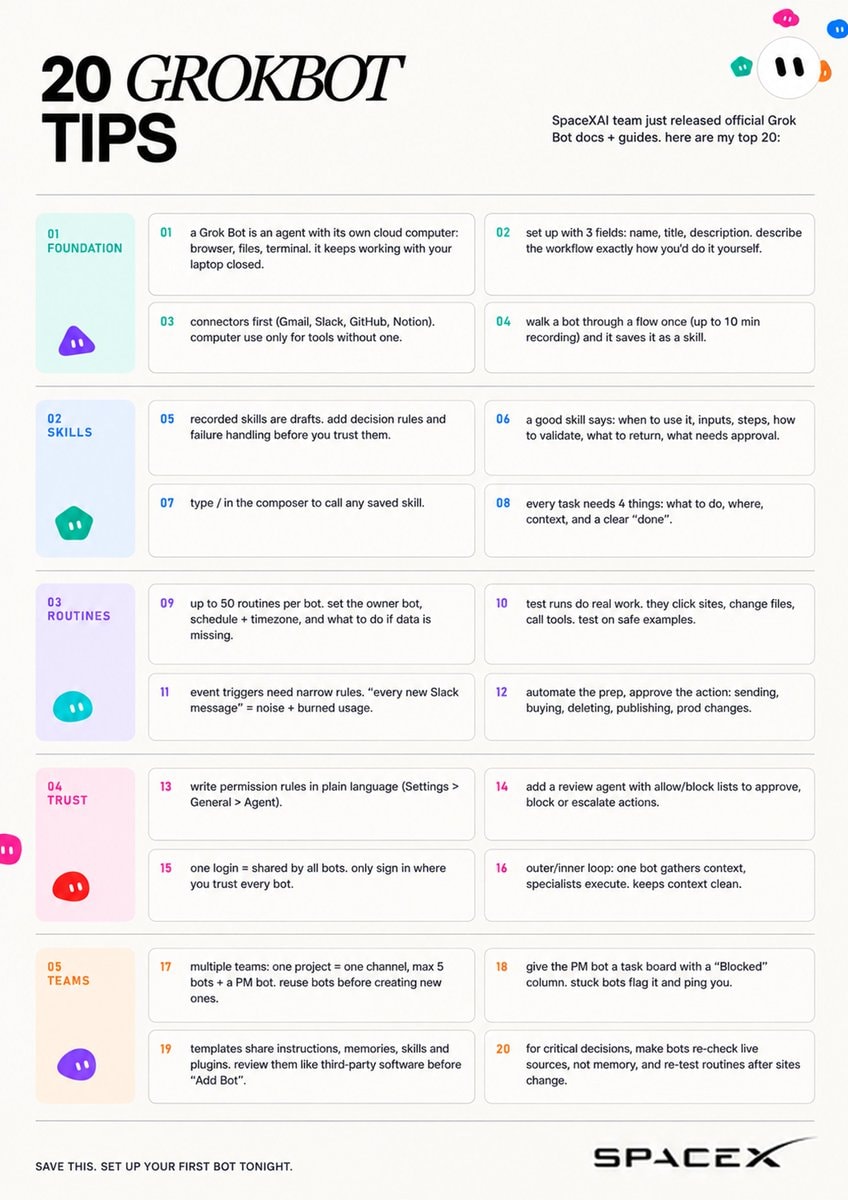
@ts_floydThe SpaceXAI team just dropped an official guide titled 'How to Use Grok Bot at 101% of Its power', and the technical depth here is worth a serious look. A Grok Bot operates as a standalone agent equipped with its own cloud computer, complete with a browser, file system, and terminal that keeps running even if your laptop lid is shut. Setting one up starts with three specific fields: name, title, and a description that maps out the workflow exactly as you would execute it. Prioritize connectors for established services like Gmail, Slack, GitHub, and Notion; only reserve computer use features for tools that lack dedicated integrations. You can train a bot by walking it through a flow once, which records the actions into a skill within ten minutes, though these recorded skills remain drafts until you add decision rules and failure handling protocols. An effective skill definition must cover usage triggers, inputs, steps, validation methods, outputs, and any approval requirements before it is ready for deployment. Once saved, these skills are invoked in the composer simply by typing the slash symbol. Every task demands four core elements: the action itself, the location, the context, and a clear criteria for completion. Each bot has the capacity to manage up to fifty routines, where you assign owners, set schedules and timezones, and define protocols for missing data. Test runs perform real-world actions like clicking websites or modifying files, but they should always be run on safe examples first. Event triggers require narrow rules to prevent noise and excessive usage; for instance, triggering on every new Slack message creates too much activity. Automation should handle the preparation phase, while human approval remains mandatory for sending, buying, deleting, publishing, or making production changes. Permission rules are written in plain language directly within the Agent settings. A review agent can then utilize allow and block lists to approve, block, or escalate specific actions. Since one login credential is shared across all bots, trust in every single bot accessing that account is essential. The architecture often uses an outer and inner loop structure to separate context gathering from specialist execution. For multi-team projects, assign one channel per project with a maximum of five bots plus a PM bot. Giving the PM bot a task board with a Blocked column allows stuck bots to flag issues and ping the owner. Templates serve to share instructions, memories, skills, and plugins, requiring review like third-party software before adding a bot. For critical decisions, force bots to re-check live sources rather than relying on memory, and re-test routines after site changes occur. These twenty notes summarize the best practices for configuring autonomous agents, and reading the full article on building a team of GrokBot agents from scratch provides the necessary foundation.
Ver publicação original